
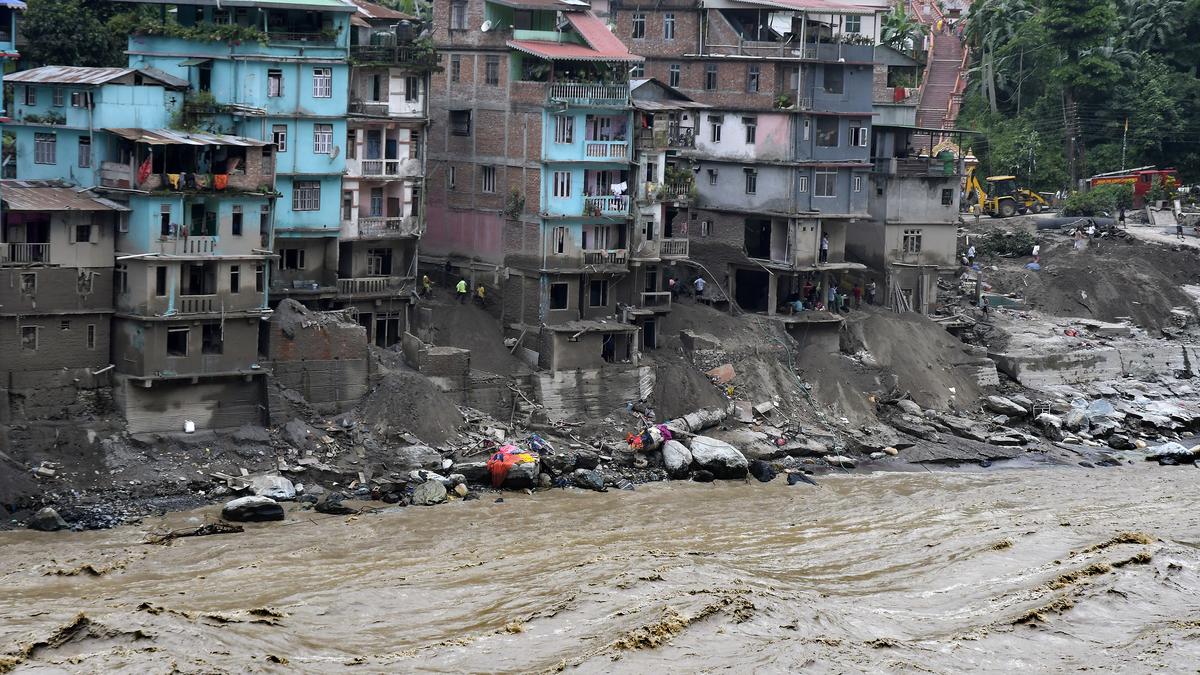
The Teesta in spate in Sikkim in 2023 | Photo Credit: Ritu Raj Konwar In August and October this year, devastating floods in the Bhotekoshi, Trishuli, and Budhi Gandaki rivers in Nepal swept away houses and bridges, damaged hydropower projects, and left many people dead and missing. While a combination of complex phenomena caused these events, many spoke about Glacial Lake Outburst Floods (GLOFs). What exactly is a GLOF?Increasing numberGlacier melt is the source of virtually all Himalayan rivers, including the Ganges. Glaciers move, leaving behind a humongous amount of soil and rock material, called moraine. Sometimes glacial melt, especially in the Himalayas, is blocked by moraine dams and forms glacial lakes. Glaciers are particularly sensitive to climate change, and nearly 28% of glacial lakes larger than 10 hectares in the Himalayas have expanded significantly over the last few decades.This — on its own or combined with extreme events like cloudbursts, landslides, earthquakes, unplanned construction, deforestation, mining, and hydropower projects — can destabilise moraine dams and cause devastating floods that last for hours or days, leading to intense flooding downstream. This is called GLOF. A broken bridge and damaged houses after the flash floods in Nepal. | Photo Credit: Reuters GLOFs typically arrive with little warning. They are difficult to accurately quantify without detailed and localised studies. Remote locations, extreme weather conditions, including constant cloud cover, and the toughest terrain in the world are some of the challenges. Remote sensing, including optical imagery, radar and other technologies, allows scientists to track and give early warnings before disaster hits. The Himalayas have over 28,000 glacial lakes; some estimates put it at close to 54,000, with roughly 10% formed in the last three decades. In the Indian Himalayas alone, over 175 glacial lakes have been identified as high-risk, and hundreds more carry high hazard potential for GLOFs. But only a very small number are being monitored.Some of the largest floods in Earth’s history have been GLOFs. In Peru, GLOFs were responsible for over 32,000 deaths in the 20th century. Today, GLOFs pose a growing risk in the Himalayas, having killed thousands and destroyed villages, roads, bridges, and hydroelectric developments. In 2013, a GLOF in Chorabari lake combined with a cloudburst caused the Kedarnath catastrophe. A GLOF at South Lhonak Lake, Sikkim, in 2023 destroyed the Teesta III dam, raised the Teesta riverbed downstream, reducing its capacity and increasing flood risk. As the impact of climate change increases, GLOFs are only going to increase.Quick factsThe Great Lakes of North America are the largest active glacial lakes in the world.The Siachen Glacier is the longest glacier in the Himalayas at about 72 km length.Pangong Tso is the largest high-altitude lake of glacial origin in the Himalayas. Published - October 30, 2026 10:00 am IST
What are Glacial Lake Outburst Floods?
Full Article
Original Source
Read the full article at Thehindu →KhanList aggregates and links to publicly available news content. We do not host full articles from third-party sources. Always verify important information with original sources.