
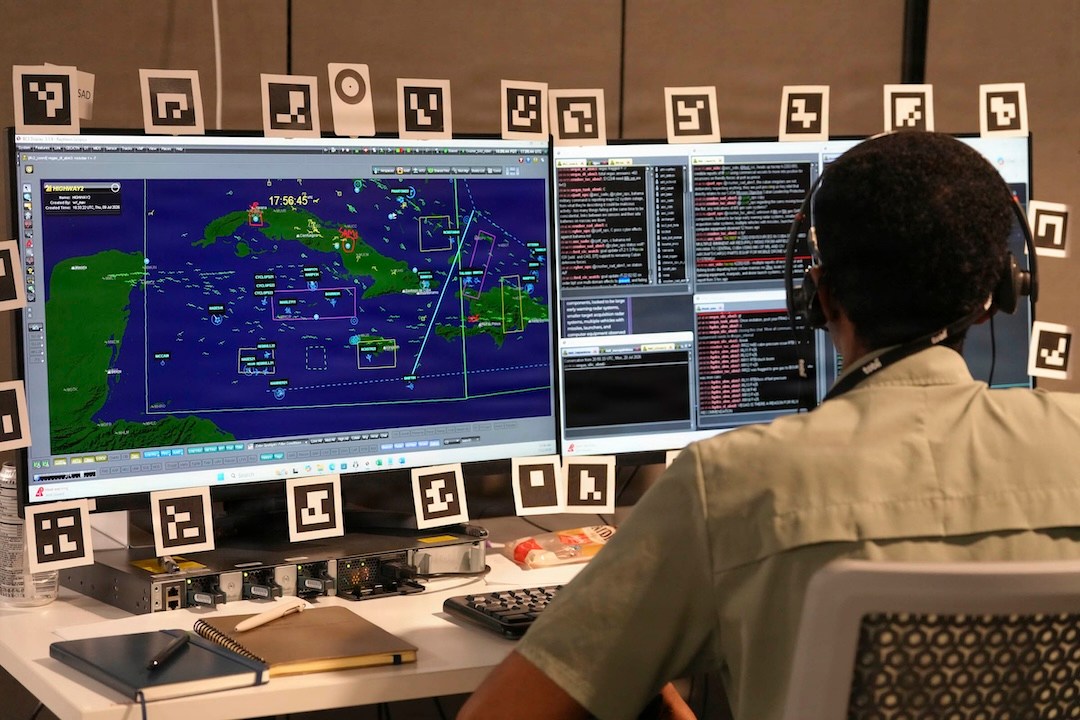
The Defense Department renamed its office dedicated to advancing artificial intelligence across the military to reflect President Donald Trump’s rebranding of the technology. The Chief Digital and Artificial Intelligence Office will now be called the Super Intelligence Office, or SIO, according to a recent announcement. In the statement, Cameron Stanley, the Pentagon’s senior official for applied AI critical technology, called the redesignation “a clear signal” of where his department is going. “We have moved beyond experimental prototypes,” he said. “As the Super Intelligence Office, our mission is to harness the full power of sovereign Super Intelligence to ensure decisive military superiority across every domain.” The term “sovereign,” as it applies to AI, refers to a model governed within a specific boundary set by a nation or organization. However, the name change appears to get ahead of the technology itself. Although super intelligence is a recognized concept in AI research, experts say it remains a theoretical possibility rather than an existing capability. The switch to “super intelligence” In September, Trump signed an executive order directing the federal government to replace the term “artificial intelligence,” as defined by federal law, with “super intelligence.” “We’re going to be naming it SI, super intelligence. We don’t want to hear artificial because it’s not artificial. It’s very powerful. It’s brilliant,” Trump said just ahead of the signing. “The SI, super intelligence, is, they’re saying, bigger than the industrial revolution, far bigger than the internet, not even close,” he added. “And we see it, and we can’t stifle it.” According to the executive order, the term recognizes the technology’s capabilities because it does more than “simply imitating or automating human intelligence as is implied by the term ‘Artificial Intelligence.’” In turn, the president directed all within the executive branch to use the term and “not acknowledge the usage of ‘Artificial Intelligence’ and ‘AI’ in any applicable setting.” Since then, departments across the federal government, including the military, have begun adopting the terminology, along with government contractors and tech executives in the field. Technically speaking, super intelligence doesn’t exist However, experts describe the term as technically incorrect because super intelligent machines do not yet exist. Jeff Crume, an IBM distinguished engineer with a PhD in cybersecurity, said “the short answer is no” in a video addressing the question: “Is AI really super intelligence?” “Today’s systems have remarkable capabilities, but they also have significant limitations,” he said, explaining that they can make factual errors, struggle with reasoning, and lack a reliable understanding about the physical world. “Their abilities can be uneven, extremely impressive in one particular contact and surprisingly poor in another,” he said. Crume explained that there are three types of artificial intelligence. These include Artificial Narrow Intelligence, or ANI; Artificial General Intelligence, or AGI; and Artificial Super Intelligence, or ASI. “The key characteristic of ANI is that its capabilities are still bounded by what the system has been designed and trained to do,” he said. “This is what we have today. A genius in some areas and an idiot in others.” He described AGI as a machine that “basically matches humans across the board” in terms of cognitive ability. “We don’t have that yet. Let’s be clear about that. And some people think we never will,” he said. But, he added: “Don’t bet against AI because it seems most of the things people have said over the years that AI could never do, well, it’s now doing that stuff.” As for ASI, the more important question to ask, rather than whether super intelligence is possible, is whether or not humans can control it. “Capability minus control equals risk,” Crume said. “We put guardrails around powerful technologies because capability without control creates risk and AI is no different. We need technical safeguards.” In philosophical terms, it isn’t accurate either Mario Antoine Aoun, a researcher with a PhD in Cognitive Informatics from the Université du Québec à Montréal, argued that “super intelligence” — if it is to mean “beyond human intelligence” — “is impossible because there will always be areas where humans can excel while intelligent machines will be lacking.” In a blog post for Communications of the ACM, he explained that there are various forms of intelligence, including biological intelligence, evolutionary intelligence, swarm intelligence, and others. “Simply saying, consider the facts that we have different kinds of intelligence … then we can notice with just a change of words that we can discreetly separate one kind of intelligence … as one type of many others while not assuming that one is better than the other,” he wrote. Instead of super intelligence, Aoun suggested a slight modification. “[C]onsidering the fact that current state-of-the-art AI algorithms require super computing power, then one could suggest a fair name: Super Computer Intelligence,” he wrote. “This preserves the super-computing-power condition that is required for AI to function properly and possibly beyond our expectations, as well as its fundamental ground that is computer intelligence, which is the basic naming right for it,” he continued. Rebranding changes the conversation Although the term superintelligence may not accurately describe today’s technology, some commentators argue that technical accuracy isn’t necessarily the point. According to reporting by Tech Policy Press, some experts contend that Trump’s push to mandate the terminology reflects a combination of executive authority, political messaging and an effort to exert influence over a technological conversation largely driven by the private sector. Amber Sinha, a contributing editor at the publication, argued that the term “artificial intelligence” originated more as a branding exercise than as a product of rigorous scientific taxonomy. He explained that a computer scientist first used the phrase in 1955 to distinguish his research project from cybernetics. “That initial linguistic choice initiated a historical path of dependency that continues to plague tech policy today. It established an inescapable, anthropomorphic baseline that implicitly evaluates silicon computation against human cognition,” Sinha wrote. Rather than replace one potentially misleading label with another, Sinha argued that policymakers should move away from such terminology and focus on “enforceable, democratic guardrails grounded in reality.” Arturo Montesinos, a former software developer who writes about AI, offered a different perspective in an essay defending the name change. He argued that the term “super intelligence” would shift the conversation toward what the technology can accomplish rather than how it was developed. “Artificial intelligence invites us to ask whether the submarine is really swimming. Superintelligence asks how deep it can dive,” he wrote. “That seems like progress.” Super intelligence in the military Despite the administration’s push to rebrand the technology, the military’s descriptions of its use suggest that its role remains largely unchanged: helping humans work faster and make better use of information. Last month, Lt. Gen. Christopher Eubank, commanding general of the U.S. Army Cyber Command, or ARCYBER, explained at a panel during the 2026 Association of the U.S. Army’s Annual Meeting and Exposition that AI will augment rather than replace humans. “We are in the process of creating an agentic workforce that works hand-in-hand with the human workforce, so human-machine teaming [happens] each and every day,” Eubank said. “I think the thing people need to walk away with is what it’s doing for us. It is enabling us to move faster than we could ever move without it.” More recently, Dr. Demica Reeves, the data and SI officer for Air Force Materiel Command, or AFMC, echoed that sentiment as she discussed a new Data and Super Intelligent Strategy and Implementation Plan. “SI is applicable to anyone and everyone,” she said in a statement, explaining how the technology will be used to process data and develop workflows to inform decision makers. She listed potential use cases as supporting contract activities and encouraged enterprise use. However, she said that they will keep “human oversight as part of the process.”
What AI’s rebrand to ‘super intelligence’ means for the Pentagon
Full Article
Original Source
Read the full article at Militarytimes →KhanList aggregates and links to publicly available news content. We do not host full articles from third-party sources. Always verify important information with original sources.