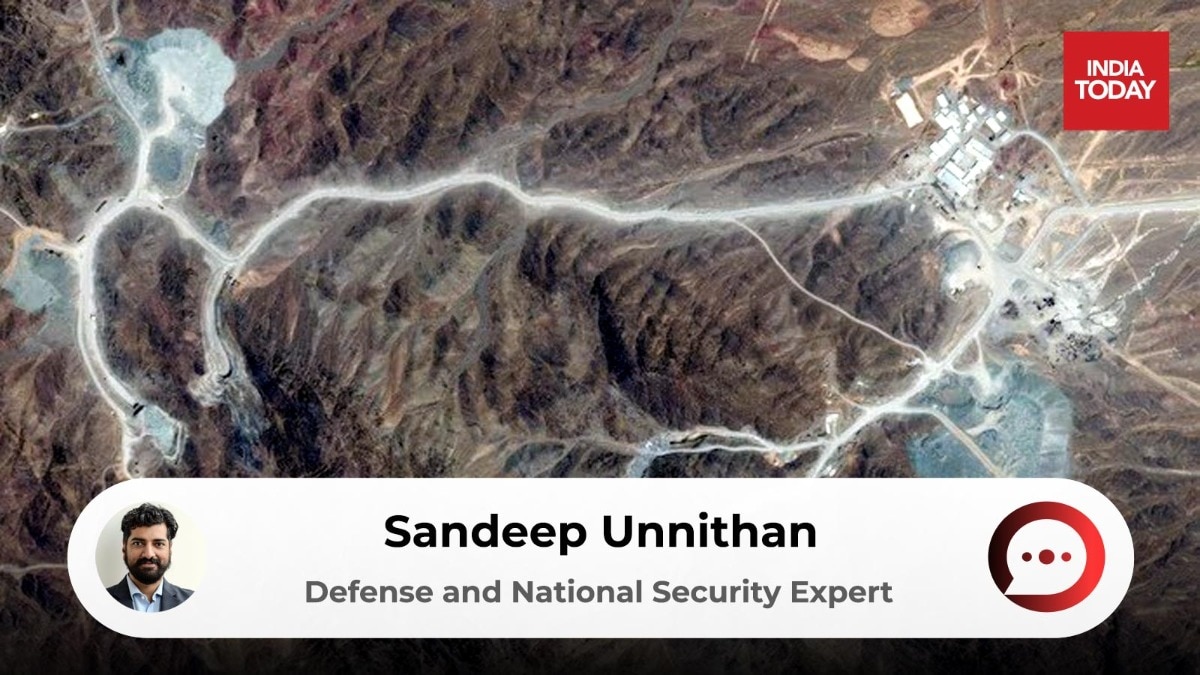
The US could consider aerial attacks or special forces raids or a combination of both.A satellite view shows tunnel entrances at Pickaxe Mountain, of the Natanz nuclear facility, near Natanz, Iran, June 30, 2026. (Vantor/Handout via REUTERS/ITG)US President Donald Trump has threatened to strike an Iranian underground nuclear enrichment facility two times in the past nine days."We have eyes on it and Pickaxe mountain is a possible target for a nice big fat shot right in the front door," President Trump said on a TV show on July 13.He repeated the threat on July 22, telling reporters in the White House: “We’ll be hitting the area pretty soon, and very heavily.”These threats come even as the US has bombed Iran for 11 consecutive days, provoking Iranian retaliation, a ‘tit for tat’ conflict as political scientist John Mearshimer calls it. The US entered the war with Iran on February 28 seeking to halt Tehran's nuclear enrichment programme, dismantle its ballistic missile programme and end its support for proxy groups such as the Houthis, Hamas and Hezbollah.The war has now entered its sixth month, with none of Washington's stated objectives achieved. Instead, Iran shifted global attention to the Strait of Hormuz by blockading the waterway, triggering economic disruption and driving up global oil prices. By threatening strikes on Pickaxe Mountain, Trump wants to bring attention back to Iran’s nuclear weapons programme. He has repeatedly warned that Iran cannot have the bomb.The US and Israel have bombed all three Iranian nuclear sites–Fordow, Natanz and Isfahan–over the past year. And attention has now shifted to a fourth nuclear-related site located 200 kilometres south of Tehran.The large mountain harbouring the main tunnel complex is called the Kuh-e Kolang Gas La (Kolang translates to Pickaxe). Construction on the facility started in the fall of 2020, when Iran announced that the underground halls were intended to replace destroyed above-ground advanced centrifuge assembly facilities at the main Natanz site.The multi-level nuclear facility is believed to be 100 metres deep inside a granite mountain, far beyond the range of weapons like the 14-ton GBU-57 Massive Ordnance Penetrator (MOP), the biggest non-nuclear bomb in the US arsenal.The facility has a large security perimeter and extensive tunnel entrance hardening.Last year, Iran wrapped the mountain in a new double-fenced and walled security perimeter with a patrol route surrounding the mountain and the adjacent Natanz Nuclear Complex security perimeter.All four tunnel entrances to the Pickaxe mountain facility are excavated in a channel of rock. Two of the four tunnel portals feature entrance extensions hardened with layers of concrete and earth over tunnel entrances to protect them from airstrikes.What could a strike on Pickaxe Mountain look like?Based on a July 14 report by the Institute for Science and International Security (ISIS) two options appear plausible :Air attack: An aerial attack on the facility using F-15 fighters and/ or B-1 and B-2 bombers appears to be the most likely course of action. Air strikes could target above ground incoming power supply lines, ventilation shafts or equipment, and the open tunnel entrances.While the facility is deeply buried to protect itself from such aerial attacks, vulnerabilities may also exist that can be exploited by deep earth penetrating weapons via aerial schematics.Schematics for the Pickaxe Mountain facility have not been seen publicly in a way they have been for other prominent Iranian nuclear sites, Fordow and Shahid Boroujerdi ( a suspected nuclear weapon core assembly facility, which was struck in 2026)."Both these tunnel facilities were built by Iran’s Amad nuclear weapons program and attacked in June 2025 and March 2026. US bombers struck at the ventilation shafts, a weak point that allowed greater internal access for earth penetrating weapons," the ISIS report says.The bombers could also target the two exposed western tunnel entrances into the facility, even though airstrikes targeting only the hardened tunnel portal entrances without shockwaves or blast impact affecting the facility, would likely only temporarily deny Iran access, and would add Pickaxe mountain to the list of facilities to be watched closely for Iranian attempts to regain access.Ground attack: This could be problematic because this would mean deploying US boots on ground for an extended period, leaving them vulnerable to Iranian troops that could quickly move in to fight and capture them.Memories of ‘Eagle Claw’, a failed 1980 US special forces rescue attempt in Iran, will haunt ground special forces operations. Underground schematics of the Pickaxe mountain facility are non-existent, thereby complicating an entry into the site.There is a possibility tunnel entrances could be booby trapped by the Iranians to trap US forces.If the US does indeed opt for this risky strike, it will launch a nighttime raid—using their superior night fighting capabilities against the lesser equipped Iranian ground forces.Commandos backed by close air support—bombers, helicopters, Spectre gunships—would need to overcome the physical rings of security around the heavily defended area. The commandos would need to storm the pair of western tunnel entrances visible in the latest imagery from the site on July 9, 2026.Once the entrances are cleared of booby traps, the commandos will need to go into the facility and plant explosives deep inside before withdrawing. The US has an array of specialised man portable explosives ranging from conventional to nuclear. It has the W54 Special Atomic Demolition Munition (SADM) which has a yield of between 0.02 to 1 kiloton (an explosive yield of between 200 kgs to around a thousand tons of TNT).The W54 was operationally deployed during the Cold War between 1964 and 1988. It weighed less than 73 kgs, around the weight of an adult male, and was designed to be back-packable. The nuclear blast would melt the rock, completely collapse the facility and inject heavy radiation into it, rendering it completely unusable.Such an explosion would be in the manner of a nuclear weapons test shaft, sealed on itself after a nuclear test. But the use of a tactical nuke would be highly problematic, prompting greater global outrage. It is therefore likely that US special forces will need to use a large amount of conventional plastic explosives or enhanced blast explosives like the PBXN-114 and AFX-757 to destroy the tunnels.These explosives would have to be brought in using specialist loaders rolling off from transport aircraft.Once the explosives are rigged deep inside the facility the aim will be to explode, creating pressure waves to collapse the structure and achieve the effects of a GBU-57 MOP deep underground, completely destroying the facility.- EndsPublished On: Jul 22, 2026 15:53 IST
What a US attack on Iran's Pickaxe mountain could look like
Full Article
Original Source
Read the full article at Indiatoday →KhanList aggregates and links to publicly available news content. We do not host full articles from third-party sources. Always verify important information with original sources.