
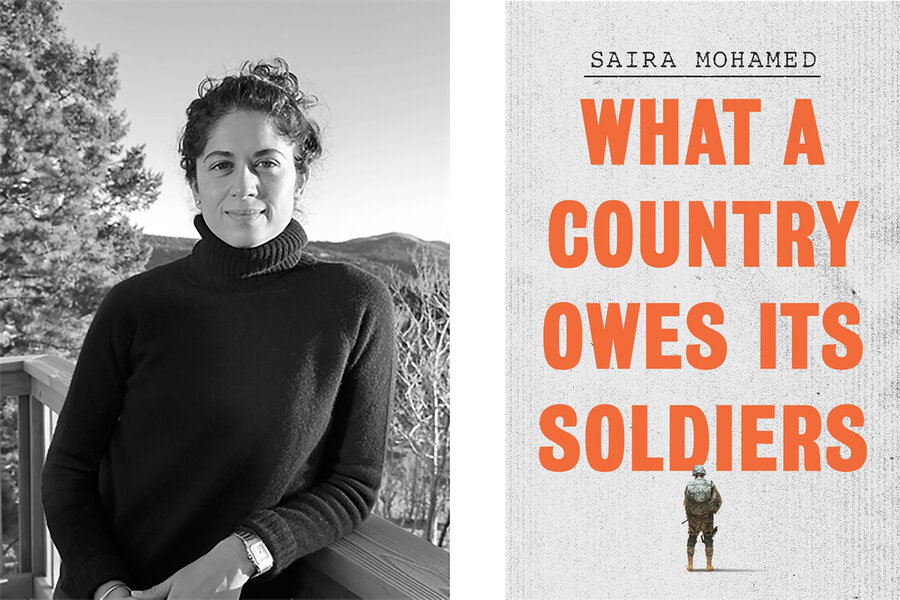
Imagine a world where the families of the 23 United States service members killed in the Iran war could sue President Donald Trump for wrongful death, arguing their loved ones died in an illegal war launched without congressional approval. Or where hundreds of wounded veterans pursued negligence claims against Secretary of Defense Pete Hegseth for failing to prepare for the predictable Iranian counterattacks to U.S.-Israeli airstrikes.This is the reality proposed by “What a Country Owes Its Soldiers,” a timely book by Saira Mohamed, a professor at the University of California, Berkeley, School of Law. Across 288 heavily footnoted pages, Ms. Mohamed argues that it is not enough for Americans to fly flags, honor veterans with parades, or even provide generous healthcare, education, and disability benefits. A nation, she writes, owes its soldiers something basic: to be treated as full human beings, who enjoy the same rights as everyone else.Ms. Mohamed begins her book with a training accident. In the summer of 2020, an amphibious assault vehicle carrying 16 service members sank off the coast of San Clemente, California. Nine crew members died. Four were still teenagers; the oldest was age 22. An investigation found fault with the vehicle’s commander, who failed to order an evacuation, but also blamed higher-ups who sent it onto the water even after it was determined the aging vessel should be decommissioned. When the crew tried to escape, they found the hatch’s handle was broken. Only two had completed required underwater egress training. Their deaths were preventable – and though some military officials lost their jobs over the disaster, the families themselves were left with little recourse. This is one of many incidents Ms. Mohamed cites in building her case that America’s relationship with its soldiers needs to be fundamentally rethought. Were such a failure to occur in the private sector, litigation would surely have followed. But soldiers and their survivors have few options. A 1950 Supreme Court decision, Feres v. United States, bars active-duty service members from suing the federal government for injuries or deaths in nearly all cases. Their survivors must instead make do with a folded flag and death gratuity of $100,000.The results of this immunity, Ms. Mohamed writes, include “routine instances of neglect, of carelessness, of an acceptance of risk that goes beyond what is necessary – instances that destroy lives and families and that nonetheless are nearly invisible in the law.” She presents alternatives. In 2013, the United Kingdom’s Supreme Court ruled the British government could be held liable for failing to prevent the deaths of three men killed by roadside bombs in Iraq, because their vehicles were not adequately armored. If the U.S. government were legally compelled to respect soldiers’ rights, she writes, perhaps it would protect them.Ms. Mohamed’s book is strongest when she draws the link between soldiers’ rights and ethics in armed conflict. She builds off the work of Jonathan Shay, a Department of Veterans Affairs psychiatrist who coined the term “moral injury” 30 years ago in his groundbreaking book, “Achilles in Vietnam.” The established diagnosis of post-traumatic stress disorder, Dr. Shay believed, did not accurately reflect the condition experienced by many of the Vietnam veterans he treated. There was a difference, he wrote, between simply experiencing a horrific event, and the psychological harm inflicted on people who themselves act in a way that ruptures their moral core. A war crime like the My Lai massacre harms the soldiers who perpetrate it, Dr. Shay argued. He received the prestigious MacArthur Foundation “genius” award for this contribution. “What a Country Owes Its Soldiers” takes Dr. Shay’s work and turns it into a legal argument. Article 93 of the Uniform Code of Military Justice, Ms. Mohamed notes, decrees that “any person subject to this chapter who is guilty of cruelty toward, or oppression or maltreatment of, any person subject to his orders shall be punished as a court-martial may direct.” But when the abuses at Abu Ghraib were revealed in Iraq, commanders were not prosecuted under Article 93 for oppressing their military subordinates. Indeed, she writes, “most of those in leadership positions were left alone.”Similarly, U.S. Army Staff Sgt. Calvin Gibbs, leader of the self-named “kill team” of the 5th Stryker Brigade in Afghanistan, was found guilty of murdering Afghan civilians, but not for harming his own troops by issuing illegal orders. Ms. Mohamed argues that should be done under Article 93.During the second Trump administration, military veterans in Congress, including Arizona Sen. Mark Kelly, have urged military personnel to fulfill “the legal duty of members of the military not to follow illegal orders.”But why does it fall to grunts to stand up to powerful commanders? Why not hold the commanders accountable? In the absence of legal accountability for leaders giving those orders, some service members may find themselves in a nearly impossible position: Refuse and be punished for insubordination – or live with the psychological consequences of acting in a way they know to be wrong.Ms. Mohamed does not address Mr. Kelly’s call directly in her book, but she offers something more important: a framework for reimagining civilian society’s relationship with the military. “The tacit acceptance of the idea that military service members operate at the whim of the president is sustained by an understanding that military personnel are not full human subjects,” she writes. “Recognizing military personnel as mere people – not superhuman heroes – also can help protect against a military that operates unrestrained by the state and the people.” Deepen your worldviewwith Monitor Highlights.Politics with respectGet political stories with respectful analysis.There‘s a world of new ideas in everyBooks newsletter.There‘s more to life, enrich yours withCulture & Learning weekly.Follow humanity‘s discoveries withScience & Nature stories in your inbox.Gain a spiritual perspectivefrom the stories in your inbox.Want to understand the deeper impact of critical events? Learn the Monitor‘s insight.Already a subscriber? Log in to hide ads. Lawmakers considering whether to impeach Mr. Hegseth for his conduct during the Iran war would be wise to read Ms. Mohamed’s book; so would Democrats preparing to launch investigations of Trump administration officials when they assume control of Congress in January. As for the rest of us, cracking open a copy of “What a Country Owes Its Soldiers” is an excellent way to honor the troops this Veterans Day.Monitor staff writer Aaron Glantz is author of three books on the Iraq War and the U.S. government’s treatment of military veterans. ALREADY A SUBSCRIBER? LoginReal news can be honest, hopeful, credible, constructive.The Christian Science Monitor was founded in 1908 to lift the standard of journalism and uplift humanity. We aim to “speak the truth in love.” Our goal is not to tell you what to think, but to give you the essential knowledge and understanding to come to your own intelligent conclusions. Join us in this mission by subscribing.
‘What a Country Owes Its Soldiers’ calls for a rethink of the rights due to soldiers
Full Article
Original Source
Read the full article at Csmonitor →KhanList aggregates and links to publicly available news content. We do not host full articles from third-party sources. Always verify important information with original sources.