
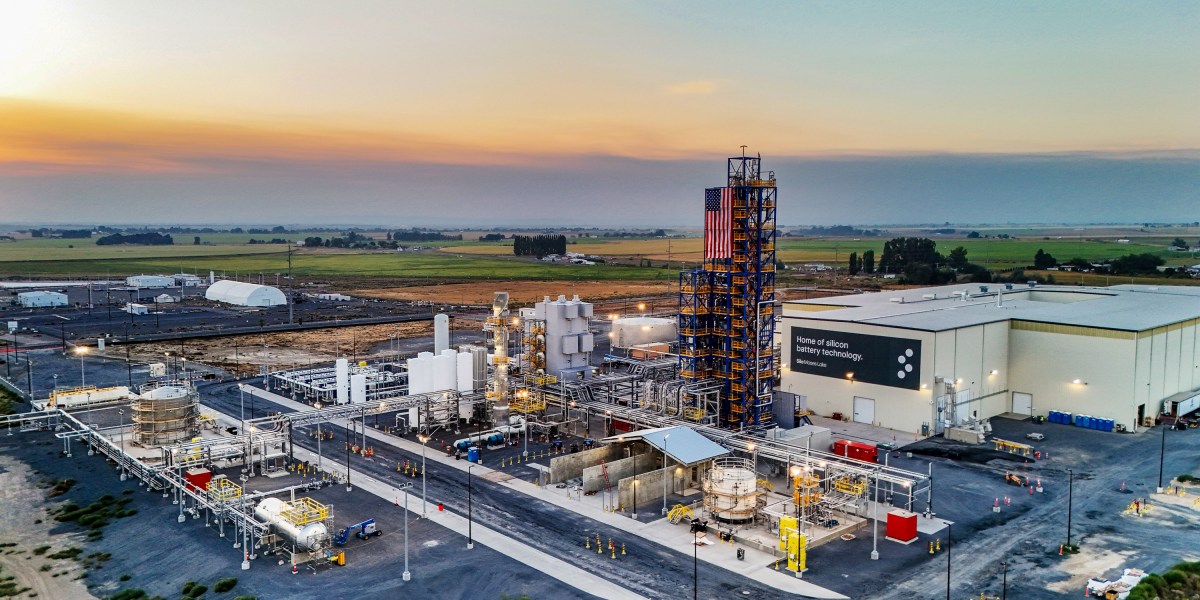
After a tough few years littered with some high-profile failures, there’s some positive news for next-generation batteries in the US. Sila just signed an agreement with Panasonic Energy, a global battery manufacturer, to supply silicon-carbon anode material, a possible key to smaller, lighter batteries. It’s a deal that Sila says could be worth more than $1 billion over time. This arrangement also shows how much the politics of batteries have shifted lately. A major part of the financial backing for this factory’s production is a $1.4 billion loan from the Trump administration’s Defense Department. While batteries can be a major tool to help drive the energy transition and cut emissions, right now much of the industry is more focused on geopolitics. Founded in 2011, Sila makes silicon-based anodes for lithium-ion batteries. The big selling point here is the potential to improve energy density—Sila’s anode weighs a fifth as much as the graphite used in anodes today and cuts the volume in half, according to the company. So using this new material enables batteries to pack more energy into the same weight and volume, allowing longer range for EVs, for example. The material can also deliver more power and recharge faster, compared with conventional chemistry. We’ve been following Sila (and its competitors) for years. My colleague James Temple covered the company when its battery first appeared in Whoop fitness wearables in 2021. Things have gotten a lot bigger since then. In 2022, Sila announced plans for a factory in Moses Lake, Washington, and received $100 million from the US Department of Energy, part of a multibillion-dollar round of grants under the Biden administration to support the US battery supply chain. The company opened its factory in September 2025, and it’s already operating. But the deal with Panasonic will help it scale to at least 10 times more production than current levels, says Gene Berdichevsky, the company’s cofounder and CEO. Panasonic has committed to buying tens of thousands of tons of material, Berdichevsky says, though Sila isn’t sharing specific numbers on the total commitment or the price Panasonic is paying. This agreement is Sila’s first mass-market deal and a big one for the United States’ next-generation battery market, which has largely been on the ropes over the past few years. Two billion-dollar battery companies, 24M and ESS Tech, have declared bankruptcy and shut down just in the last year. The glimmer of hope here is tied up with something I’ve been noticing about this industry: the shifting politics. While batteries used to be firmly considered a climate technology, we’ve seen a lot of companies move away from messaging around the clean energy transition and lean into geopolitics. China dominates the battery world and particularly the battery anode market, controlling over 90% of graphite production today. For years, the US has been trying to curb reliance on Chinese batteries, battery materials, and other materials used in crucial technologies, like rare earth metals. But the Trump administration has ramped things up, and earlier this year the US Defense Department committed a $1.4 billion loan to Sila aimed at helping the US face a “significant technology sovereignty challenge,” as a press release put it. Sila’s announcement of the Panasonic deal does mention EVs—but not climate, emissions or the energy transition. Rather, it’s all about American industrialization. (And, of course, a mention that a North American battery supply chain can also help power the AI market.) I asked Berdichevsky about this shift and whether the company holds decarbonization as a priority. “I think the politics of it has shifted around us much more than our motivations have shifted,” he said. “It’s really the energy efficiency that motivates engineers like myself and technologists at our company. And I still think that that’s still at the heart of it.” This article is from The Spark, MIT Technology Review’s weekly climate newsletter. To receive it in your inbox every Wednesday, sign up here.
What a billion-dollar deal says about the US battery market
Full Article
Original Source
Read the full article at Technologyreview →KhanList aggregates and links to publicly available news content. We do not host full articles from third-party sources. Always verify important information with original sources.