
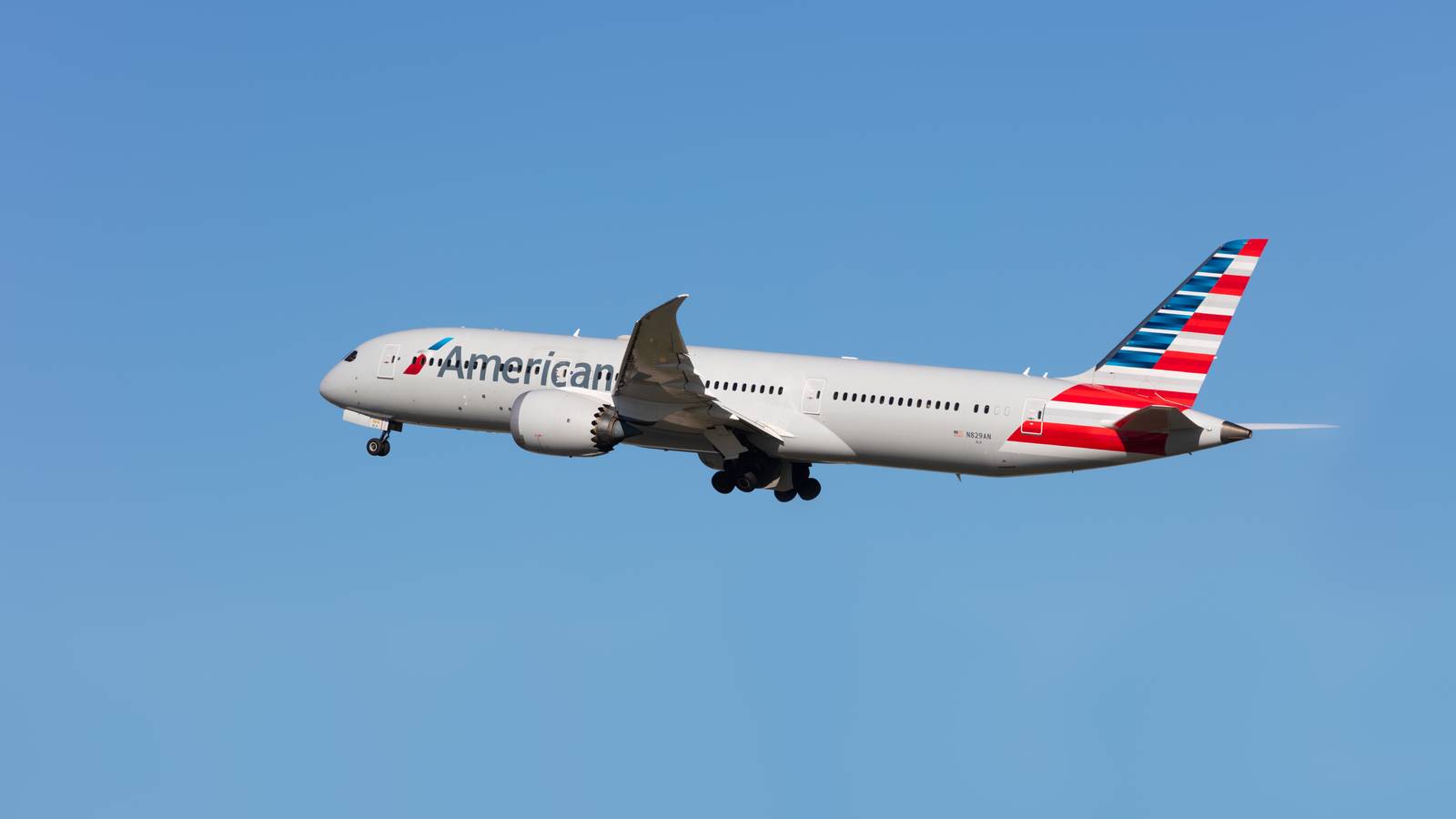
Published Nov 15, 2026, 10:00 PM EST Aaron is an aviation enthusiast and world traveler with a deep interest in aerospace history and technology. He has traveled around the world numerous times, often incorporating visits to aviation museums and historic aircraft collections into his journeys. A native of New Zealand, he is an expert in aviation and maintains a broad interest in a variety of other subjects. American Airlines, United Airlines, and Air India fly the nonstop ultra-long-haul route between John F. Kennedy International Airport (JFK) and Indira Gandhi International Airport (DEL) in India. The route is just long enough to trigger regulations in both the US and India to require a four-person crew. The flagship route combines airlines' highest-end equipment, the most senior pilots, and long (24-48-hour) layovers. This makes adding an extra pilot extremely expensive. Because American pilots are paid more than their Indian counterparts, the incremental out-of-pocket expense for American is higher than for Air India. The cost for United to fly the twin route from Newark is likely similar to American's, but is not considered here, while Delta Air Lines does not operate the route. Here is what to know about how much the requirement to include an extra pilot (Captain or First Officer) costs American and how it compares with Air India. The Regulations Governing The Ultra-Long-Haul Route Credit: Austin Deppe l Shutterstock Both the Federal Aviation Administration (FAA) and India's Directorate General of Civil Aviation (DGCA) rule that the route from New York to New Delhi is an ultra-long-haul route and one that requires an augmented four-pilot crew. The flight takes around 15 hours eastbound and around 16.5 to 17 hours westbound. The regulations for these flights are covered by the FAA's FAR Part 117 and India's DGCA FDTL rules. These regulations require the flight to have either two Captains and two First Officers (required for Indian carriers) or one Captain and three First Officers (allowed for US carriers). The FAA FAR Part 117 explains that "no certificate holder may schedule and no flightcrew member may accept an assignment or continue an assigned flight duty period if the total flight time...," or "will exceed 17 hours if the operation is conducted with a 4-pilot flightcrew." Because JFK-DEL routinely runs 15–17 hours block time, a three-pilot crew is legally barred at the 13-hour cap, forcing airlines to assign a four-pilot crew. DGCA similarly requires airlines to assign a four-person crew. But unlike the FAA, which allows for an en-route PIC-qualified First Officer to relieve the Captain in cruise, India does not. The DGCA explicitly requires a Rated Captain at the controls and on duty at all times. This only applies to Indian carriers, so Air India or any other Indian airline flying the route must have two Captains. Airlines Flying The JFK-DEL Route Credit: Michael Derrer Fuchs l Shutterstock New York-JFK is the most connected international airport in the US, with flights across the world. The JFK-DEL route is served daily on the Boeing 787-9 Dreamliner, as well as Air India on its Airbus A350-900s. The American flight departs JFK at 8:15 PM, while the Air India flight departs at 11.55 am. According to flight tracking data, the Delhi-bound flight generally takes between 13 and 14 hours. AI102 appears to take about an hour longer, at between 14 and 15 hours. AA293 from Delhi to New York departs at 11:55 pm local time, with flight history showing it averages between 15 hours and 15 hours and 30 minutes. Flight Scheduled duration Aircraft JFK Terminal DEL Terminal AA292 (outbound) 14 hours and 35-50 minutes Boeing 787-9 Dreamliner Terminal 8 Terminal 3 AI102 (inbound) 14 hours 55 minutes to 15 hours and 30 minutes Airbus A350-900 Terminal 4 Terminal 3 AA293 (inbound) 16 hours and 40 minutes Boeing 787-9 Dreamliner Terminal 8 Terminal 3 AI101 (outbound) 17 hours and 20-40 minutes Airbus A350-900 Terminal 4 Terminal 3 AI101 departs at 1:50 AM and takes about 16 hours and 30 minutes to 17 hours. Air India also operates three flights weekly on the twin route from Delhi to New York/New Jersey Newark Liberty. The Newark to Delhi route is also served weekly by United Airlines with its 787-9s. United's flights are scheduled almost identically to American's (8:15 pm outbound, 11:55 pm inbound). How Much A Second Captain Costs American Credit: Gemma Fletcher l Shutterstock Simple Flying previously explored how Captain pay is primarily based on seniority and that the most senior Captains and First Officers bid for widebody airliners on flagship routes. The Delhi route is a flagship route using American's prized 787-9s. Put another way, the pilots on these flights are among the highest paid in service with American. As this is an ultra-long-haul round trip, it represents three to four days for the pilots. The big three US legacy carriers each offer some of the industry's highest pay for pilots. Senior widebody captains flying Dreamliners for American can expect to earn around $430 to $484 or so per hour. A First Officer on these flights will earn around $240 to $298 per hour. Senior widebody captains in the US flying for legacy carriers can earn $400,000 to over $500,000 annually. How much they earn depends heavily on factors such as how much they choose to fly and what is included in the calculations (such as retirement contributions and allowances). US widebody captains generally sit at or near the pinnacle of commercial pilot pay. Credit: Ian Dewar Photography l Shutterstock Using some back-of-the-envelope math, an extra Captain at $450 per hour x 33 credit hours is around $14,850 in base wages. This increases to around $17,500 when adding in 18% 401(k) contributions and to $19,200 when adding payroll taxes. A typical JFK-DEL pairing spans roughly 75 to 85 hours TAFB (including a 24-48-hour layover in Delhi). International Per Diem (Time Away From Base TAFB) is at a rate of $3.40 to $5.00 per hour, adding another $255 to $425 for the pilots. International Override provides yet another $260–$275. Once in Delhi, American Airlines needs to provide between four-and five-star lodging and ground transport for the pilot. This can be expected to add another $175 to $300 per night. This can rise to as much as $600 if it's a 48-hour layover. Generally speaking, there shouldn't be a seat opportunity cost, as the 787-9 has two dedicated overhead flight-deck bunks as well as a designated business-class rest seat. Adding a fifth pilot would cost American another business seat, but that is not considered here. Finally, getting into the weeds of incremental costs, the extra weight of the pilot (estimated at around 230 lbs or 104 kg with bags) will carry a round-trip jet fuel cost of around 200lbs or around $75–100. Adding this together, the total cost to American of adding another senior Captain is around $20,000. Credit: A Periam Photography l Shutterstock Unlike Air India, American can add a First Officer (FO) instead of an extra Captain. The cost varies significantly depending on the seniority of the FO. Assuming the extra FO was a senior with 12 years of flying, then the rate would be $318 per hour. This gives base hourly wages (33 credit hours) of $10,485. Adding in 18% 401(k), taxes, Per Diem, hotels, etc., the total comes out at around $13,290 to $14,530. In practice, the extra crews for these flights are all senior, as there is no distinction between an 'operating' and 'extra' First Officer. In the one Captain and three first officer setup, all three FOs hold regular widebody FO bid lines. That said, junior FOs (typically years 3-6) can get assigned on short-call (e.g., if a senior FO calls in sick) or on holiday flights, such as Christmas, when senior pilots don't want to work. An FO with one year of experience has a base rate of $120, but such a junior officer is unlikely to fly a widebody on an ultra-long-haul route. An FO with five years of service will have a base rate of $223 per hour. At 33 credit hours, this added up to $7,368 and a total out-of-pocket expense for American of around $10,000. Credit: Aerospace Trek l Shutterstock Taking a moment to assess the incremental cost for America's rival, Air India, and the picture is more favorable. Air India must add a Rated Captain on the flight. Air India's compensation structure is fundamentally different from that of US airlines, relying primarily on a fixed monthly salary rather than high hourly flight rates. For a 33-hour JFK-Delhi round-trip pairing, adding an extra Commander incurs roughly $2,520 to $3,580 in hourly flying allowances, alongside $4,430 to $4,990 in prorated fixed monthly compensation (CTC) and widebody allowances. Once layover expenses, such as hotels, per diems, and marginal fuel burn, are factored in, Air India’s total out-of-pocket cost ranges from $7,700 to $9,300, assuming the airline does not need to block off additional revenue business class seats for crew rest. Note that Air India pays its pilots in Indian Rupees, and amounts in dollar terms vary with currency movements. Overall, when it comes to certain operating costs, such as crew, Air India has a fundamental advantage over its US-based counterparts. But US carriers also often enjoy other advantages, such as lower interest rates on borrowing and not needing to worry about Rupee depreciation. US carriers also benefit from established loyalty programs such as AAdvantage and can sometimes turn their prestige status as US-based carriers into a fare premium.
What A 2nd Captain Adds To The Cost Of American Airlines' 16-Hour JFK-Delhi Flight
Full Article
Original Source
Read the full article at Simpleflying →KhanList aggregates and links to publicly available news content. We do not host full articles from third-party sources. Always verify important information with original sources.