
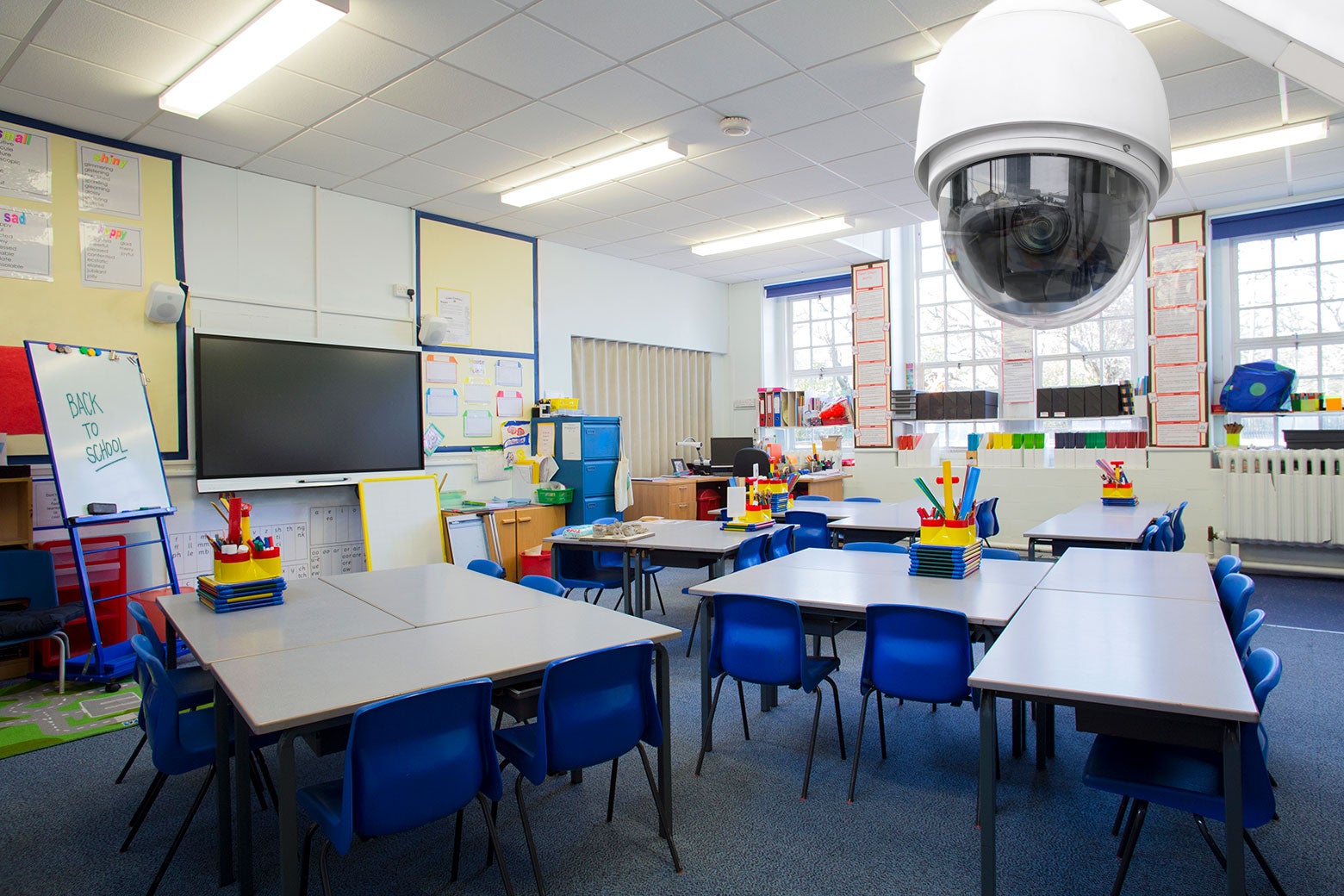
Jurisprudence Photo illustration by Slate. Photos by Getty Images Plus. Sign up for Executive Dysfunction, a newsletter that highlights one under-the-radar story each week about how Trump is changing the law—and how the law is pushing back. You’ll also receive updates on the latest from Slate’s Jurisprudence team. A sophomore in Arizona typed an email he never sent. Home with his mother before school, he was drafting a note to a teacher about a bad grade, and in between, he tapped out a few jokes and deleted each one. Thinking out loud and swallowing it back, basically. Gaggle’s monitoring software caught the keystrokes anyway. He never hit send. He was suspended before the day was out. By the time the district agreed to shorten the punishment, he’d already served 11 days. Those keystrokes are the whole thing. Not the joke, which was dumb the way 15-year-olds are dumb. The fact that a few characters typed and deleted in his mother’s kitchen became a document the school could act on. He walked into that disciplinary process already legible. Already scored. Whatever he said next was a rebuttal to a case somebody else had opened without telling him, using words he’d tried to erase. This is the school year starting now, in August, in Beverly Hills, California, and in whatever town you grew up in. Students are going back to the most surveilled campuses in American history. Facial recognition at the doors. A.I. weapons detection in the halls. Bathroom sensors shaped like smoke detectors, listening for aggression. Drones. Plate readers logging the cars in the pickup line. Beverly Hills High spent $4.8 million on its apparatus in a single fiscal year, and it’s less an outlier than a preview of what the vendors want everywhere. The pitch never changes. It’s always safety. The notion that this enhanced surveillance increases safety doesn’t actually hold up, though. A 2023 American Civil Liberties Union report found that of the 10 deadliest school shootings in two decades, eight happened on campuses that already had surveillance cameras. Parkland had cameras. Uvalde had cameras. The equipment watched, recorded, and saved no one. What this technology is good at, reliably, is generating paperwork about children who’ve done nothing. When Gaggle quarantines a draft, when Securly assigns a kid a rolling “wellness level,” when a detection system decides the shape in a student’s hand is a gun, the software is filing a report about a young person’s intentions. And it arrives first. It shows up carrying the authority of a system that cost the district millions and speaks in the grammar of objectivity, and it lands in front of an administrator or a school cop before the kid has said a word. The student’s account comes second, when it’s generally too late. Last fall in Baltimore County, Maryland, a detection system decided a teenager named Taki Allen was holding a firearm. He was holding a bag of Doritos. Around eight police cars came. They put him on the ground and cuffed him at gunpoint over a snack. The machine was wrong, cartoonishly wrong, and it didn’t matter, because the report had already summoned armed adults who believed it over the boy standing right there telling the truth. The algorithm outranked him. James C. Scott called this legibility, the way institutions flatten complicated people into categories they can manage. He was writing about census rolls and cadastral maps. He’d know a Securly dashboard on sight. The kids who lose these contests aren’t chosen at random. A Center for Democracy and Technology survey found that once students know they’re being monitored, they pull back: About half say they don’t share their true thoughts online, and roughly 8 in 10 say they’re more careful about what they search. The same research found nearly a third of LGBTQ+ students reported that they or someone they knew had been outed because of the monitoring, sometimes to administrators, through nothing but a private search. The child the algorithm reads as a threat is the child the institution already distrusted. This year the last thin layer of recourse peeled off. In July the Department of Education stripped the disparate-impact standard from its Title VI enforcement, the doctrine that let you challenge a facially neutral policy, an algorithm included, when it landed harder on protected students without anyone having to prove that was the point. Final rule, effective immediately, no notice and comment. Which tells you how much scrutiny they wanted. It was never a strong shield. But it was a shield. Now a student flagged and outed and disciplined by a system that reads queerness or Blackness as a signal of risk has lost one more one place to stand. The timing is almost too clean. The tools switch on for the new year the same season the guardrail comes off. Most parents signing the acceptable-use form have no idea. Most kids don’t either. They know the plain fact that they’re being monitored by their school administrators, which approximately a third of teenagers told the ACLU makes them “always feel like I’m being watched,” and they’ve adjusted to it the way you adjust to weather. A generation is learning, before it can vote, that its account of its own life is provisional. That the record comes before the person. That when you and the machine disagree about what just happened, you’re the one who has to prove it. School used to be, in theory, the one place a young person got to stay illegible. Got to write the sentence and delete it. Got to be a kid, which means unfinished, which means more than the worst thing you were ever flagged for. We’re building that out of the institution, camera by camera, contract by contract, and calling it care. The machine files its report first. The least we can do is stop treating its report as the truth. Artificial Intelligence Education Government Surveillance Jurisprudence Kids Teens
We’ve Replaced School Security With the Creepiest Possible System
Full Article
Original Source
Read the full article at Slate →KhanList aggregates and links to publicly available news content. We do not host full articles from third-party sources. Always verify important information with original sources.