
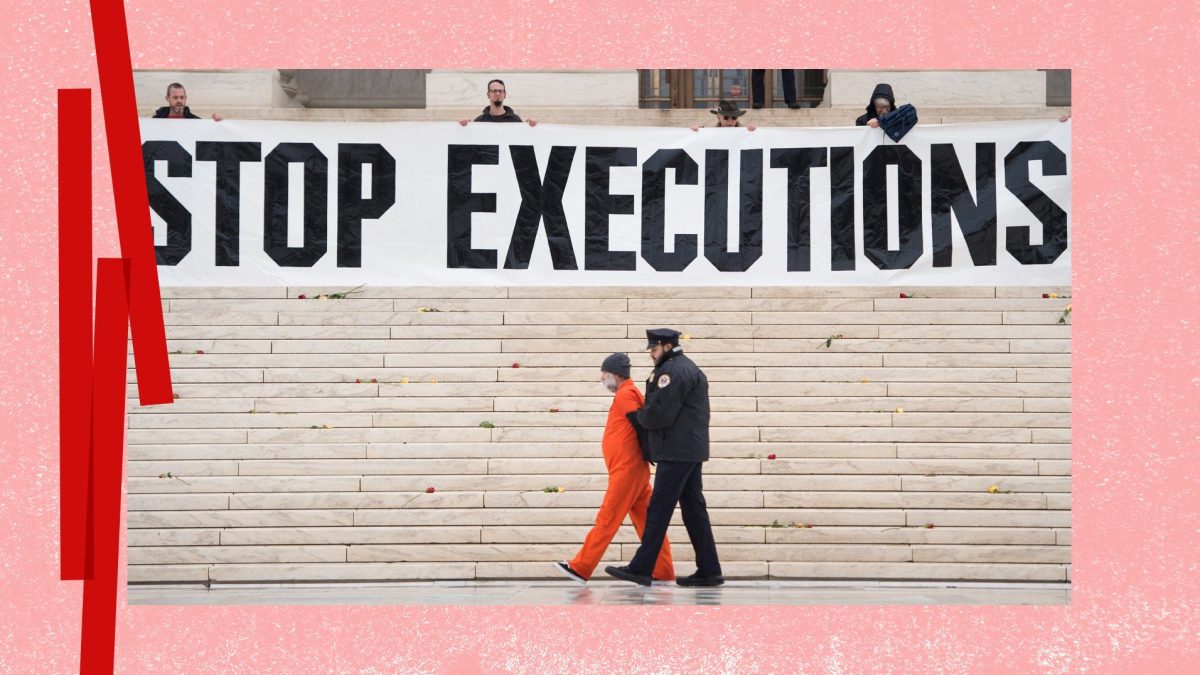
Randy Gardner will never forget the sight of his brother’s body after he was executed by firing squad. Standing in the mortuary in Utah in 2010, he unzipped the black bag containing Ronnie Lee Gardner’s body and looked at four big holes in his sibling’s chest. “It was disgusting,” Gardner told The i Paper in an interview. “It was horrific.” Shorts What came next was arguably worse, when a post-mortem examination revealed that just one of the four bullets had grazed his heart, even though a target had been placed on it for the shooters who stood 20ft away. Rather than dying in 10-15 seconds, as should have happened, it took two minutes for Ronnie Lee, who was 49, to be pronounced dead. The public shock over his death meant no executions by firing squad were carried out in the US for 15 years. But now the method is making a comeback. Last year, three people were shot dead in South Carolina after it approved the firing squad as a method of execution. Four other states also allow death by firing squad: Oklahoma, Mississippi, Utah and Idaho – which last month made it the “preferred” method of killing death row inmates. ‘What’s important is these people get killed’ The firing squad has, improbably, now emerged as the most “humane” option of execution given a catalogue of problems with other methods. Lethal injections became more popular in the US from the 1980s, but pharmaceutical companies have been limiting the use of their drugs in the procedure, forcing states to use untested alternatives. It led to infamous botched executions like that of Clayton Lockett in 2014, who took 43 minutes to die while writhing and convulsing after a lethal injection in Oklahoma State Penitentiary that should have killed him in minutes. Other methods have caused controversy, too: in 1990, double murderer Jesse Joseph Tafero was set on fire after the wrong sponge was used during his electrocution at a Florida prison. Randy Gardner at a Death Penalty Action protest. On his left arm is a tattoo in memory of his late brother Against that background, the “firing squad seems archaic, but it makes sense”, says Abraham Bonowitz, co-founder of Death Penalty Action, a group which campaigns against executions. “When it’s done right, it is the quickest method,” he told The i Paper. “What you’re seeing now is states killing people while they still can, before the law changes and before public opinion goes even further against it. “We know the numbers of new death sentences are lower than they have been for decades and so they’re going to run out of people they can execute. “I’ve had legislators tell me: ‘We’ve got plenty of bullets. We’re going to use whatever we have available because what’s important is these people get killed’.” The setup for the firing squad executions has not changed much since Ronnie Lee was put to death for shooting a man dead in 1985 during an escape from a courthouse. He spent decades on death row fighting his sentence, with his lawyer pointing to a troubled upbringing involving physical and sexual abuse and a drug addiction that began when he was just five years old. The family of his victim, Mike Burdell, had also said their relative would not have wanted Ronnie Lee to be executed. But in 2010, a team of five anonymous marksmen armed with .30-calibre rifles aimed at the target on his chest from a gun port behind a brick wall 25ft away. The shooters were all volunteers from Utah law enforcement, and one of their rifles was loaded with a blank so nobody would know who had ended Ronnie Lee’s life. The public shock resulting from Ronnie Lee Gardner’s death meant no executions by firing squad were carried out in the US for 15 years ‘They pinned a white target on my brother’s heart – and missed’ Ronnie Lee requested that none of his family attend his execution, as he did not want them to live with the violent memory. That meant Randy Gardner had to wait until the morgue to see what his brother’s body looked like. “We were at the mortuary, with his daughter, his son and his mother, and he was in a black bag with just his head showing,” he said. “I wanted to look at the bullet holes so I asked everyone else if they could find an urn for the cremation. “As soon as they walked away, I unzipped the bag and looked at his chest and, sure enough, there were four big holes there. At that point I was satisfied that at least they got him. “But years later, we had another doctor review the autopsy photos and the report, and he said with no uncertainty that not one of the bullets hit his heart. One nicked it, but the others were in his chest and under his arm. “They are supposed to be sharpshooters; they pinned a white target on my brother’s heart and then they missed.” Randy at a protest in April outside the engineering firm’s office contracted to design Idaho’s new firing squad execution chamber (Photo: Sarah A Miller/Getty) ‘Nothing humane about this way of killing’ Gardner has also looked at the autopsy photos, which he said were “gross, horrific”. “It’s the most terrible thing I’ve ever seen and I got PTSD because of it. I have dreams about executing my kids, and my poor mother asking me why I did it. “There’s nothing humane about this way of killing people”, he said. “The US is supposed to be the most humane country in the world and yet we’re one of the countries executing people. The others are China, Saudi Arabia and Pakistan.” Among those set to meet such a fate is Thomas Creech, 73, a serial killer who is Idaho’s longest-serving death-row inmate, having been behind bars for 50 years. In 2024, his execution by lethal injection was halted after eight failed attempts to find an IV line. His lawyers are fighting to prevent another attempt. Thomas Creech’s execution was halted after officials failed to establish an IV line to administer the fatal drug (Photo: Idaho Department of Correction via AP) A source familiar with Creech’s case told The i Paper that he is still “significantly traumatised” by his failed execution attempt. But Creech won’t get to decide how he is killed if a new date for his execution is approved. Idaho has built a new $1m execution chamber inside F-Block at the Idaho Maximum Security Institution near Boise, where three law enforcement officers will aim at prisoners’ hearts from 30ft away. In April, Donald Trump’s Department of Justice urged prisons to expand their methods of execution to include the firing squad, as well as nitrogen hypoxia, which is essentially suffocation. The DOJ has also shortened the time from the attorney general ordering an execution for federal inmates to the execution taking place, from four months to a matter of weeks. According to Abraham Bonowitz of Death Penalty Action, it is a sign of the President, long obsessed with the death penalty, flexing his power. “It’s Donald Trump being Donald Trump,” he said. “He has a personal penchant for the death penalty and for the power of a king to be able to decree that this is what we’re doing.”
‘We’ve got plenty of bullets’: How death by firing squad returned to the US
Full Article
Original Source
Read the full article at Inews →KhanList aggregates and links to publicly available news content. We do not host full articles from third-party sources. Always verify important information with original sources.