
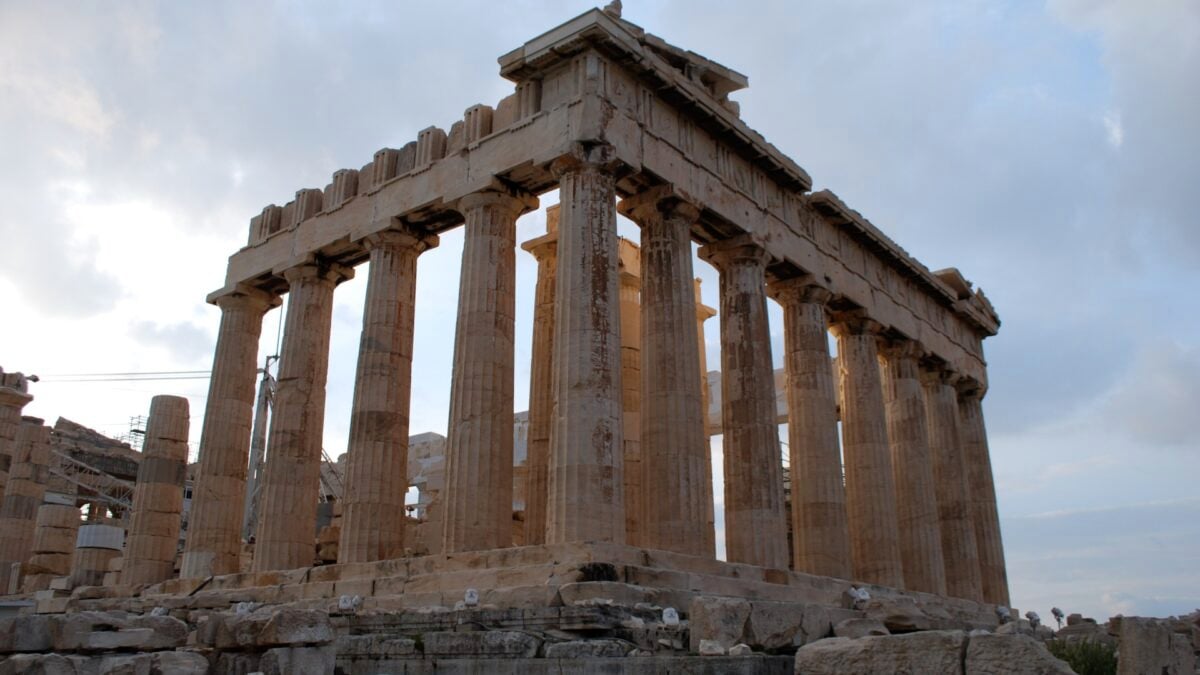
The Parthenon represents one of the most impressive works left behind by ancient Greek architects, and a popular idea posits that the temple’s elaborate, geometric placement of columns was meant to create an optical illusion. Given the mathematical implications of this idea, Oxford mathematician Alain Goriely took it upon himself to check that the math was mathing. And it turns out that the math did not math. The Parthenon—built as a temple to Athena—looks like it was built from straight, periodic elements. In reality, its architectural elements are more curved in shape and palcement. The myth is that these represent intentional decisions by architects to create the illusion that the curves are straight and the irregular spacing is regular. According to Goriely’s latest paper, published in Royal Society Open Science, scholars have proposed at least 12 different such optical refinements—but these ideas are “either unsupported by evidence or too small to have a perceptible effect under typical viewing conditions,” he wrote. “The myth remains widely accepted despite an absence of direct historical or experimental evidence,” Goriely wrote. “Yet, these myths are so widespread that they have been repeated in specialized books about the Parthenon, encyclopedias, documentaries, and, ad nauseam, over the planetary dumping ground of human knowledge, propaganda, truths, lies and myths, called the internet.” The birth of a myth According to the paper, the earliest mention of optical illusions at the Parthenon comes a whopping 400 years after its construction. In other words, the myth was born long after—presumably—the deaths of architects who worked on the temple. Vitruvius, who Goriely described as an “important but notoriously opaque writer,” argued that certain elements of the Parthenon were meant to present optical refinements. Then in the Renaissance, humanists and architects “rediscovered” Vitruvius and ran with his ideas. That said, Goriely added that despite its popularity, the myth was “never universally accepted among experts.” Multiple historians, artists, architects, and anthropologists have acknowledged that not all refinements may serve this purpose. But even these detractors have been tame in their criticisms of the myth, Goriely said, and that the “extraordinary claim” has largely stood on “insufficient historical evidence and no scientific evidence.” Toppling an idea Goriely’s analysis tackled several myths surrounding the Parthenon’s optical illusions. One major claim is that the Parthenon’s base, which isn’t flat but gently curve upward in the center, counters how a very long, straight line appears to sag in the middle. Experiments in psychology and human vision suggest that our brains aren’t so easily tricked, Goriely noted. The comparison between two profiles: one has perfectly straight horizontal elements and one has the exact curvature found in the east façade of the Parthenon. It demonstrates that the horizontal lines do not appear to sag and that an upward curvature can be detected in principle under ideal conditions. © Goriely 2026 There’s the added element of how “vantage points” tourists visit are specifically selected “so that they can be told about optical correction,” he wrote. That is, the illusion is visible if you’re looking the right way—which frankly defeats the purpose of claiming the design’s intentionality. So-called “vantage points” are marked in purple. It is at these points that all the columns would be seen of equal thickness as claimed by the optical illusion myth—assuming perfect lighting conditions. © Goriely 2026 Another theory is concerns column entasis, which refers to the slight bulging of colum shafts at the Parthenon. These curvatures supposedly corrects an optical illusion that makes them look too narrow. According to Goriely, this is honestly a stretch—this bulge we speak of is a measly 0.7 inches (18 milimeters), which would be near unintelligible at viewing distances. The myth of the entasis explains the small swelling of columns as a correction to a visual illusion. None of these statements is correct. © Goriely 2026 So what? Goriely listed potential reasons as to why these myths persisted for so long. First of all, there might be a sort of “romantic” view of Greek civilization as the “pinnacle of knowledge and art,” an idea that originated from the Enlightenment era. That then evolved into the assumption that the Parthenon’s architects possessed a “perfect awareness of abstract geometry, structural mechanics, visual perception and artistic theory” on par with the “combined knowledge of twentieth-century modern sciences and more.” Believe it or not, Goriely’s intention isn’t to badmouth the Parthenon or the ancient Greeks. The Greeks likely did have keen structural intuition and empirical knowledge—but more based on experience and experimentation. In fact, different cultures historically have executed mind-boggling feats without being perfectly aware of the theoretical or scientific justifications behind their work. It’s just us in the modern era, with said justifications, that marvel at their achievements. And because we’re (understandably) so impressed with symbols like the Parthenon, its myths will “probably linger forever in the public mind,” Goriely said. “There is, nevertheless, much to be learned from the wisdom of ancient Greece,” he added. “In the Republic, Plato insists that geometry trains the soul to see beyond sensory deception. It is time to transcend our own tendency to see illusions where none exist and to apply mathematics and science to see beyond our own delusions.”
We’ve Been Giving the Parthenon’s Architects Credit for a Trick They Might Not Have Even Used
Full Article
Original Source
Read the full article at Gizmodo →KhanList aggregates and links to publicly available news content. We do not host full articles from third-party sources. Always verify important information with original sources.