
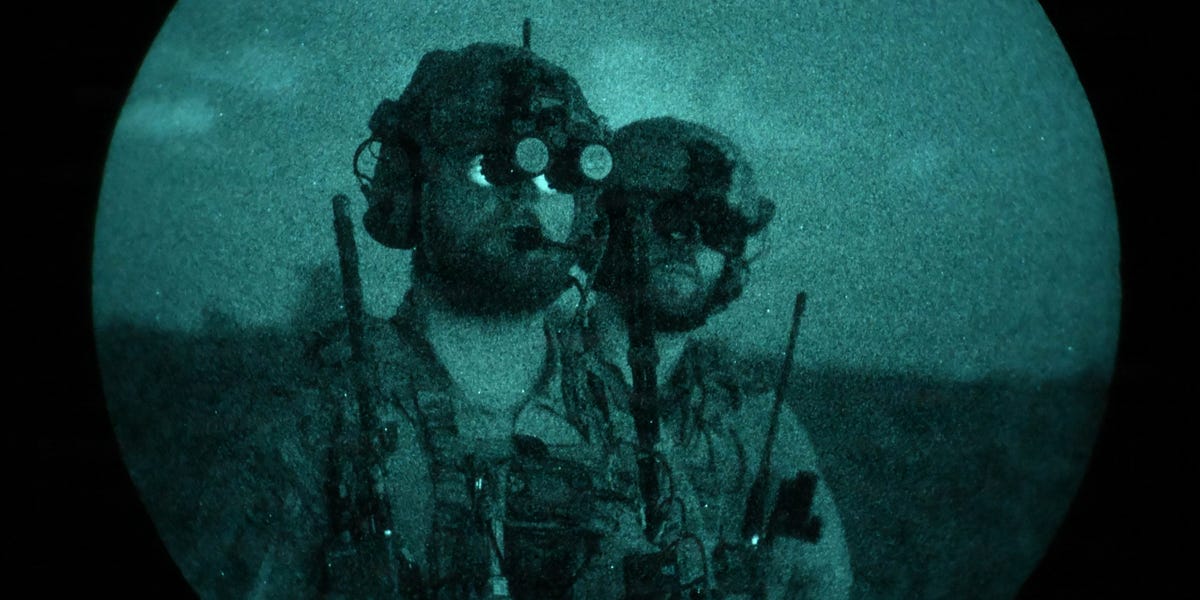
Western special forces are training without their 'high-tech wizardry’ to survive a kill zone like the one in Ukraine NATO special forces are training without high-tech gear to survive on a battlefield like Ukraine. US Air Force photo Elite NATO commandos are training without high-tech gear to make sure they can survive modern battlefields like the one in Ukraine, where some advanced equipment can be easily tracked by enemy drones and other sensors.Polish special forces recently became the first to participate in "Deep Strike," a new NATO exercise designed to test how Western operators get back to basics.The Polish troops, who were tasked with assaulting a target with drones, had to cross dozens of miles of forest and farmland in just a few days, during which they were hunted by drones with thermal cameras, dogs, and US Army paratroopers, NATO said in a statement this month.Completing the mission meant doing so without the cutting-edge technology that special operations forces are known for. "Indeed, on the modern battlefield, sophisticated electronics can broadcast a team's location, leading to their capture," NATO said.NATO special forces units have long leveraged what the alliance described as "high-tech wizardry" to operate in stealth, while relying on jets for air support and helicopters for surprise insertion and rapid extraction.Russia's war against Ukraine has demonstrated the potential vulnerabilities of overreliance on some high-end tech."When both sides have night vision goggles, nobody owns the night," NATO said in its statement, adding that "the proliferation of advanced heat-sensing thermal optics makes moving undetected even more difficult." On top of this, air defense systems fielded on both sides prevent fighter jets and helicopters from getting too close to the front lines. NATO special operators during the Deep Strike exercise. NATO photo Furthermore, drones have turned the front lines into what Ukrainian soldiers and officials describe as a miles-wide kill zone, where any movement can be tracked, leading to instantaneous pinpoint strikes.As they watched the kill zone evolve and grow, NATO military leaders decided to create an exercise that would test how soldiers could survive on a battlefield like the one in Ukraine. US Special Operations Command Europe created the scenario — a time-sensitive, deep-strike mission informed by lessons learned from Ukrainian special operators. SOCEUR ran two trials with the Army's 10th Special Forces Group before opening up the course to NATO allies.Poland was the first to sign up. The special operators who participated in the recent exercise carried assault rifles with short barrels and traveled light for increased agility. NATO said they evaded the US paratroopers, snuck through enemy lines, and successfully assaulted the target.Several other allied special forces units have signaled interest in participating in Deep Strike. New iterations of the exercise will be guided by the latest lessons from Ukraine, according to NATO.Special forces operations are among several areas of warfare in which NATO militaries are drawing lessons from Ukraine and applying them to their own training.In recent years, NATO allies have held air, naval, and land-focused exercises rooted in an understanding that many of the tactics and procedures they previously relied on have been upended by the rise of drones. Read next Business Insider tells the innovative stories you want to know Business Insider tells the innovative stories you want to know Business Insider tells the innovative stories you want to know Business Insider tells the innovative stories you want to know Jake Epstein is a defense correspondent in London for Business Insider, covering the US military, NATO, and European security, as well as emerging tech in warfare.Jake has filed stories from conflict zones in Ukraine and the Middle East, where he embedded with a US aircraft carrier on a combat mission in the Red Sea. Jake has reported extensively on NATO operations and activities across Europe, including from aboard one of its AWACS surveillance aircraft along the Russian border, a British Voyager tanker refueling fighter jets over the Baltic Sea, and a Dutch helicopter flying to a warship in the Arctic. NATO Ukraine
Western special forces are training without their 'high-tech wizardry’ to survive a kill zone like the one in Ukraine
Full Article
Original Source
Read the full article at Businessinsider →KhanList aggregates and links to publicly available news content. We do not host full articles from third-party sources. Always verify important information with original sources.