
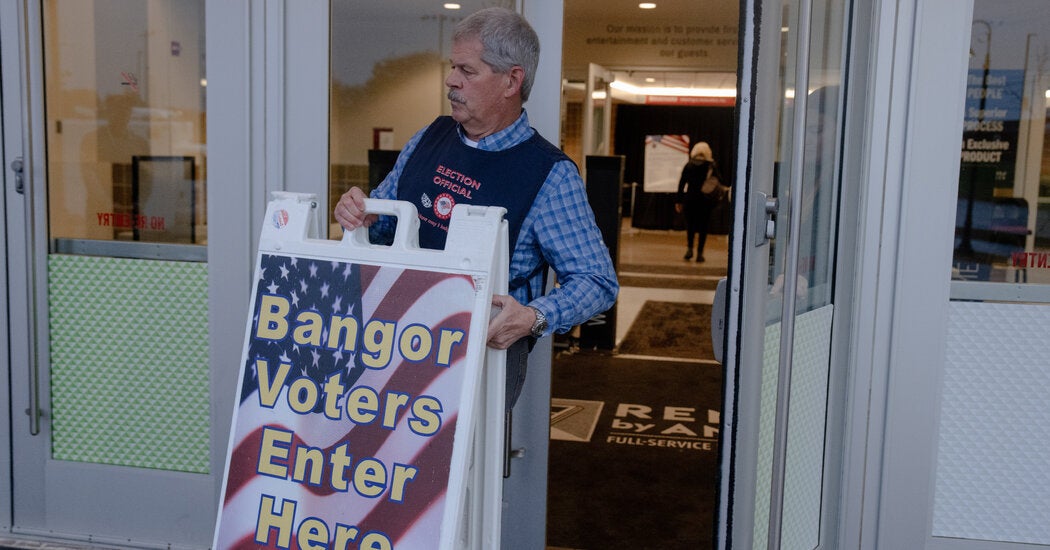
LatestHere’s the latest.Democrats got off to a strong start in their quest to regain control of Congress on Tuesday, securing victories in Senate races in Georgia, North Carolina and New Hampshire as the party’s candidates appeared to be outperforming expectations according to early returns.Senator Jon Ossoff of Georgia, a Democrat, fended off his challenger in a crucial battleground race, according to The Associated Press, while Roy Cooper, the former governor of North Carolina, flipped a Republican-held seat there. Representative Chris Pappas, a Democrat, held a Senate seat for his party in New Hampshire, a purple state that both parties viewed as critical.Turnout appeared strong across the country, as millions of people cast votes that will deliver a verdict on an unpopular president who has implored the country to act as if he were on the ballot.Democratic candidates have blamed President Trump, and the war he started this year in Iran, for the economic hardships that have driven a current of frustration across the nation. Republicans have focused on portraying their Democratic opponents as extreme on social issues and the economy as they played defense in reliably red states.Favorable polling has buoyed Democrats’ hopes of taking control of the House, but Republicans have worked to protect their majority with aggressive redistricting efforts. In the Senate, Republicans sought to use their fund-raising advantage to protect seats in traditionally conservative strongholds, including Texas and Kansas, where some polling places have closed.In Florida, Republicans fended off one significant challenge: Senator Ashley Moody defeated Angie Nixon, a progressive Democrat, in a tight contest. But Democrats turned back an attempt by Republicans to flip two seats via redistricting, with Representative Jared Moskowitz and Representative Kathy Castor winning re-election in districts that Republicans redrew in an effort to oust them.. In South Carolina, Senator Darline Graham has been filling the seat long occupied by her late brother, Lindsey, and Democrats have hoped that Dr. Annie Andrews, a pediatrician, could flip the seat. In Ohio — which also features an acrimonious race for governor — former Senator Sherrod Brown, a Democrat, is vying for a comeback as he tries to oust Senator Jon Husted, a RepublicanThe last polling places will not close until 1 a.m. Eastern on Wednesday, in Alaska. Full results won’t be known until well into the evening — and maybe not for days or longer, particularly if many of the races are close — but it’s clear that voters were eager to have their say. In each of the major Senate battlegrounds, including Texas, North Carolina and Michigan, early turnout eclipsed that of the last midterm cycle.In Texas, overall turnout could exceed 10 million votes, which would top the total from each of the last two midterms. In Georgia, Election Day turnout was on track to beat that of the 2024 presidential election, the Georgia secretary of state said.Here’s what else we’re covering:A complicated landscape: More than 400 Times reporters, editors, data analysts, video journalists and photographers are covering the midterms, seeking to understand a large country with voters who are complicated — and sometimes contradictory. Read more ›The counting process: Control of the Senate will hinge on the outcomes in the battleground states of Alaska, Iowa, Kansas, Maine, Michigan, Minnesota, Nebraska, New Hampshire, Ohio, South Carolina and Texas. Here’s when to expect results ›Big spending: This is the most expensive midterm election, as measured in spending on political advertising, since at least 2018, according to data from AdImpact. Elon Musk, the world’s richest person, alone contributed $474 million to Republican groups, candidates and their allies, more than any donor has ever spent in a single election cycle. Read more ›Minor disruptions: A technical problem with voting machines in Westchester County, N.Y., outside New York City, led officials there to collect ballots by hand in a competitive House race. In Florida, flooding forced more than 20 polling stations across eight counties to be relocated. In North Carolina, technical problems at several precincts caused minor delays; state election officials said they would delay the release of election results to at least 8:15 p.m. from 7:30 p.m. Read more ›Election integrity: Many election officials and Democrats have said they fear that Mr. Trump’s attacks on the integrity of U.S. elections could lead to tensions during voting and baseless challenges to the outcome. The administration has sought to prove that many noncitizens have cast ballots, but few people have been charged with offenses related to voting fraud. Local and state officials say they are well prepared to run a secure election.Court rulings: A federal judge has turned down a request by Democratic lawmakers and party organizations to prohibit the Trump administration from coercing states into screening incoming ballots. And the Supreme Court issued what appeared to be an extraordinary rebuke to Mr. Trump, signaling that it was not interested in assisting his efforts to interfere with how states administer elections.Senator Ashley Moody, a Republican, has won the special election in Florida to complete Marco Rubio’s term. Republicans expected to cruise in her race. But Angie Nixon’s shocking win the Democratic Senate primary reshaped the contours of the race and turned it into a real contest. Moody hung on despite waging something of a quiet campaign. Her winning margin will be much narrower than that of other recent Florida Republican Senate candidates.The Florida Senate bid by Angie Nixon, a member of the Democratic Socialists of America, was viewed as a test case for the left’s theory that they could win in battleground areas. She fell short against Ashley Moody, but her strong showing is still likely to be viewed as a positive sign by progressives.Scenes From Election DayWashingtonAlex Kent/The New York TimesPhoenixAdriana Zehbrauskas for The New York TimesMilwaukeeJamie Kelter Davis for The New York TimesManhattanHiroko Masuike/The New York TimesAnchorageErin Schaff/The New York TimesWest Des Moines, IowaKC McGinnis for The New York TimesAnchorageErin Schaff/The New York TimesSan FranciscoJonah Reenders for The New York TimesColumbus, OhioMaddie McGarvey for The New York TimesRound Rock, TexasJames Talarico, Democratic candidate for SenateHaiyun Jiang/The New York TimesWhite Lake, Mich.Mike Rogers, Republican candidate for SenateVictor J. Blue for The New York TimesLos AngelesAriana Drehsler for The New York TimesAnn Arbor, Mich.Dr. Abdul El-Sayed, Democratic candidate for SenateTodd Heisler/The New York TimesDetroitVictor J. Blue for The New York TimesUpper Arlington, OhioVivek Ramaswamy, Republican candidate for governorMaddie McGarvey for The New York TimesBexley, OhioDr. Amy Acton, Democratic candidate for governorMaddie McGarvey for The New York TimesFort WorthJeremy Raff/The New York TimesRichmond, Va.Demetrius Freeman for The New York TimesManhattanHiroko Masuike/The New York TimesBangor, MaineBrent McDonald/The New York TimesMilwaukeeJamie Kelter Davis for The New York TimesQueensJosé A. Alvarado Jr. for The New York TimesAdvertisementSKIP ADVERTISEMENTAnother race I’m tracking in Texas is the usually little-watched election for the Texas Railroad Commission, the state’s oil and gas regulatory body. Jon Rosenthal, the Democrat and an oil and gas engineer from Houston, is up against Bo French, a former Republican county chairman whose family owns and oil and gas company. This fall, French drew blowback for racist social media posts and comments.Ashley Moody will complete Marco Rubio’s term in the Senate in Florida.ImageAshley Moody, a former Florida state attorney general, will serve two more years in the Senate.Credit...Jacob Langston for The New York TimesSenator Ashley Moody of Florida, the Republican appointed last year to replace Marco Rubio, won a special election on Tuesday to complete his term, according to The Associated Press. She fended off a challenge from State Representative Angie Nixon, the Democratic nominee, who had mounted a grass-roots campaign that kept the race closer than expected.Ms. Moody’s victory cemented Republicans’ dominance in recent Florida Senate races. Republican Senate candidates have won every time they have been on the ballot in the state since 2018 as the former political battleground has become more reliably Republican.Ms. Moody, 51, will now get to serve two more years in the Senate. She will be able to seek re-election to a full term in 2028.That she faced so much of a contest this year in a state that President Trump won by 13 percentage points two years ago was surprising. Florida Republicans won Senate races by double-digit margins in 2022 and 2024, and Ms. Moody was expected to continue that streak when Gov. Ron DeSantis picked her for the job last year. She was serving a second term as the state’s attorney general at the time.But Ms. Nixon’s shocking win in the Democratic Senate primary in August jolted the race. She deployed her skills as a former union organizer to score an upset despite having been at a vast fund-raising disadvantage compared with a rival favored by the party establishment.In the general election, Ms. Nixon, 42, bet that she would be more successful by leaning into progressive policies, such as single-payer health care and universal child care, than by moving to the political center like past Democratic Senate nominees in the state had done. Ms. Nixon would have been Florida’s first Black senator.She joined the Democratic Socialists of America in June. That party did not endorse her campaign, but Ms. Moody used the democratic socialist label to cast Ms. Nixon as much too radical for the “free state of Florida.”Ms. Moody had endorsements from Mr. DeSantis and from Mr. Trump, whose unpopularity dragged down Republican candidates across the country. The president rallied twice in Florida in the last days of the campaign, getting loyal supporters to the polls.Ms. Moody ran as something of a generic Republican, little known to many Florida voters because she had never run for the Senate before — and because her Senate campaign was not very visible, especially compared with Ms. Nixon’s.But Ms. Nixon was not well known, either, and had much less money to introduce herself to Florida’s big and diverse electorate.According to the White House pool report, President Trump is watching returns in the East Room with some of his cabinet members and advisers.AdvertisementSKIP ADVERTISEMENTSenate Republicans had hoped to grab a Democratic-held seat in New Hampshire to offset potential losses elsewhere. They believed former Senator John Sununu had a path to do so given the political power of the family name and his previous tenure in the Senate. Democrats always thought that would be a heavy lift, considering that the state voted Democratic in recent presidential elections. They proved to be correct, easing concerns that the party could lose on friendly territory in these midterms.It can be easy to overlook former Gov. Roy Cooper’s victory in North Carolina’s Senate race because Republicans abandoned the race weeks ago. But Cooper is the first Democrat to win a Senate race there since 2008, and the state has repeatedly broken the hopeful hearts of Democrats in Senate races since then.In the South Carolina Senate race, Annie Andrews is outperforming Kamala Harris’s 2024 margins by double digits in three counties where results are essentially complete. These areas vary greatly from one another in terms of demographics: Lee County is majority Black and Kamala Harris won it by 18 percentage points in 2024, while Barnwell and McCormick counties are predominantly white regions that President Trump won.ImageCredit...Arfa Momin/The New York TimesA map of votes reported for the South Carolina U.S. Senate election, highlighting Lee, Barnwell and McCormick Counties where more than 95 percent of votes are in. Annie Andrews leads by 37 points in Lee and 4 points in Barnwell. Lindsey Graham leads by 6 points in McCormick.AdvertisementSKIP ADVERTISEMENTThe Democratic Party’s path to the Senate once looked extraordinarily challenging, as the party needed to win at least two states where President Trump won by double digits. But the early returns already suggest Democrats have a clear path to winning in two such states, Texas and South Carolina. The party hasn’t won a statewide federal election in either state in decades.Some Florida Democrats have worried for a few months now that they would wake up the day after the election and wished they had had just a little more money to compete in statewide races that now appear very close. Both Angie Nixon in the Senate race and David Jolly in the governor’s race got vastly outspent. Florida is an incredibly expensive state for political campaigns, and national Democratic donors and fund-raising groups have been reluctant to spend in the state in recent election cycles after having done so and lost so many times before.With more than 90 percent of the vote counted in the Florida Senate race, Senator Ashley Moody has taken the lead over Angie Nixon, the Democratic challenger. Nixon had led for much of the night, with results showing shifts to the left from the 2024 presidential election in most counties, and Nixon is overperforming the final Times/Siena poll of the race by a few percentage points. That said, even a 10-point shift in the state would not erase President Trump’s 13-point margin in Florida in 2024. Our election forecast expects Moody to increase her lead as more vote arrives.In the Texas Senate race, James Talarico, the Democratic nominee, is leading Ken Paxton by more than 20 percentage points in both Williamson County in the Austin area and Tarrant County in the Dallas area, with roughly 80 percent of the expected vote having been reported in both counties. President Trump won Williamson by two percentage points and Tarrant by five points in 2024. Talarico is doing well in the initial reports from a state where a large majority of voters cast their ballots early. But the deep-red rural counties of the state have yet to report.ImageCredit...Jacqueline Gu/The New York TimesAdvertisementSKIP ADVERTISEMENTIn several phone calls today, both Republican and Democratic political experts in Florida uttered a dreaded word — “recount” — because voter turnout suggested some races would be quite close, as the governor’s race looks right now. Under Florida law, races go to automatic machine recounts if they are separated by half a percentage point or less, and to automatic manual recounts if they are separated by a quarter of a percentage point or less.Chris Pappas’s victory will make him the first openly gay man in U.S. history to win a U.S. Senate seat. This isn’t something he spoke of often on the campaign trail, but it’s something he reflected on in interviews with me.“The fact is, I’m living a reality today that I didn’t think was possible when I was growing up just a few decades ago,” Pappas said. “My state, our country, has come a long way.”ImageCredit...John Tully for The New York TimesRepresentative María Elvira Salazar, the Republican in a tight race in a heavily Hispanic district in South Florida, had warned members of her party privately for months that their hard-line posture on immigration and the Trump administration’s aggressive crackdown might cost Republicans support from Latino voters. But her efforts to introduce a bipartisan immigration reform bill to help address the vulnerability were met with fierce and vocal resistance from the conservative wing of the Republican party.Susan Collins took the stage at her election-night headquarters in Bangor after the polls closed in Maine to thank her supporters as a crowd of hundreds cheered her on. “We went all over the state and I’ve got to tell you, the crowds were huge, the reception was warm and the response could not have been better,” the Republican incumbent said as she was surrounded by her extended family. But she noted that it was very early in the night. “The results are going to take a while and we will keep watching,” she said before heading back to her personal watch party.ImageCredit...Lexi Parra/The New York TimesAdvertisementSKIP ADVERTISEMENTRoy Cooper’s Senate victory for Democrats in North Carolina has been expected for many weeks now. But it was not a given as the midterm elections were shaping up last year and earlier this year, when North Carolina looked like it might wage one of the most expensive Senate contests of the midterms. Cooper’s name recognition and popularity as a former governor, as well as his succinct campaign slogan, “Make Stuff Cost Less,” helped Democrats shore up North Carolina and free money for the party to compete in other tight states.In win for Democrats, Roy Cooper flips a North Carolina Senate seat.ImageRoy Cooper became the first Democrat elected to the Senate in North Carolina since 2008.Credit...Cornell Watson for The New York TimesRoy Cooper, a popular former North Carolina governor and a Democrat, won the state’s Senate race on Tuesday, according to The Associated Press. The victory gives Democrats their first flip of the night and an essential victory as the party tries to gain Senate control.Mr. Cooper, who left the governor’s office last year after two terms, defeated Michael Whatley, the former Republican National Committee chairman. President Trump had handpicked Mr. Whatley try to hold the Senate seat in a battleground state that has voted for him three times.But Mr. Whatley proved no match for Mr. Cooper, who has never lost an election in his nearly four decades in North Carolina politics. He is the first Democrat elected to the Senate in North Carolina since 2008.Mr. Cooper will succeed Senator Thom Tillis, a Republican who had clashed with Mr. Trump and chose to retire after the president threatened him with a primary challenger.Both parties expected an expensive and contested race between Mr. Cooper, 69, and Mr. Whatley, 58. The two sides spent significantly on political advertising until about a month ago, when Mr. Cooper’s consistent lead in polls began to look insurmountable.Still, Democrats feared complacency in a state where they have fallen short in past Senate races. Mr. Trump and Vice President JD Vance traveled to North Carolina several times in recent weeks to rally for Mr. Whatley and Republicans in competitive House races.A longtime Republican political operative, Mr. Whatley campaigned as a loyal Trump supporter and tried to portray Mr. Cooper, who served 16 years as the North Carolina attorney general, as soft on crime. That attack line was ineffective in a year in which voters were focused on the economy.Mr. Cooper campaigned under the slogan “Make Stuff Cost Less.”Republicans also tried to paint Mr. Cooper as a radical leftist, but it was difficult to redefine him after he had built a reputation as a moderate over 38 years in elective office.As governor, Mr. Cooper guided the state through the coronavirus pandemic and three major hurricanes. His signature accomplishment was expanding Medicaid coverage to more than 600,000 people.How well is the night going for Democrats so far? Democratic candidates for Senate have been declared winners in New Hampshire and North Carolina already, while the race in Kentucky has yet to be called for the Republican nominee.AdvertisementSKIP ADVERTISEMENTJames Talarico has won the early vote by a wide margin in Texas, where only about a quarter of the vote is expected to be cast on Election Day. In the state’s major metropolitan counties, he’s outrunning Kamala Harris by by around 25 percentage points. Ken Paxton will need to win the Election Day vote by a wide margin.ImageCredit...Haiyun Jiang/The New York TimesDemocrats hold onto a critical Senate seat in New Hampshire.ImageChris Pappas has served for four terms in the House.Credit...John Tully for The New York TimesRepresentative Chris Pappas, a Democrat, has won the Senate race in New Hampshire, according to The Associated Press, holding a seat for his party in a purple state that both parties viewed as critical. His victory makes him the first openly gay man in U.S. history to win a Senate seat.Mr. Pappas defeated John E. Sununu, a former senator who lost re-election in 2008. A scion of a Republican political family whose father and brother served as governor, Mr. Sununu sought to present himself as distinct from President Trump’s MAGA movement. But he was unable to overcome the distaste for the president in New Hampshire, which has never backed Mr. Trump in a presidential election.Mr. Pappas, 46, has represented the state’s swingy First Congressional District for four terms with an understated political style mirroring that of Senator Jeanne Shaheen, the retiring Democrat he is set to replace. (Ms. Shaheen beat Mr. Sununu in 2008.)During his campaign, Mr. Pappas spoke little of the history he would make if he won, saying in interviews that he preferred to keep the focus on voters, not on himself. But gay rights advocates around the nation celebrated his victory as a sign of progress nearly four decades after Barney Frank of Massachusetts became the first gay member of Congress to come out voluntarily, in 1987.“The fact is, I’m living a reality today that I didn’t think was possible when I was growing up just a few decades ago,” Mr. Pappas said in an interview during the campaign. “My state, our country, has come a long way.”A son of Manchester, N.H., who came home after college to work at his family’s restaurant and run for local office, Mr. Pappas sought to nationalize the race, repeatedly reminding voters that Senate control could run through the state.He called Mr. Sununu “another vote for Donald Trump’s failed, reckless agenda” and framed his opponent as a pillar of the status quo. He ignored the fact that it was he, not Mr. Sununu, who had spent much of the past 20 years in elected office.The Sununu name is so prominent in the state that Mr. Pappas and his allies frequently joked that voters did not actually know which member of the family was on the ballot. Mr. Sununu’s charismatic brother, Chris, served as governor from 2017 to 2025; his father, John H. Sununu, was George H.W. Bush’s chief of staff and the New Hampshire governor from 1983 to 1989.John E. Sununu, 62, worked aggressively to distance himself from Mr. Trump on issues like tariffs and the war with Iran, hoping to appeal to independent voters and moderate Republicans. He ran an ad saying he had “never even met the man.” And he framed his candidacy as being about what comes after Mr. Trump.“In two years, the president will leave office,” Mr. Sununu said during a debate last month. “And my question is, where do we go next?”The answer New Hampshire voters delivered was: Not back to a candidate many associated with the past.AdvertisementSKIP ADVERTISEMENTThe tightest of Florida House races right now is a tossup between Representative María Elvira Salazar, the incumbent Republican, and Eliott Rodriguez, her Democratic challenger, in a Miami-based district that had been seen as an indicator for potential Hispanic voter backlash over the Trump administration’s aggressive immigration enforcement.AdvertisementSKIP ADVERTISEMENTAdvertisementSKIP ADVERTISEMENTAdvertisementSKIP ADVERTISEMENTAdvertisementSKIP ADVERTISEMENTAdvertisementSKIP ADVERTISEMENTWe’re watching a few key areas as polls close in Maine and Michigan.ImageIn 2020, Senator Susan Collins fared well in Bangor, Maine, where she resides, narrowly winning the Democratic-leaning city even as President Trump lost it by 21 points.Credit...Lexi Parra/The New York TimesThe Senate contests in Maine and Michigan will be rare tests of progressive Democrats’ appeal in battleground states. There are a few key areas we are focusing on as polls at 8 p.m.Both of the states have large numbers of Democratic voters, but President Trump won Michigan in 2024 and Senator Susan Collins won Maine in 2020. This year’s Democratic candidates — Troy Jackson in Maine and Dr. Abdul El-Sayed in Michigan — will try to win back coalitions that have recently swung away from the party.It’s a marathon in Michigan, not a sprint.Michigan counts its votes relatively slowly. In 2024, when this year’s Republican nominee, Mike Rogers, came within 20,000 votes of victory, only around half of the state’s ballots had been counted by midnight Eastern. If the margin is particularly close, there’s a decent chance we will be waiting on Wayne County, the most populous county in the state and one that is teeming with Democrats. It is also usually among the last to finish reporting its votes: In the August primary, Wayne had not reported 90 percent of its results until around 3 a.m. Eastern.Dr. El-Sayed expects to draw a lot of support in Wayne — Kamala Harris won the county by around 250,000 votes in 2024 — but shifts inside the county could be critical to his overall success. In particular, we will be watching Dearborn, Dearborn Heights, and Hamtramck, a group of Wayne cities with large Arab and Muslim populations that made large shifts toward Mr. Trump in 2024. Those shifts were motivated at least in part by President Biden’s handling of the war in Gaza, which should not apply to Dr. El-Sayed, a vocal critic of the United States’ policies toward Israel.Conversely, Mr. Rogers will hope to cut into Democratic margins in the suburban Oakland County, which he lost by 12 percentage points in the 2024 Senate race. Dr. El-Sayed could be vulnerable there after losing Oakland in the Democratic primary to Representative Haley Stevens, who represents most of the county in Congress, and endorsed Mr. Rogers’ Senate bid following a highly public feud with Dr. El-Sayed. Both men have made appeals to Michigan’s Jewish voters, a large share of whom reside in Oakland.Things could also be interesting in Saginaw County, a key swing region that Mr. Rogers lost by nine votes in 2024 even as Mr. Trump narrowly carried the county (and the state) on the same ballot. A victory for Dr. El-Sayed in Saginaw would be an encouraging sign for his prospects statewide.Collins needs as many split-ticket voters as she can get.At first glance, Maine is much friendlier for Democrats than other states where Republican incumbents are being challenged: Mr. Trump lost the state in all three of his presidential campaigns. But the other Democratic candidates for Senate aren’t facing Ms. Collins, who defied the polls and won re-election by more than eight percentage points in 2020, even as Mr. Trump lost Maine by nine.Maine reports its election results by municipality, and there are nearly 500 of them in the state. In 2020, Ms. Collins proved particularly strong in high-income municipalities where a majority of voters are college-educated, like Cumberland (where she ran ahead of Mr. Trump by 27 percentage points in 2020) and Scarborough (where she ran ahead by 23). She also fared well in Bangor, where she resides, narrowly winning the Democratic-leaning city even as Mr. Trump lost it by 21 points.Far to the north, Ms. Collins also fared quite well in Aroostook County in 2020, home to Caribou, where she was born and raised. Her strength there will be tested: Mr. Jackson, a fellow Aroostook native, represented much of the area in the state legislature for decades.In the event neither candidate reaches 50 percent of the vote, the contest will be decided via ranked-choice tabulation, a process which took ten days in both 2024 and the June primary.
We’re watching a few key areas as polls close in Maine and Michigan.
Full Article
Original Source
Read the full article at Nytimes →KhanList aggregates and links to publicly available news content. We do not host full articles from third-party sources. Always verify important information with original sources.