
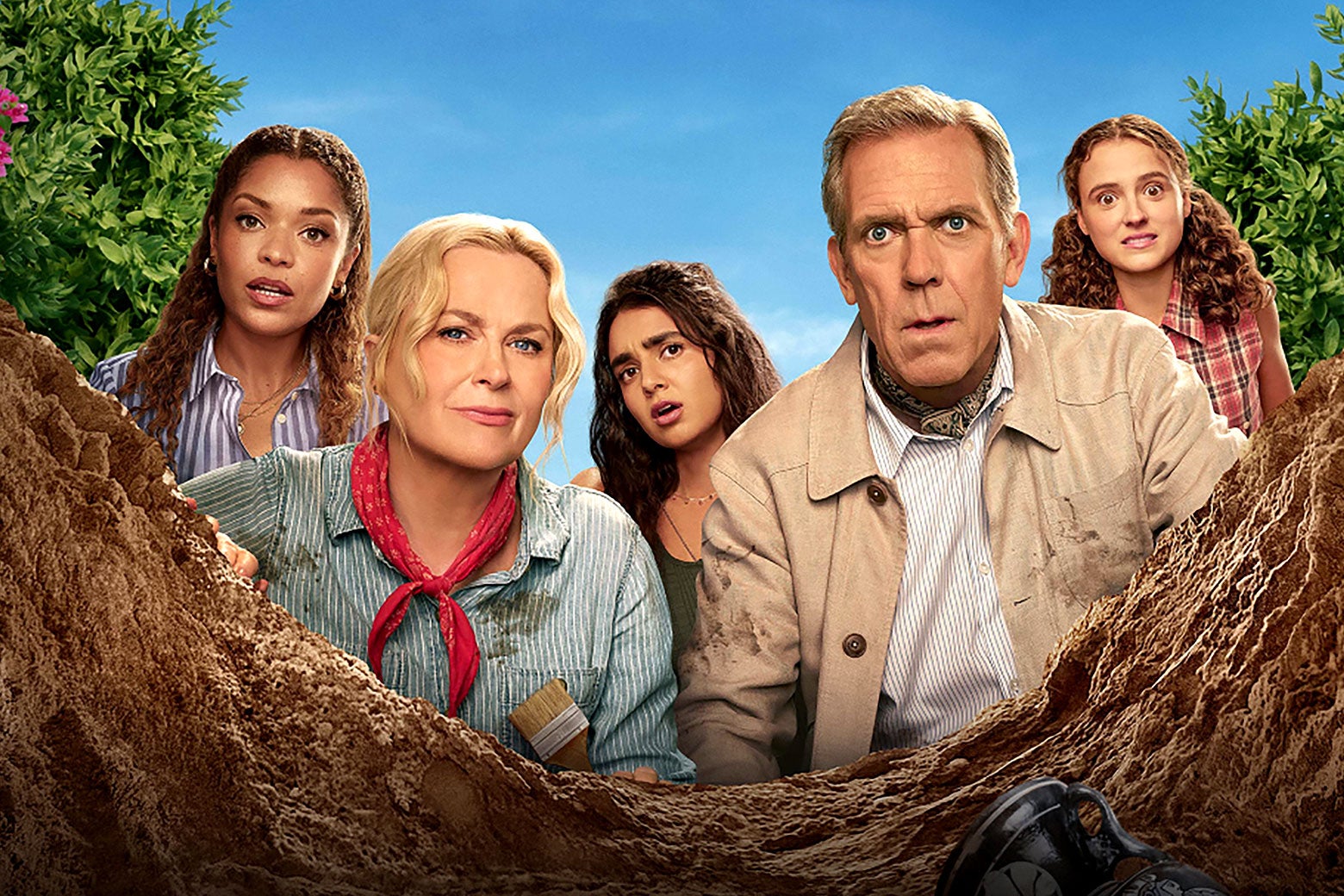
Television If Amy Poehler and the creator of The Good Place can’t save the sitcom, who can? By Enter your email to receive alerts for this author. Sign in or create an account to better manage your email preferences. Unsubscribe from email alerts Are you sure you want to unsubscribe from email alerts for Sam Adams? Nov 23, 20265:50 AM Peacock Sign up for the Slatest to get the most insightful analysis, criticism, and advice out there, delivered to your inbox daily. These are strange times for the American sitcom. In the glory days of Must See TV, it wasn’t uncommon for half-hour comedies to make up half of the 10 most watched shows on network television, but a series of challenges—from cable dramas, reality shows, and eventually streaming—knocked one of the most distinctive, if never quite most respected, art forms in the U.S. off its perch. The ratings for the most recent broadcast TV season, itself largely a relic of a bygone era, still include four sitcoms among the top 25 shows, but three of them—the Big Bang Theory spinoff Georgie & Mandy’s First Marriage, the Tim Allen vehicle Shifting Gears, and Scrubs—rely on creators and stars whose credits stretch back to the ’80s and ’90s, and only one, CBS’s Ghosts, offers anything like hope for the future. As Friends and Will & Grace writer Jeff Greenstein recently explained on social media, the entire ecosystem of executives, showrunners, and apprentice writers that once sustained the traditional multicamera sitcom has “crumbled into dust, and it can’t be rebuilt. Sorry!” While classic sitcoms like Friends provided a popular comfort watch for nostalgic millennials, the traditional virtues of the half-hour comedy—its zippy pace (derived from the rhythms of theatrical farce) and endless repeatability—work against the impetuses of the streaming era. The sameness that was so gratifying when you tuned in week after week—there were Norm and Cliff, on their barstools as always—grows numbing over a binge-watch, and the lack of plot and character development made episode-ending cliff-hangers tricky to pull off. Netflix still invests in buzzy half-hours like Nobody Wants This, but its list of all-time most-watched shows includes nothing but serialized hourlong storytelling. Who’s got time for a breezy rom-com when there’s Bridgerton to watch? Perhaps the most successful transition to the new era was made by Michael Schur, the co-creator of Parks and Recreation and Brooklyn Nine-Nine who, with The Good Place, pulled off one of the greatest conceptual twists in TV history. Like a classic sitcom, The Good Place reset the plot at the end of each season, but only because its characters discovered at the end of its first season that they were trapped in hell, condemned to repeat their own mistakes with no way to learn from them. It wasn’t until after The Good Place wrapped up in 2020 that Schur made the inevitable switch from terrestrial television to streaming, creating the short-lived Rutherford Falls for Peacock and the bittersweet Man on the Inside, whose third and final season is now in production, for Netflix. Both shows have their charms, but the transition hasn’t been an entirely smooth or successful one. The rhythms of a streaming half-hour aren’t the same as a network sitcom’s—even if, as is the case on Peacock, the show has to build in commercial breaks for viewers on a lower pricing tier. There’s no rush to get to the next joke, or even the tacit promise that there will be one at all. And without that underlying drive, Schur and his writers don’t always seem to know which way to go. Peacock’s Dig, which reunites Schur with Parks and Rec star Amy Poehler, ought to be cause for rejoicing. Like the irrepressible Leslie Knope, Poehler’s Elise is a woman holding on to idealism in a world that rarely rewards it—in this case, she’s an archeologist who’s been working on the same excavation site in Greece for years. Elise is more than qualified to run the dig, which revives every summer in the picturesque town of Simantikos, but Neville (Hugh Laurie), the aging legend who has presided over it for decades, can’t seem to relinquish his position, or the adulation that comes with it. He’s a towering figure in the field, although the “uggs”—archeologist-speak for the students who sign on to the program—who turn up anew each year are increasingly more interested in partying in the Mediterranean sun than in digging in the dirt for shards of ancient pottery. It’s true that Elise lacks Neville’s people skills—her attempt to rally the uggs with a rousing speech is an insensitive disaster, and she’d sooner die than attempt to woo a donor—but that’s in part because she’s never had a chance to develop them. Neville makes noises about stepping aside, but then he’s off on some windy story about his days at Eton or recalling at length some wise words Churchill once said, and the moment just drifts away. So when she stumbles onto an important discovery at an abandoned dig site, her first impulse is to keep it to herself. This is, we’re frequently reminded, both illegal and unethical, as well as a very bad idea: New discoveries have to be reported to the local government immediately to prevent looting, and the reputational glory will fall on Neville, or he’ll find a way to claim it. Elise works on uncovering her find alone, but she’s steadily forced to take on co-conspirators: Clare (Antonia Thomas), a stuffy British preservationist who’s drowning in preparations for her upcoming wedding; Dylan (Geraldine Viswanathan), a free-spirited hot mess who can’t even finish the list of things she never got around to finishing; and Patty (Fina Strazza), a nerdy farm girl who is getting her first taste of grown-up life. Elise spends the first third of Dig’s 10-episode season getting her makeshift crew together and identifying what turns out to be a fully intact statue of the goddess Hera—an incredible find, and one that could make all of their careers if they can find a way to secure their discovery without getting found out or winding up in jail. (It’s a good indicator of the show’s tone that Elise and Co. take to calling the statue “Pretty Woman,” because, as Elise puts it, its importance is “big … huge.”) They’ve got other obstacles to overcome as well. Elise is being wooed by the town mayor, Stavros (Kayvan Novak), but is still relationship-shy after a bad divorce; Clare is trying to shake off the influence of her wealthy mother, whom she’s never been able to please, and so on. Each of the show’s female protagonists is at a turning point in her life—it’s not a coincidence that their ages all end in a 9—and the show pushes them steadily toward rounding the corner and starting their next decade on a better footing. Their parallel character arcs might be less obvious, or at least feel less schematic, if Kate Myers’ source novel had been adapted as a two-hour movie. But there aren’t enough complications to sustain five-plus hours of television, and a story that might have been delightful at feature length turns into a little bit of a drag. There’s plenty of chemistry in Dig’s dynamite ensemble. Viswanathan, no surprise to anyone who saw Blockers, has screen presence to burn, and Strazza, a recent Tony nominee for John Proctor Is the Villain, brings a winning determination to the show’s most broadly written role. (It’s only her dogged commitment to the part that keeps you from rolling your eyes at the third or fourth joke about how her best friend is a cow.) There’s enough chemistry, in fact, to make you wish they made Dig as a more classically oriented sitcom, one where hanging out with the characters is the point and not just something we do until the plot catches up with the opening flash-forward. The show’s characters eventually find a way to reckon with their profession’s past, but the writers never quite work it out. Comedy Greece TV
We’re Slowly Losing One of TV’s Greatest Art Forms
Full Article
Original Source
Read the full article at Slate →KhanList aggregates and links to publicly available news content. We do not host full articles from third-party sources. Always verify important information with original sources.