
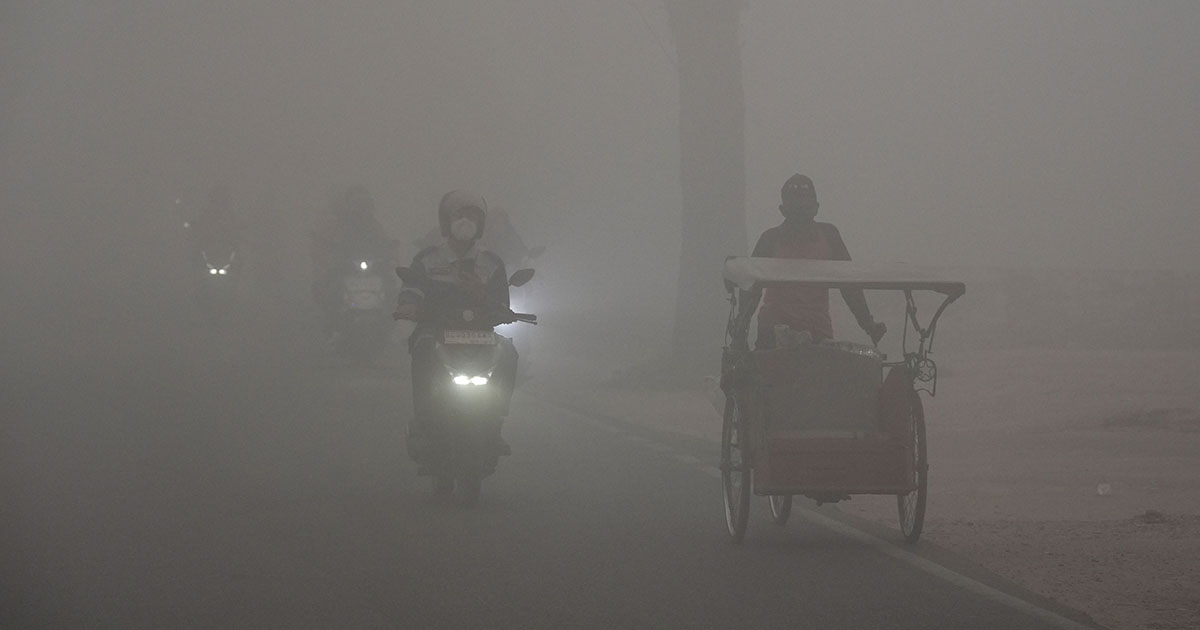
PALEMBANG – In Ogan Ilir regency on the outskirts of Palembang, South Sumatra, near-constant forest and land fires for over two months have left the ground so dry in some areas that just stepping on it kicks up a visible cloud of dust and ash.Nita Herman, 52, has to breathe it all in as she works her small farm, growing rice and vegetables. The fires and the resulting haze mean she cannot get as much done as she needs.“My chest feels tight. When I drink, it feels like there’s a fish bone stuck in my throat,” she told The Straits Times as she worked on Oct 17. Nita Herman (left) working alongside her neighbour Nur Hayati to harvest rice on a small paddy field that they manage in Ogan Ilir regency on the outskirts of Palembang. ST PHOTO: DIMAS ARDIANThe day before, Palembang’s air quality hit a record high of 1,477 on the US AQI scale, equivalent to PM2.5 800. Now, it had dropped to an AQI of 699 (PM2.5 425), but the choking air remained thick.While haze from the fires in Sumatra and Kalimantan has affected Indonesia’s neighbours, it is those like Nita and local communities who bear the brunt of the environmental catastrophe.“Every year, we suffer,” Nita said.On Sept 10, the Health Ministry said the fires had affected more than 12.5 million people in Kalimantan, Jambi, Riau and South Sumatra, where the fires are most widespread.Forced to harvest early because of drier-than-usual weather, Nita estimated her rice paddy would yield only about 2 tonnes, compared with 3.5 tonnes in 2025. Cracks are appearing in paddy fields due to an extended dry season exacerbated by El Nino. ST PHOTO: DIMAS ARDIANBut more than the reduced income from her farm, she worries about her son, 23-year-old Eko Prasetyo, a firefighter who has not been home since Aug 15.“If it doesn’t rain, he can’t come home,” said Nita, who also has a younger daughter.Eko is one of more than 60,000 personnel deployed nationwide to fight the land and forest fires, which have intensified during a strong El Nino year.The blazes have scorched more than 200,000ha between January and July, according to the Forestry Ministry’s SiPongi monitoring system, while the resulting haze has spread across parts of South-east Asia. In comparison, about 99,000ha were burnt from January to July 2025.The latest haze situation in Indonesia, showing areas where fire hot spots have been detected over the past four weeksA graphic showing areas where fire hot spots have been detected over the past four weeks in Indonesia. Source: NASA FIRMS In South Sumatra, the effects are not only environmental, but also economic and health-related. Farmers are seeing smaller harvests, while businesses that depend on tourists are losing customers. Residents are also flooding clinics seeking treatment for respiratory problems.The crisis has renewed questions about whether Indonesia is adequately equipped to tackle fires that return almost every year.tk. Firefighters trying to extinguish a fire on the outskirts of Palembang on Oct 15. They are among over 60,000 personnel from the fire department, military, police, forestry ministry and other agencies deployed for firefighting operations. ST VIDEO: DIMAS ARDIAN Lives and livelihoodsNita said Eko was in Sungai Baung, north-east of Palembang, a region that takes eight hours from Ogan Ilir to reach by boat and truck.As the peatland fires there continue to smoulder, Eko’s brigade has set up camp in nearby woodlands to keep the flames under control. They return to the firefighters’ command centre in Simpang Tiga, a few hours’ drive away, only to pick up food and supplies.“If they leave, the fire can spread again,” Nita said. “So they have to stand by in their tents.” Firefighters and officials on the outskirts of Palembang testing a new fire-suppressant powder that turns into a gel when mixed with water. The gel boosts firefighting effectiveness tenfold, according to its Brazilian maker. ST PHOTO: DIMAS ARDIANRake Sandi, 39, who has been a firefighter for 17 years, said the greatest danger is when the wind suddenly changes direction while a crew is deep in a burning zone.“Before you know it, you’re surrounded by smoke,” Rake told ST on Oct 17, as he was being sent to a new hot spot. “You can evade the flames, but it’s very difficult to escape the smoke.”A sudden shift like that once caused a colleague to collapse while they were fighting a blaze in Palembang’s Gandus district. After they got the colleague to safety, the crew returned to the fire.“For wildfires, we need to get to the centre of the fire and try to cut it off there. But that’s where it gets very dangerous when the wind shifts,” Rake said. Rake, who has a son and a daughter, says his wife supports what he does. But his son, now 11, worries that it is a dangerous job. “I’ll tell him, yes, it can be dangerous, but we’re doing it to help people, and we’re equipped with training and knowledge,” he said. “Insyaallah, my colleagues and I will be all right.”While firefighters’ lives are on the line, local businesses watch their livelihoods dwindle.In Palembang’s city centre, Ponco Pramono, 46, is struggling to keep his restaurant, Mie Celor 26, open.The Palembang noodle spot is popular with Indonesian tourists, who usually come to the city for its food. The restaurant’s signature mie celor is a noodle dish with coconut milk and shrimp broth, served with bean sprouts and a boiled egg. But as the haze worsens, so do Ponco’s profits.“In September, our sales dropped by 20%,” Ponco told ST on Oct 15. “This month, it’s even worse – it is down 40%.” Only one-third of the tables at the popular restaurant Mie Celor 26 in Palembang city were occupied when ST visited during dinner time on Oct 15. ST PHOTO: DIMAS ARDIANHaze has affected more than 200 flights to Palembang since the beginning of October, deterring visitors. Locals are also staying home more, leaving Mie Celor 26’s usually packed dining room relatively sparse.“We have 10 employees here and we want to keep everyone, but things are hard,” Ponco said.People are angry. “We pay taxes every year, but the government cannot protect us,” he lamented.Roadside vendor Marlini Suwandi, 44, is also watching helplessly as her income takes a hit.She usually makes around 200,000 rupiah (S$14) a day selling vegetables near the Pasar 26 wet market in Palembang. But since the haze worsened in mid-October, her sales have fallen by half.“The gorengan (fried snacks) cart vendors are my usual customers, but with all this smoke, many of them aren’t going out any more,” she told ST. “When the haze wasn't as bad, there were still many people shopping. Now, it’s gone down by a lot.” Marlini Suwandi’s earnings from selling vegetables in a wet market in Palembang has shrunk 50% due to the haze. ST PHOTO: DIMAS ARDIANOn top of all this, parents worry about the toll the fires are taking on their children’s health and futures.Schools in Palembang have moved lessons online to keep students indoors since Sept 9, and the switch has been hardest on those already struggling to keep up. Many students in public schools in Indonesia lack access to laptop computers, so they attend Zoom classes on their mobile phones.At SMPN 13, junior high school teacher Dewi Buana, 51, said not every student has a phone of his or her own. One Grade 9 student had managed fine with online lessons until his phone broke down suddenly. “Their parents have to come to school to pick up their assignments,” she said. As schools in Palembang go online, teachers face challenges in engaging students, some of whom may not have their own mobile phones. ST PHOTO: DIMAS ARDIAN Even for students with phones, online learning has its pitfalls.Sri Ariyani, 38, whose son is in his final year of junior high school, worries he is falling behind.“He joins the Zoom for a bit, and once it’s done, he goes straight into playing on his phone,” she said.With no Wi-Fi at home, she buys mobile data at 13,000 rupiah for 3GB, intending for it to last several days. But it can run out in a day or two when her children use it to play games.Stuck at home, they also no longer see their friends. “At school, they focus on their lessons,” she said. “At home, I can’t watch them all the time.” Mothers Sri Ariyani (left) and Siti Kurniawati have struggled to keep their ninth graders focused during online lessons. Both have caught their children switching screens to play games while class was in session. ST PHOTO: DIMAS ARDIANBut keeping children at home does not always keep them safe.Firmansyah, 60, a parking attendant, lives in a ramshackle hut on the banks of the Musi River with his wife, daughter and five grandchildren, including two-year-old Arkanza.“It’s worse here than in the city because the wind by the river brings haze directly to us,” Firmansyah told ST on Oct 15. Living by the Musi River means greater exposure to the wind that brings haze to Firmansyah (standing) and his family. ST PHOTO: DIMAS ARDIANEven though the house has no air-conditioning, the haze has been bad enough since August to force his family to keep their doors and windows closed for much of the day.The family’s health has also suffered.When ST came across them, Arkanza and his mother, Maulidia, 29, had just returned from the local community health centre to get treatment for the toddler’s cough. “The whole house has had runny noses or coughs recently,” Maulidia said.Firmansyah and his family are not alone – the South Sumatra health agency recorded 52,483 acute respiratory illness cases in September, the highest monthly total so far in 2026.With the worsening haze, the agency set up a tent in the city centre in early October to serve as a clinic for residents with respiratory issues. A makeshift clinic set up in Palembang’s city centre offers passers-by quick medical check-ups, as well as masks, portable oxygen cans, cough medicine and eye drops. ST PHOTO: DIMAS ARDIAN Housewife Eli Akmal, 63, who lives in Palembang, had her heart checked at the clinic and learnt that it was fine. The problem, though, is the haze, which always hurts her eyes. “It stings,” she said. ST PHOTO: DIMAS ARDIAN“Most patients who come here complain of cough or runny noses. Some also have dry eyes,” Dr Indira, a general physician from the South Sumatra province-run hospital Binar who was manning the clinic, told ST.“We give out medicine depending on the symptoms, and we also provide face masks as well as vitamins to strengthen the immune system.” The clinic also has oxygen tanks available, though Dr Indira has not yet treated any patient complaining of shortness of breath.But Firmansyah worries that things will only get worse. “We’re breathing in the smoke even as we sleep,” he said. “We need help.”tk. A drone’s view of Palembang’s landmark Ampera Bridge shrouded in haze from forest fires in South Sumatra a day after PM2.5 levels hit a record high on Oct 15. ST VIDEO: DIMAS ARDIAN Response and responsibilityThe government has pledged to intensify its response and has accepted firefighting assistance from neighbouring countries. But the fires present a formidable challenge.Much of the burning occurs on peatlands, where layers of partly decayed vegetation can easily catch fire under dry conditions. Flames can spread underground and smoulder long after the surface appears under control, making the fires hard to extinguish.“If it’s just a normal forest, the fire can be extinguished very quickly. But peat just keeps burning and burning,” said Nur Asikin, 53, a firefighter with 24 years of experience. Peat fires are notoriously hard to put out because they burn below the surface, creeping through thick layers of dried peat that water sprayed from above often cannot reach. ST PHOTO: DIMAS ARDIANSmoke from the fires has also decreased visibility, hampering the use of water-bombing helicopters. Several local residents in Palembang told ST they had noticed fewer helicopters overhead than during the fire season in 2025.The National Disaster Mitigation Agency (BNPB), which is handling much of the firefighting response, has also faced funding cuts over the years. Its budget shrank to 491 billion rupiah in 2026, less than a quarter of what it was in 2025.The recent removal of BNPB head Suharyanto, after his younger brother was arrested over alleged corruption involving emergency relief funds, has put even more scrutiny on the agency’s ability to address the wildfire crisis.National Disaster Mitigation Agency’s budget has shrunk to 491 billion rupiah (S$34.8 million) in 2026, only 4% of what it was in 2020.tk. A fire can smoulder underground for weeks and flare up again after the surface flames have been put out. ST VIDEO: DIMAS ARDIAN Praying for rainFor people living closest to the fires, the immediate priority is relief, whatever the causes of the crisis or its longer-term solutions may be.The government has repeatedly said putting out the flames is a priority and has turned to alternative methods, from dry ice to a Brazilian fire-suppressant powder, to bring a quicker resolution to the crisis.But given how far the flames have already spread, most can only hope for the arrival of the rainy season. In a meeting with agency heads and Cabinet members on Oct 12, Indonesian President Prabowo Subianto acknowledged the limits of the government’s response. “I suppose in the end (the only solution) is rain,” he said.The elephant in the room, beyond the immediate challenge of extinguishing the fires, is why they keep returning, despite stricter requirements for plantation companies to have firefighting equipment and the construction of fire surveillance towers in fire-prone areas to tackle a longstanding problem.Despite these measures, a recently released report from the Indonesian Forum for the Environment (Walhi) said thousands of wildfire hot spots continue to be found on oil palm plantations and forestry concessions linked to large conglomerates. All indications are that such companies continue to use slash-and-burn agricultural practices to clear the land.The findings have renewed calls for stronger enforcement and greater accountability for companies whose lands are repeatedly burned. Fires set by irresponsible parties to clear land can spread out of control and reach productive oil palm plantations owned by others, as seen here outside Palembang on Oct 17. “Future handling of forest and land fires needs to focus on strengthening beneficial ownership transparency, tracing accountability up to the business group level, comprehensively evaluating concessions that repeatedly burn, and strengthening government and corporate accountability in preventing recurring environmental damage,” Walhi said in its report.The situation in 2026 is not much different from 2015, when the country experienced its worst haze crisis. Though the scale of the burning in 2026 is smaller than the 2.6 million ha burned over a decade ago, there are concerns that the authorities have not learnt enough from 2015 to prevent a recurrence the next time a strong El Nino strikes.Meanwhile, the communities living near these concessions continue to suffer and pay the price for corporate malfeasance. Indonesia’s firefighters have been battling forest fires for months, struggling with thick smog and poor visibility. ST PHOTO: DIMAS ARDIANBack in Ogan Ilir, Nita prays for rain. She is soothed by the occasional call from Eko, when he can get a phone signal. “He’ll video-call me and say, ‘Look mum, there’s a big fire’,” she said.At night, however, thoughts of Eko keep her awake. “I think about whether he’s eaten yet, because he often misses meals when he’s working,” she said. “Hopefully, the rain comes soon and he comes home soon.”A video of how Brazilian gel could be Indonesia's new ‘weapon’ in fighting forest fires A video of how Brazilian gel could be Indonesia's new ‘weapon’ in fighting forest fires
‘We’re breathing in the smoke even as we sleep’: Living with haze in Sumatra
Full Article
Original Source
Read the full article at Straitstimes →KhanList aggregates and links to publicly available news content. We do not host full articles from third-party sources. Always verify important information with original sources.