
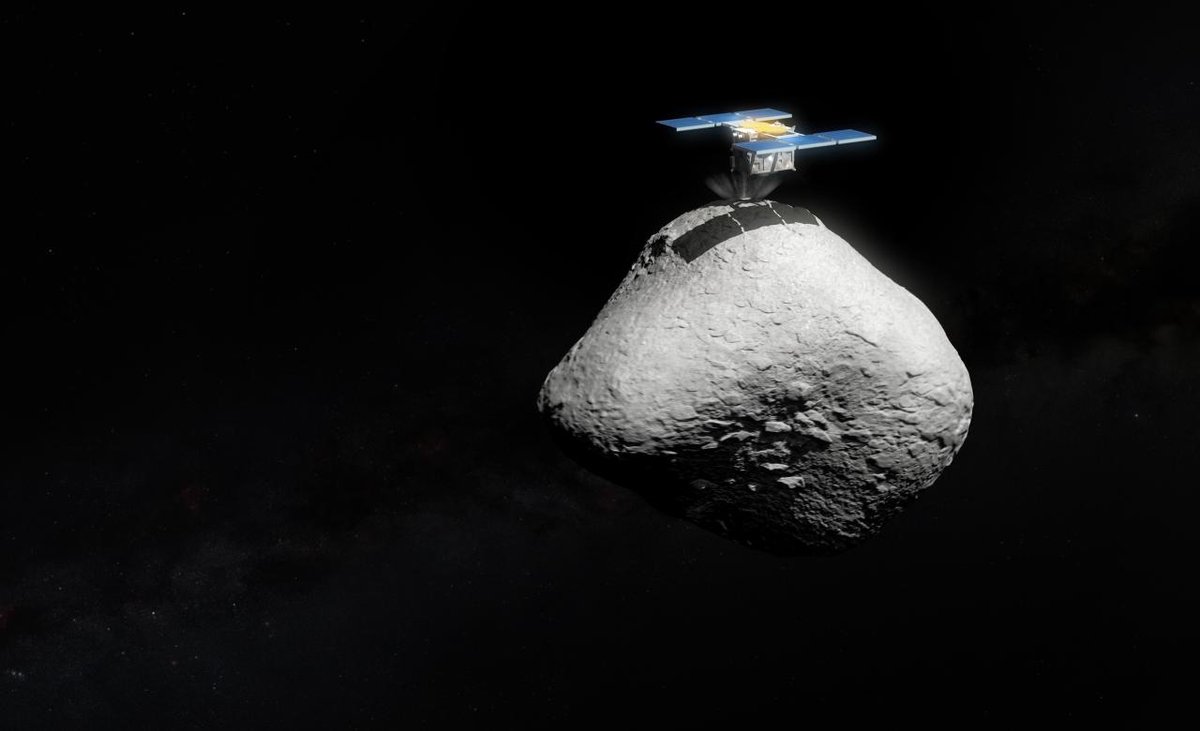
November 21, 20264 min read Add Us On GoogleAdd SciAmThe strange “dark comet” 1998 KY26 is moving in a way scientists have yet to fully understand. A Japanese space probe was set to visit in 2031, but engine trouble will prevent that encounter, leaving the mystery unsolvedAn artist's impression of Japan’s Hayabusa2 space mission touching down on the surface of the asteroid 1998 KY26—an event that will now never occur as the spacecraft has been rerouted to a different destination. ESO/M. Kornmesser. Asteroid: T. Santana-Ros et al. Hayabusa2 model: SuperTKG (CC-BY-SA)On November 16 officials from the Japan Aerospace Exploration Agency (JAXA) announced that their Hayabusa2 spacecraft will no longer visit a small, rapidly rotating and mysteriously accelerating space rock called 1998 KY26. Operating well past its nominal lifetime, the probe is now in an “extended mission.” But as a result of problems with its engines, it couldn’t reach this object for an intended rendezvous in 2031. Instead Hayabusa2 will now visit a different target, the near-Earth asteroid 2015 BM510, in 2028.In recent years, 1998 KY26 has certainly attracted an inordinate amount of attention from space scientists and the interested public alike because of its mysterious nongravitationalacceleration—that is, an acceleration that couldn’t be explained by the gravitational influence of other objects in the solar system and must have been driven by something else. I led a team that identified this object’s odd motion in 2022. Some have speculated that this anomalous movement could be a clue that 1998 KY26 isn’t a space rock at all but rather some sort of technological artifact—perhaps even the long-lost Soviet spacecraft Phobos 1.There’s a lot to unpack here, but the gist is that 1998 KY26 is indeed challenging our understanding of comets and asteroids—and has been for several years.On supporting science journalismIf you're enjoying this article, consider supporting our award-winning journalism by subscribing. By purchasing a subscription you are helping to ensure the future of impactful stories about the discoveries and ideas shaping our world today.A nongravitational acceleration alone isn’t necessarily cause for invoking a spacecraft; we routinely measure such effects on comets and asteroids alike. When comets get close to the sun, ices heat up and sublimate from their surfaces as vapor, producing a rocketlike (and distinctly nongravitational) recoil. The escaping vapor also usually lofts sunlight-reflecting dust along with it, creating the beautiful tails we associate with comets.Asteroids don’t have tails and presumably don’t have much ice, but we do measure similar, albeit weaker, accelerations on them, too. These are a consequence of subtler effects that all boil down to sunlight either pushing on them or unevenly heating their surfaces.But as is so often the case in nature, not all so-called minor bodies comfortably fit in our tidy, simple “comet or asteroid” categorization. In fact, in recent years Davide Farnocchia of NASA’s Jet Propulsion Laboratory and I led three papers reporting the discovery of almost 20 objects in our solar system that blur this line in a new way. These “dark comets” have properties from both comets and asteroids; they have nongravitational accelerations stronger than those of typical asteroids but exhibit no tails—or rather they showed no tails when we first detected their mysterious movements.Observations suggest two distinct “dark comet” populations—those with longer orbits (red) and those with shorter orbits (gray). The orbit of the “dark comet” 1998 KY26 is shown in blue.The more of these dark comets that we find, the clearer we see a telltale trend. In 2024 I led a paper that showed that they seem to be divided into two different populations: outer and inner dark comets (shown in the red and gray orbits, respectively, in the image above). The outer ones are much larger and have more elliptical orbits, while the inner ones are smaller and closer to Earth, with more circular orbits. The latter include 1998 KY26, and its relative proximity to our planet was one of the reasons it became a target for Hayabusa2; for a time, it seemed like that mission would eventually be what solved the mystery of dark comets.Now, of course, the situation is more complicated.Within the last year, we finally snapped images of cometary tails on two of the known outer dark comets, confirming that cometary venting was causing their mysterious motion. Meanwhile telescope data have revealed that 1998 KY26 is significantly smaller than previously thought, and Farnocchia led a study that showed how, given this smaller size, the effects of sunlight alone could explain 1998 KY26’s motion. And a couple of weeks ago Korbin Hansen and Masatoshi Hirabayashi, both at the Georgia Institute of Technology, published another study showing that 1998 KY26 is probably too warm to sustain ice, lending more credence to the updated radiation model from Farnocchia and his colleagues.None of this proves that 1998 KY26 isn’t some derelict spacecraft. On the contrary, given that cometlike venting of vapor probably doesn’t explain the motion of 1998 KY26, it could be argued that, by extension, this weakens that explanation for other inner dark comets, too. Then again, in the past some researchers have argued that other dark comets were defunct spacecraft as well, but these claims were quickly shown to be incorrect. While it would be a remarkable development if some of the dark comets turned out to be spacecraft, we have plausible explanations for all of their motions.It is disappointing that Hayabusa2 won’t be visiting 1998 KY26, but the reasons for this have nothing to do with this object being anything besides an admittedly weird space rock. The reality is that the updated radiation-force model tracks with the best available measurements that indicate 1998 KY26’s reduced size, potentially obviating the need for more off-beat interpretations.And still a beguiling mystery remains: the emerging picture in this rapidly developing field is that dark comets really are divided into two distinct populations. These outer objects seem to be covert comets disguising themselves as innocuous asteroids, while the inner ones are something else entirely, forcing us to rethink how radiation forces work in the solar system’s asteroids. The solar system—and the dark comets it contains—keeps presenting us with new puzzles.This is an opinion and analysis article, and the views expressed by the author or authors are not necessarily those of Scientific American.
Weirdly accelerating space rock keeps puzzling astronomers
Full Article
Original Source
Read the full article at Scientificamerican →KhanList aggregates and links to publicly available news content. We do not host full articles from third-party sources. Always verify important information with original sources.