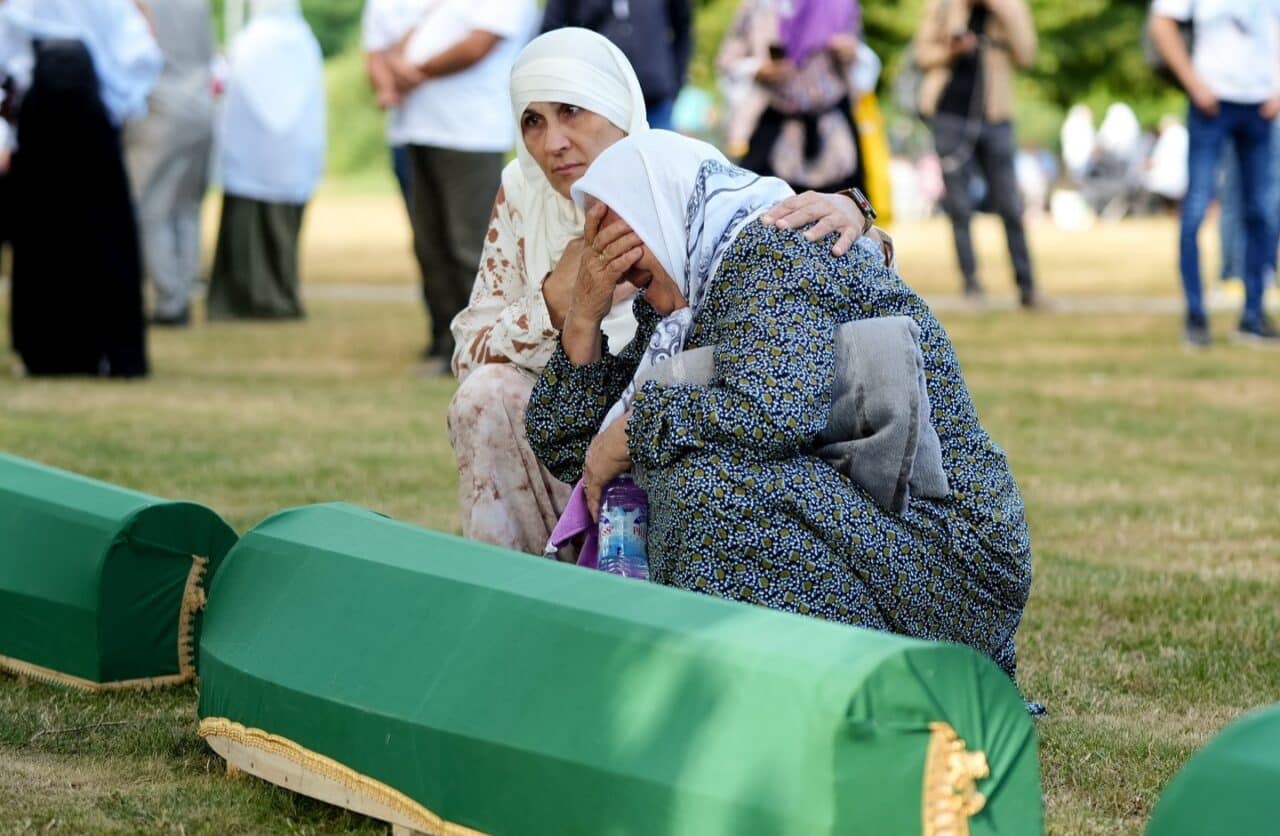
More than flags Flags of the Republic of Bosnia and Herzegovina, the current national flag of Bosnia and Herzegovina, and the flag of the wartime Army of the Republic of Bosnia and Herzegovina fly in front of the Kovači Martyrs’ Cemetery in Sarajevo. Photo: Hamdi Firat Buyuk/BIRN Bosnia and Herzegovina’s historic qualification for the 2026 World Cup briefly united a deeply divided country. But beneath the celebrations, old disputes over identity and memory continue to shape political life. In her opinion piece, Kristina Ljevak Bajramovic says that a proposed law in the Serb-led Republika Srpska entity, criminalising the display of the wartime Bosnian Army flag, is about far more than symbols. She argues that it reflects a broader struggle over who gets to define Bosnia and Herzegovina’s history, warning that attempts to police historical memory risk deepening already deep divisions. Read more: When a Flag Becomes a Crime in Bosnia (July 14, 2026) Coup legacy People shout slogans holding Turkish flags during a rally for the second anniversary of the failed coup attempt on Bosphorus Bridge in Istanbul, Turkey, 15 July 2018. Photo: EPA/ERDEM SAHIN Ten years after Turkey’s failed coup attempt, the legacy of the ensuing state of emergency continues to shape its politics and justice system. What began as a crackdown on alleged coup plotters has evolved into a broader debate over accountability, human rights and the rule of law. The widespread purges and emergency measures enacted after 2016 remain an unresolved challenge for Turkish democracy, argues Human rights lawyer Emre Turkut in this opinion piece. While international courts have documented systemic rights violations, he suggests that meaningful reconciliation will require political will, legal reform and a broader effort to confront the legacy of the post-coup years. Read more: A Decade Since Turkey’s Failed Coup: Confronting the Past, Charting a Way Forward (July 15, 2026) Rival narratives Graves prepared for burials at the Srebrenica Memorial Centre before the July 11 mass funeral. Photo: BIRN. Thirty-one years after the Srebrenica genocide, the facts established by international courts remain unchanged – but media coverage across the Balkans continues to tell very different stories. The anniversary again exposed how competing narratives shape public understanding of the past. While media in Bosnia’s Bosniak and Croat dominated Federation entity, Croatia and Montenegro focused on remembrance and victims, many outlets in Bosnia’s Serb-dominated entity Republika Srpska and in Serbia avoided the term “genocide” or promoted alternative interpretations. Analysts warn that such contrasting coverage reinforces political divisions and leaves new generations with fundamentally different perceptions of one of the world’s worst atrocities in modern history. Read more: Media Coverage of Srebrenica Anniversary Reflects Balkans’ Divided Societies (July 14, 2026) Culture of impunity North Macedonia’s former prime minister, Nikola Gruevski, leaves the office of the Special Prosecution in Skopje, November 2017. Photo: EPA/GEORGI LICOVSKI. Nearly a decade after North Macedonia’s former Special Prosecution Office launched landmark corruption cases against senior political figures, one of its most significant prosecutions has ended not with accountability but acquittal. The outcome has reignited concerns about whether the country’s justice system is capable of tackling high-level political corruption. The acquittal of former Prime Minister Nikola Gruevski in the “Talir 2” case has been widely seen as a symbol of a broader culture of impunity. Critics argue that years of procedural delays and controversial changes to the criminal code have undermined one of the country’s most important anti-corruption cases, reinforcing fears that abuses of political power are unlikely to face meaningful consequences. Read more: Justice Denied? Corruption Acquittal Symbolises North Macedonia’s Culture of Impunity (July 16, 2026) Nature vs development Protestors chant slogans in the area planned for the coastal resort project linked to Jared Kushner, son-in-law of US President Donald Trump near Vlora, Albania, 06 June 2026. Photo: EPA/MALTON DIBRA As Albania’s EU accession talks advance, Brussels is putting pressure on Tirana to align its environmental legislation with European standards. What was once largely a domestic dispute over coastal development now has implications for the country’s membership ambitions. This week, Enlargement Commissioner Marta Kos urged Prime Minister Edi Rama to repeal controversial laws enabling large-scale tourism projects in protected areas. But while Rama promised legislative changes, he insisted the disputed Zvernec resort project would continue. Meanwhile, the ruling majority has blocked opposition efforts to repeal the laws, raising doubts over whether the government’s promises will translate into action. Read more: EU Pressure Mounts Over Albania’s Environment Laws, But MPs Block Repeal Efforts (July 17, 2026) Search for compromise Leader of the Vetevendosje party Albin Kurti attends a session for electing a new speaker of parliament in Pristina, December 2019. Photo: EPA/VALDRIN XHEMAJ. After three elections in little more than a year, Kosovo’s political leaders are under pressure to avoid yet another trip to the polls. While no major party emerged fully satisfied from last month’s vote, that shared disappointment may create an opening for compromise. Caretaker Prime Minister Albin Kurti has begun talks with opposition leaders in the hope of securing parliamentary support to elect the country’s next president. But divisions within opposition ranks and continued resistance from other rivals leave the outcome uncertain. Analysts warn that failure to strike a deal could plunge Kosovo into another political crisis. Read more: Vote Weary: Can Fear of Another Election Conjure Compromise in Kosovo? (July 14, 2026)
Week in Review: Hostages to the Past
Full Article
Original Source
Read the full article at Balkaninsight →KhanList aggregates and links to publicly available news content. We do not host full articles from third-party sources. Always verify important information with original sources.