
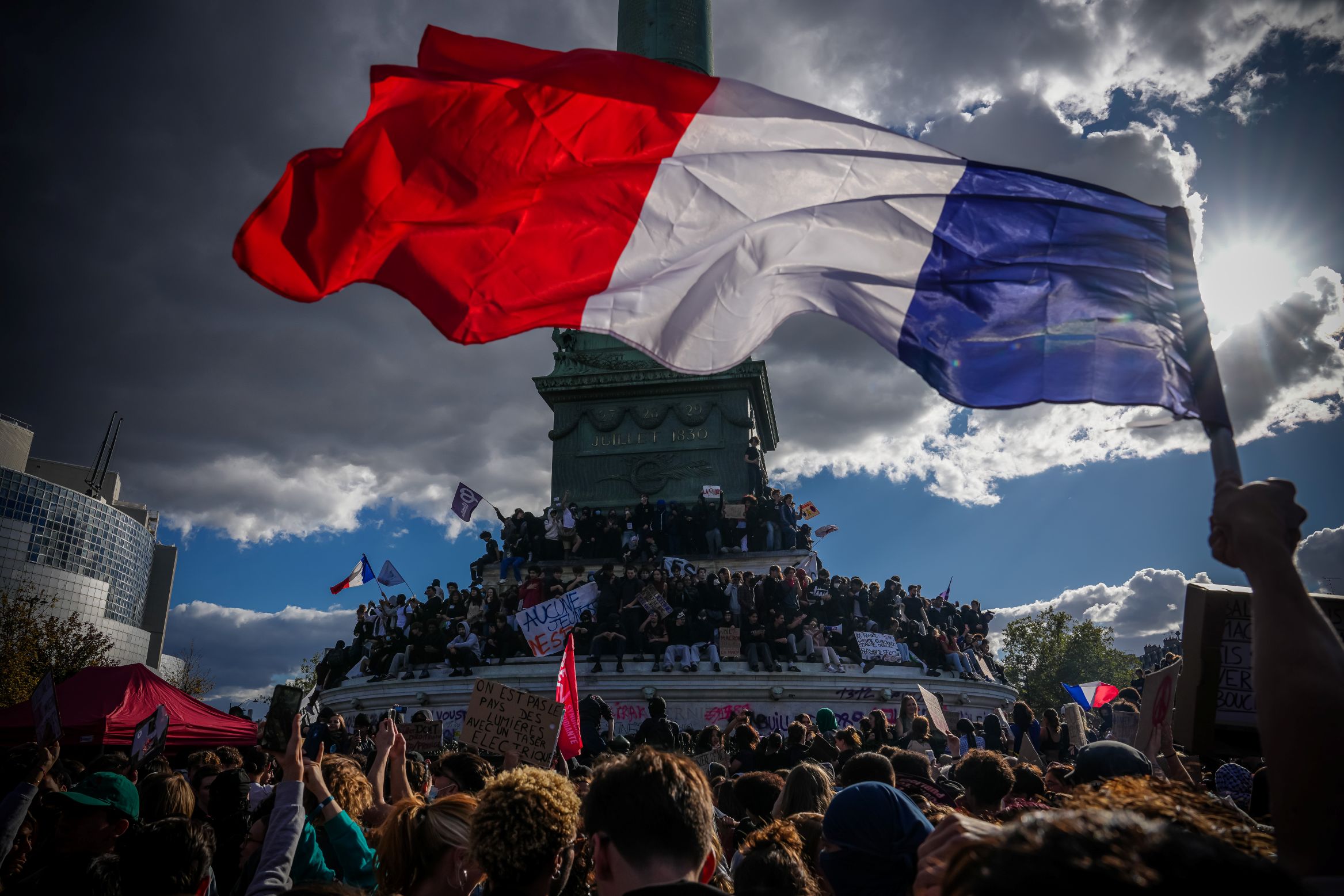
Nationwide protests over education, purchasing power and energy prices are gaining momentum as the debt-ridden government faces painful choices for the 2027 budget.PARIS (CN) — Lawmakers in France’s National Assembly — its lower chamber of Parliament — are at an impasse over a tricky 2027 budget as social unrest roils the streets.On Tuesday, Parliament postponed a critical revenue budget vote for the second time while thousands of high schoolers blockaded schools and marched through Paris and other cities to demand improvements to education.“What strikes observers is that today all the media are focused on the movements, the riots, the looting, the strikes, the blockades at universities while our representatives are voting on the budget,” François Facchini, economist and professor at the Université Paris 1 Panthéon-Sorbonne, said. “In October, the National Assembly rejected the Social Security financing bill, so this is no small matter; it’s very important, it means that pensions, healthcare, family benefits were cast aside.”While debates are stalling with two weeks before a budget deadline, the social movement is gaining force. On Thursday, students will join a nationwide general strike — a wider expression of discontent about the cost of living, workers’ rights, fuel prices and more that is projected to have the biggest turnout the country has seen in years.But the demand for social reforms is colliding with a debt crisis that the government is struggling to control. Experts describe a double bind.“Politically, you find yourself confronted with a lot of social expectations — purchasing power, investment in education, the energy transition, pensions, healthcare, you name it,” Mathieu Plane, a deputy director at the French Institute of Economics, known as the IFE, said. “And at the same time, you also have to be fiscally responsible, which means we no longer have the means to fund all of this, so [concessions] will have to be made.”Protesters carrying a sign reading "Angry Youth" march during a demonstration against rising living costs in Paris, Saturday, Oct. 24, 2026. (AP Photo/Thibault Camus)The French government has been under increasing pressure to get its finances under control. Data released by the Ministry of Public Action and Accounts show the budget deficit at roughly $180 billion in September, equivalent to over 5% of the country’s GDP and well-above the EU’s reference of 3%.Public debt stands at roughly 119.3% of GDP, and is expected to grow to a record 121.7% in 2027, according to the Finance Ministry in September’s draft budget bill.Economic growth has lagged this year, falling behind the European average.Charlotte de Montpellier, a senior economist responsible for the French economic forecast at the ING think tank, explained how the numbers could have contributed to the current social climate.“The underlying issue of all of this is the lack of growth, right? Because if you have no growth, you don’t have purchasing power gains, you have public finances that are very tricky,” she said. “And specifically for schools and public services, you have all the money going into the retirement system and no money left for the current organization of the schools and the public services in general.”But there is also a feedback loop.“The sentiment, the protests and so on are also weakening growth,” de Montpellier said. “Because if people are very pessimistic, they consume less, they invest less, and this is one additional factor that is weakening growth going ahead.”A sign reading "Strikes Blockades", flags with flares are displayed during the yellow vests 56th round demonstration in Paris, Saturday, Dec. 7, 2019. A few thousand yellow vest protesters marched Saturday from the Finance Ministry building on the Seine River through southeast Paris, pushing their year-old demands for economic justice and adding the retirement reform to their list of grievances. (AP Photo/Francois Mori)When French President Emmanuel Macron took office nearly 10 years ago, the country’s finances were relatively steady. But multiple crises triggered quick solutions that outweighed the risks of long-term consequences.“When things started to go off the rails — at least that’s my analysis — was with the Yellow Vest crisis,” Plane said.After months of nationwide protests in 2018, Macron made roughly $19 billion in tax concessions.“The way to finish the conflict was to buy social peace with more spending from the government and excluding the [tax increases] that were supposed to happen,” de Montpellier said. “So that was the starting point of the difficulties.”Covid was the second turning point. Plane described a “whatever it takes” approach toward an unprecedented health crisis, where certain taxes were scrapped and billions were poured into hospitals.“They’re not bad measures, whether for the middle class and purchasing power, for businesses and their competitiveness, or for healthcare; they’re actually pretty good measures,” Plane said. “Except that at no point, since we were in a time of crisis, did the government stop and think that maybe for these tens of billions, we need to find funding to offset them.”But France’s parliamentary makeup is not conducive to budget negotiations. After Macron called snap legislative elections in 2024, the National Assembly was roughly split into three blocs with no majority. Red lines tend to override compromise.“For some, it’s going to be ‘Don’t touch corporate taxes’ or ‘Don’t tax the rich.’ For others, it means “Don’t touch social spending, so don’t touch retirees.’ For others, it’s the environment,” Plane said. “It’s not impossible today that France could find itself without a budget again at the end of the year, meaning it would be forced to pass special legislation.”Parliament has until Nov. 17 to vote on the draft budget; if it’s still delayed, the drafts will pass directly to the Senate for review.Subscribe to our free newslettersOur weekly newsletter Closing Arguments offers the latest about ongoing trials, major litigation and rulings in courthouses around the U.S. and the world, while the monthly Under the Lights dishes the legal dirt from Hollywood, sports, Big Tech and the arts.Additional Reads
Wedged between social unrest and budget crisis, France puts off tough decisions
Full Article
Original Source
Read the full article at Courthousenews →KhanList aggregates and links to publicly available news content. We do not host full articles from third-party sources. Always verify important information with original sources.