
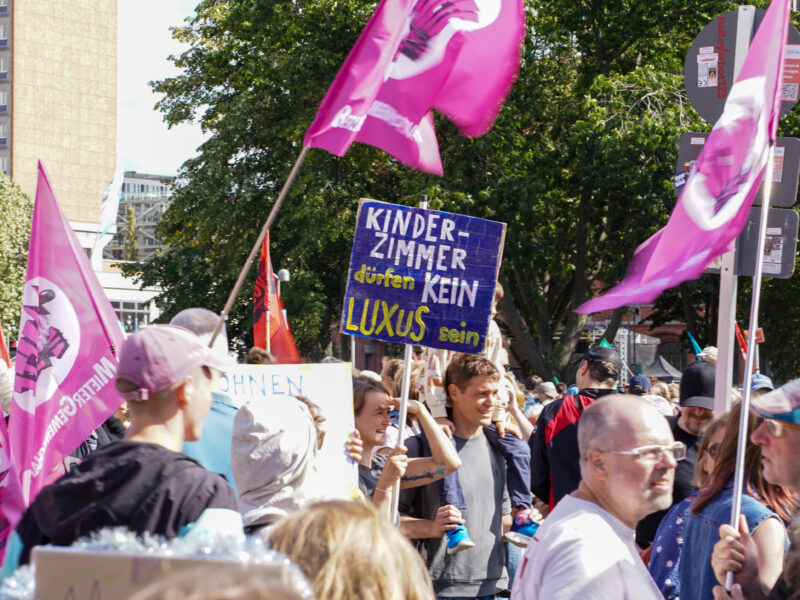
BERLIN (CN) — The housing crisis is all-consuming for Berliners: From university cafeterias to corporate breakrooms, astute eavesdroppers will pick up complaints about rising prices, the crushing slog of landing new apartments, and daydreams of where — and with whom — you live not being dictated by a screaming-hot market.Now, the crisis isn’t just on much of the city’s lips — it occupies prime real estate on campaign posters of parties from across the spectrum headed into state elections Sunday. Housing tops polls as the most important issue in the German capital.“What’s happened with rental costs in this city is sick, it can’t continue,” Simone, a 62-year-old nurse, told Courthouse News.Even those not directly affected hope for a shift.“I actually own my apartment, but the exploding rental costs have changed the city so much, and put so many people under acute pressure, that it’s still my number one issue,” said 54-year-old Christoph.Berlin was long one of the most affordable Western European cities. Those days are long gone.“When I first got to Berlin 17 years ago, my rent was 240 euros. Now you can’t find anything close to that, and you’d be paying two, or more likely three times as much for a similar place,” Mathias, a teacher in his 30s, told Courthouse News.Plans to rein in housing costs are central to a tightly contested election to decide the state parliament, which chooses the mayor. They could be even more important to coalition building once ballots are counted. Disputes around implementing a 2021 referendum on expropriating ‘megalandlords’ could prove particularly sticky.Runaway rentsThe divided city’s unique Cold War history meant it had an abundance of cheap, sometimes entirely empty, housing after the fall of the Berlin Wall. The decades since have put pressure on the rental market.“I was born and raised in East Berlin and can remember the prices before the Wall fell. There’s just no comparing it,” said Simone. “So much was privatized, and now we’re all footing the bill.”Protesters dressed as houses gather at a demonstration against high rental costs in Berlin, Germany. (Dave Braneck/Courthouse News)Affordability — both for housing and spaces for creative projects, as well as a generally low cost of living — made Berlin a magnet for growth that quickly filled the housing stock and outpaced building. While the population has grown by roughly 500,000 since 2010, only 159,000 apartments were built in the same period.Meanwhile, the cash-strapped city sold more than 200,000 units of public housing in the ’90s and 2000s, just before Berlin’s global popularity kicked in and prices exploded. Rents have risen nearly 70% in the last decade, faster than anywhere else in the country. This is a nearly universal issue in a city where 84% of the population rents.“It’s really tough as a student. It’s hard to find anything for under 500 euros ($575), and even that is considered decent,” Markus, a 22-year-old studying social work, told Courthouse News. He notes Germany’s federal financial assistance for students estimates monthly costs at around 900 euros, meaning many have little left over after paying rent.Protesters wield a banner reading "Nationalize Vonovia & Co., Affordable Housing for All!" at a protest against high housing costs in Berlin, Germany. (Dave Braneck/Courthouse News)Berlin rental contracts are often long-term and rarely increase — a boon to renters that also makes moving out, downsizing or changing neighborhoods prohibitively expensive. New rentals cost roughly twice as much as existing contracts.For those who have to move, low supply means even overpriced new units are gobbled up quickly, and apartment viewings with lines stretching around the block are common.“I get a notification whenever somewhere is listed in the city and you have at most 60 minutes to respond and hope you can get through,” said Alex, who just began apartment hunting in Berlin’s highly-sought-after Neukölln neighborhood. “I’ve sent about 60 requests in two weeks and have gotten two responses.”Radical responses scupperedWhile everyone acknowledges the crisis, Berlin has struggled to find a solution. A 2020 city-wide rent cap was overturned in 2021 by the federal constitutional court, which said the state-level legislation was unconstitutional because it trumped existing federal laws. Landlords were allowed to charge back rent from furious renters.That year, 59% of the city voted in a nonbinding referendum to expropriate private landlords with more than 3,000 units and incorporate them into public housing stock. This would account for more than 200,000 apartments. The law’s constitutionality is still under debate, but two successive Berlin governments have dragged their feet in implementing it anyway.Dietmar Bartsch and Elif Eralp, politicians from The Left party, are taking part in the “Silberlocken für Elif” rally at Victor-Klemperer-Platz as part of the campaign leading up to the Berlin House of Representatives election, on Sept. 15, 2026. (Jens Kalaene/ dpa Picture-Alliance via AFP)With housing at the center of attention and a surging Left Party hoping to lead the city’s government for the first time, the five-year-old referendum has reentered the limelight. Left Party candidate Elif Eralp is a hair ahead in polling at 21% and has committed to enforcing the referendum. This has contributed to support for the party among struggling renters.“The Left Party are the only ones I believe would actually go through with it,” said Christoph. Even if they top the polls, it won’t be up to them alone.The center-right Christian Democrats and far-right Alternative for Germany, polling at 20% and 18%, respectively, reject the referendum. Current Mayor Kai Wegner of the Christian Democrats is not running for reelection.For Eralp to become mayor, she’d likely have to form a coalition with the Greens, who support expropriation, and the Social Democrats, who oppose it.This will prove tricky. The Social Democrats could have led a progressive coalition with the Greens and the Left after the last election but opted to serve as junior partners to the Christian Democrats, in part over disagreements about Berlin’s housing issues. A wide-open electoral slate makes for plentiful possibilities for coalitions. That, and the ensuing bargaining power of potential kingmakers like the Social Democrats, means debates will continue long after voting booths close.“Something has to happen to ease the pressure of housing prices. I am for expropriation — I honestly don’t really expect any of the parties to just go out and do it on their own, we’ll need lots of protest to put pressure on whoever wins to ensure they finally do something about this,” said Mathias.Courthouse News reporter Dave Braneck is based in Germany.Subscribe to our free newslettersOur weekly newsletter Closing Arguments offers the latest about ongoing trials, major litigation and rulings in courthouses around the U.S. and the world, while the monthly Under the Lights dishes the legal dirt from Hollywood, sports, Big Tech and the arts.Additional Reads
Weary Berliners head to polls seeking balm for crisis-hit housing market
Full Article
Original Source
Read the full article at Courthousenews →KhanList aggregates and links to publicly available news content. We do not host full articles from third-party sources. Always verify important information with original sources.