
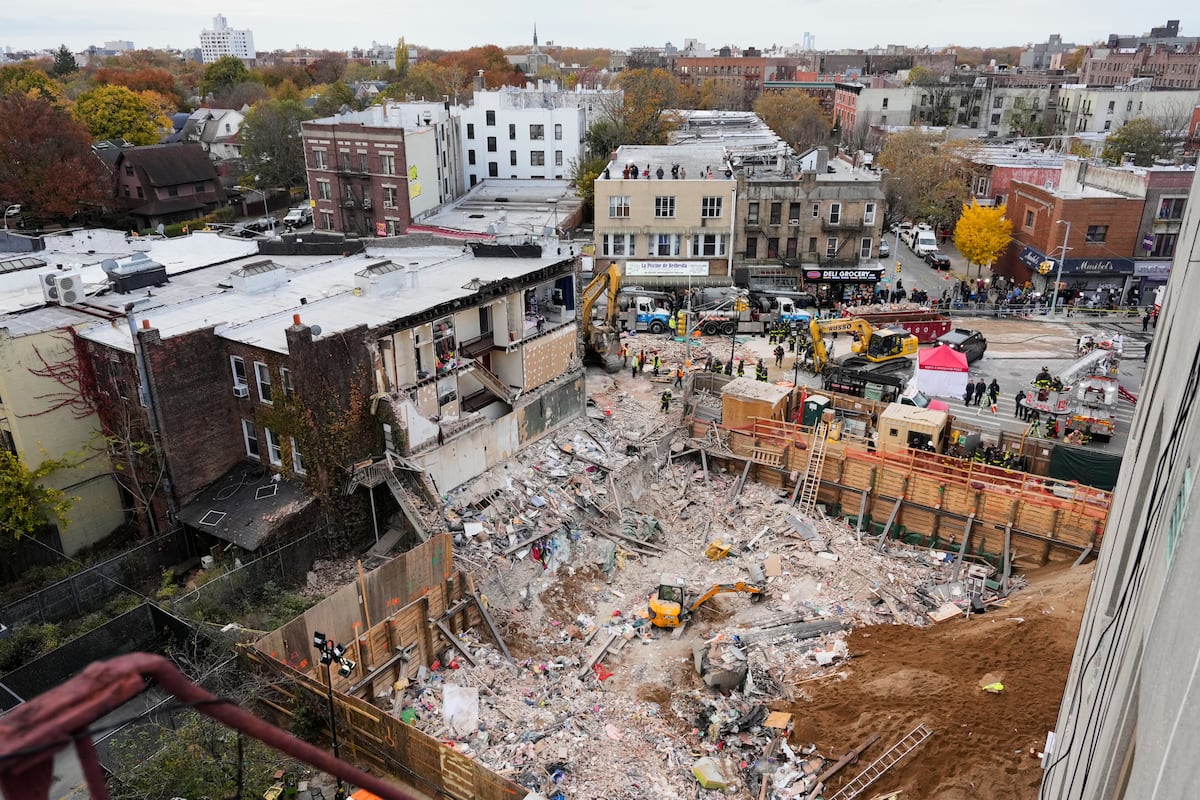
Walter Sinche looks a little agitated as he arrives at the intersection of Bedford and Flatbush avenues. He is wearing a plaid shirt and a red poncho that shields him from the heavy downpour hitting Brooklyn on Thursday at noon. José Luis Caguana, 26, an Ecuadorian man like him, was one of his students in training courses at OSHA—the federal agency that oversees occupational safety and health standards—and is now one of the identified victims after the collapse on Wednesday of a residential building in the heart of Brooklyn.The incident has placed the spotlight on construction practices in the city, and triggered both fear and anger among local residents of this largely immigrant community. Eight people, including two children ages nine and 10, died as a result of the sudden collapse, which took place as excavation work was going on at a construction site next door. Two of the victims were workers at the site, including Sinche’s former student, the 26-year-old José Luis Caguana Cosquillo. Another 18 people sustained injuries, and one is in critical condition. Affected individuals include immigrants from Mexico, Colombia, Ecuador and Trinidad, said Mayor Zohran Mamdani, speaking at the site of the accident. The Colombian consulate in New York on Thursday confirmed that the two minors were Colombian nationals, as was one of the deceased adults. Another Colombian woman is on the list of injured victims, officials added.By the time Sinche reached the scene, the mayor had already arrived at the scene and begun his briefing to a group of reporters. Sinche wanted to confront the mayor about his responsibility in the death of one of their own. “I wanted to tell him to do his job better,” he says, visibly upset. “We are the ones who put our bodies on the line. We work day after day like slaves in this country and they don’t give us safety.” But Sinche could not reach Mamdani. A police officer blocked his path and would not let him advance to where the mayor stood surrounded by reporters from the city’s major outlets.Caguana had arrived in the United States from Ambato, in Tungurahua province, Ecuador, about six years earlier. His wife, with whom he had a four-year-old son, is about to give birth. The child’s teachers at the Bushwick United Headstart center described Caguana as a “loving and devoted” father. “His love for his children was evident,” they said in a GoFundMe campaign to raise funds for the family.Two years earlier, Caguana took a class with Sinche to start working in construction. Among everything Sinche teaches his students, there is one thing he insists on: “Demand safety,” he tells them. “And if they don’t give you safety, don’t work.”But Wednesday’s accident goes beyond an individual worker’s responsibility, says the OSHA inspector. Building 1321 on Flatbush Avenue collapsed into a hole created by nearby construction and caused a side wall of the adjacent property to fall. That, Sinche says, is a responsibility that exceeds construction workers. “It’s not just that they didn’t give you a hard hat or gloves,” he says. “Whether a building collapses no longer depends on the worker, but on the authorities that oversee this kind of work. Therefore it is the responsibility of the Department of Buildings, the company owners and the supervisors. They are responsible; they should be jailed.”On Thursday the entire area was filled with dozens of local residents stunned by an incident whose causes are still under investigation. The questions are piling up as time passes and new lines of inquiry open for the city: did the excavation weaken the building’s foundations or walls? Which company was responsible for the work? Had any warnings been issued that something like this could happen?“Our lives are not cheap”Flatbush residents’ anger was evident. Kamela Payne lives in the area and, if she had to sum up what has happened, she would put it this way: “I think our city has been sold, honestly,” she says. She believes the Department of Buildings, which is supposed to oversee this kind of construction, is not doing an appropriate job.“I think some of these developers are putting economic pressure on some of these people and organizations,” Payne says. “Our lives are not cheap, and I consider this an act of criminality. These people didn’t stand a chance. They didn’t know they would wake up in the morning and have their entire building come down on them. That says a lot about New York City. A family can wake up and end up underground. This is not a developing country.”“We have to investigate the Department of Buildings and make sure the people who must assume responsibility are held accountable,” adds Payne, who has lived in the neighborhood for more than three decades. “These people excavated under the foundations and caused other people’s deaths. That is a crime. This is not simply a mistake.”A friend accompanying Payne is convinced that what is happening in this area and in much of New York is related to the displacement of Black residents. Two brand-new buildings stand near the collapsed structure. “They’re building apartments that we can’t afford, what they call affordable housing. It’s not affordable if a two-bedroom apartment costs $3,000 a month,” the woman says.“It’s very sad, doubly so now that the Christmas holidays are approaching,” says Eneroliza Pérez, a Dominican woman who says the tragedy has dealt a blow to a community also known as Little Caribbean, where many Dominicans and Haitians live. Her family runs the deli directly across from the collapsed building, opposite where a crowd of people remains gathered, still stunned by such a tragedy in the heart of Brooklyn.Sign up for our weekly newsletter to get more English-language news coverage from EL PAÍS USA Edition
‘We work like slaves in this country and they don’t give us safety’: anger and grief after Brooklyn building collapse
Full Article
Original Source
Read the full article at English →KhanList aggregates and links to publicly available news content. We do not host full articles from third-party sources. Always verify important information with original sources.