
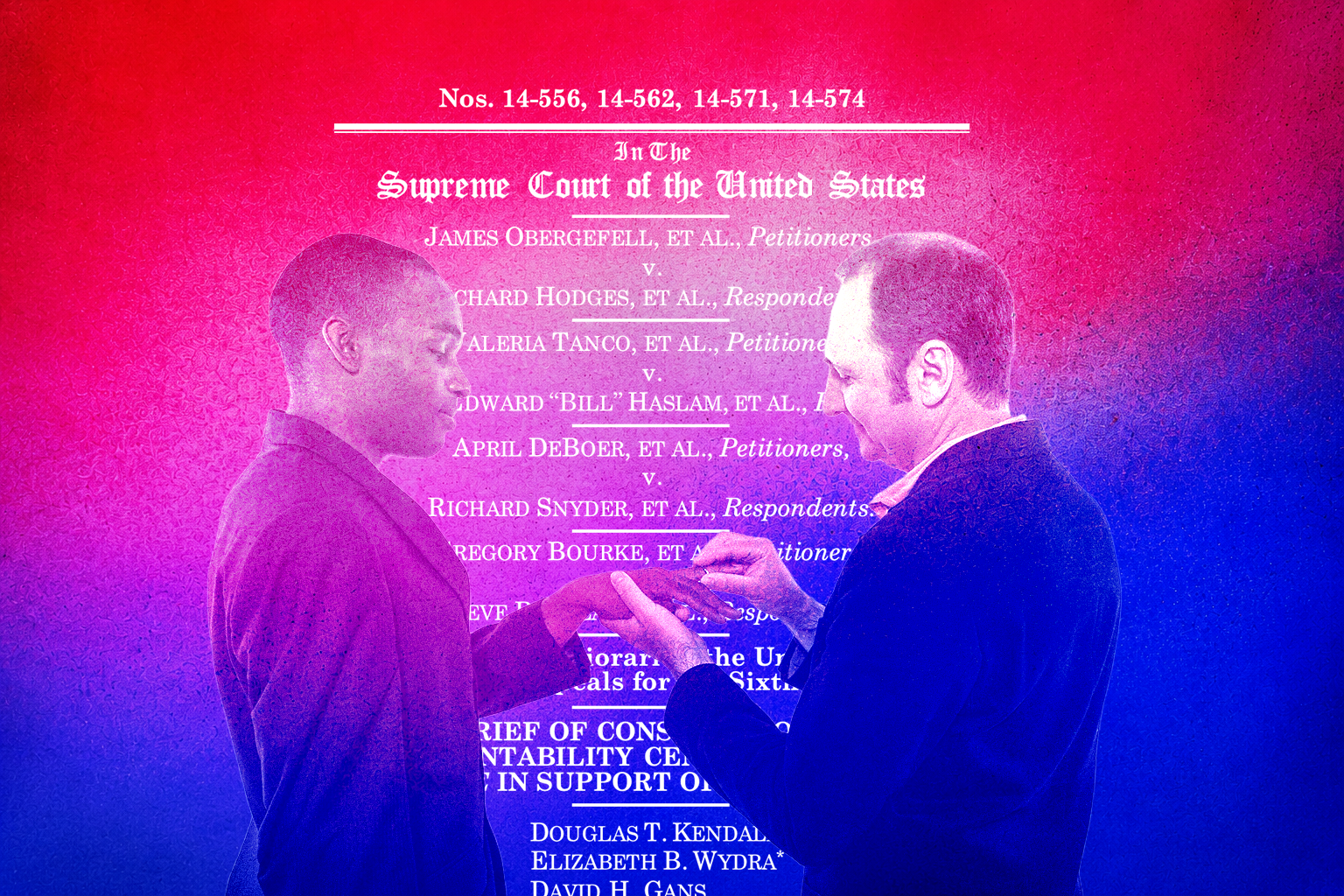
Jurisprudence It was hard-won. Photo illustration by Slate. Photo by innovatedcaptures/Getty Images Plus. This is part of Amicus and Slate’s “By the People” series, which explores how the American people can reclaim the Constitution—and the law—from this monarchical Supreme Court. In his 2016 book Engines of Liberty, David Cole explores the question of how constitutional change happens. A professor at Georgetown Law and former ACLU national legal director, Cole gives a nod to the traditional answers to that question: Supreme Court interpretation and judicial review, federalism, the interplay of the three branches of government, the media’s Fourth Estate impact, etc. But his book focuses on the vital role We the People—specifically civil society groups and activism—play in the work of making a more perfect Union. I am, as it happens, one of the main characters in the book. Cole tells the story of the Freedom to Marry campaign that I led and our success in winning marriage for same-sex couples as an example of “the power of citizen activists to make constitutional law.” In at least two ways, that campaign offers lessons and a path forward for the most urgent task upon us all at this time: the defense and reinvigoration of American liberal democracy. The first big lesson: We didn’t take the Supreme Court’s no for a final answer. When same-sex couples first began seeking the freedom to marry in earnest, at the dawn of the modern gay rights movement at Stonewall in 1969, the resounding response from pretty much every institution, every quarter of society, almost everybody (gay and nongay), was no. That hostility from politicians, churches, medicine, and public opinion found its echo in dismissal by the courts. Couples in that first wave of litigation across the country met with rejection in every court they turned to. One pioneering case, Baker v. Nelson, even reached the Supreme Court in 1972. A Minnesota librarian, James Michael McConnell, had sought to marry a law student, Richard John Baker, and had been rejected for a marriage license. Like any good law student, Baker threw in the kitchen sink, thereby prefiguring the arguments that would eventually prevail decades later, most importantly that the denial of a marriage license to same-sex couples violated the fundamental right to marry and the right to equal protection under the 14th Amendment. When the case reached 1 First St., the court again rubber-stamped discrimination. Indeed, the justices didn’t even bother to write an opinion, issuing instead a one-sentence order: “The appeal is dismissed for want of a substantial federal question.” In other words, nothing to see here. That sentence hung over the head of every gay person, every loving same-sex couple, for the next several decades. But we didn’t take the Supreme Court’s (or even society’s) no for an answer—not even when the court compounded that injustice in its infamous 1986 Bowers v. Hardwick ruling, repudiating even gay people’s claim to intimacy and consensual sex in our own homes. Tenaciously, repeatedly, strategically, over decades, we engaged the people, politicians, opinion leaders, influencers, state legislatures, courts, and, ultimately, again, the Supreme Court to get the constitutional answer right, to fulfill the promise of the Constitution and America. We made ourselves seen and heard, mounting a sustained, affirmative campaign in the states, in the legislatures, and in the courts of law alongside, most crucially, the court of public opinion. We worked in multiple arenas: national, federal, state, local, community, familial, and personal. We did so respectful of judicial independence and the crucial, sometimes countermajoritarian role the courts play—but mindful, too, of Abraham Lincoln’s instruction that “the people of these United States are the rightful masters of both Congresses and Courts.” Ultimately, over time, we went from unanimous rejection in the courts to a difficult, painful, and scary stretch of losing forward to, toward the end, a hard-earned cascade of judicial, legislative, and (eventually) electoral wins, setting the stage for our triumph in 2015 in Obergefell v. Hodges. We transformed the Supreme Court’s “Nothing to see here” into an avowal of the freedom to marry under the Constitution’s double helix of liberty and equality for all. The second big lesson the Freedom to Marry movement had to offer any new effort at popular constitutionalism was this: While our strategy built toward a nationwide victory in the Supreme Court, we worked for a transformation around and beyond the court. As the court’s majority acknowledged in Obergefell, its eventual, corrective ruling in favor of the freedom to marry came only after extensive “democratic discourse”: There have been referenda, legislative debates, and grassroots campaigns, as well as countless studies, papers, books, and other popular and scholarly writings. There has been extensive litigation in state and federal courts. Judicial opinions addressing the issue have been informed by the contentions of parties and counsel, which, in turn, reflect the more general, societal discussion of same-sex marriage and its meaning that has occurred over the past decades. Put another way, we achieved transformation and secured our equal constitutional rights not through largesse from or legal invention by the Supreme Court but rather as the culmination of our own sustained activism and persuasion of a critical mass of our fellow citizens. Indeed, my mantra through much of the decadeslong campaign had been—to borrow a phrase that at least one ardent activist actually tattooed on her arm—“There is no marriage without engagement.” In all of the lower-court decisions that we eventually began winning as we built toward the Supreme Court, my favorite sentence came in a 2013 case in ruby-red Utah. Explaining his favorable ruling, Judge Robert Shelby wrote, “It is not the Constitution that has changed, but the knowledge of what it means to be gay or lesbian.” That sentence perfectly encapsulated Freedom to Marry’s “road map to victory” strategy, which had aimed at changing hearts and minds in order to deliver the change in law and politics needed. Rather than confine ourselves to legal doctrine or litigation, we had created the climate for success by deploying all of what Martin Luther King Jr. called the methodologies of social change: litigation, legislation, public education, storytelling, organizing, political and electoral engagement, a civil society, and what I think of as the chief engine of change—conversation. A recent Substack analysis by Evan J. Segal highlights the Freedom to Marry campaign as “one of the clearest modern examples of how movements win when they combine constitutional principle with emotional intelligence, disciplined strategy, and the patience to build durable public consent.” His piece superbly distills from our campaign many key lessons, including this recipe for change: Freedom to Marry helped shift public opinion by elevating real couples and families, training allies to speak from shared values like love, commitment, and fairness, and making sure every legal victory was followed by a wave of public education—not simply a press release. In doing so, [it] showed that a rights campaign can also be a hearts-and-minds campaign, and that when those two are deliberately braided together, the result is not only a legal win, but a deeper recalibration of what the country understands as possible and just. Persuasive, successful activism “does not remain abstract; it comes home with you, sits at the table, and rewrites what is possible for kitchens, friendships, and futures. It dignifies love not in theory, but in lived life—and it leaves you looking at a wedding photograph and understanding that you are also looking at a piece of American constitutional history.” Like Cole, Segal emphasizes that “rights are not gifts from judges, but guarantees rooted in constitutional democracy and human dignity.” By “building a framework that link[s] litigation, public education, coalition-building, and electoral strategy into one coordinated campaign for legitimacy and equality,” we, individually and collectively, can overcome even a captured court, disinformation, and dysfunctional politics. It is important to remember that activism and those methodologies of change can drive our country and Constitution in discordant directions (just as Supreme Court justices can). Indeed, a different section of Engines of Liberty relates how the National Rifle Association and its ilk deployed many of the same tools we used to impose their own very different, destructive vision on the selection of judges, the Constitution, and the law. I had no quarrel with Cole recounting that lamentable story alongside mine, but we did have one occasional difference of emphasis. Cole typically spoke of the “power of citizen activists to make constitutional law,” whereas I usually framed our campaign as working to fulfill the Constitution’s promise (rather than change it). I tend to think now that we’re both right. I generally prefer, as a strategic matter, an elevation of shared values—inclusive, connective, moral language such as reclaiming, rather than reinventing or discarding. I am loath to disclaim the power that comes with symbols such as the flag, words such as freedom, and the attachments that adhere to foundational inheritances such as, yes, the Constitution. In the words of South African freedom activist Steve Biko, “If you want to say something radical, you should dress conservatively.” Decades ago, making the case for the freedom to marry as, authentically, a goal and also a strategy, I put it this way: The brilliance of our movement’s taking on marriage is that marriage is, at once and truly, both conservative and transformative, easily understood in basic human terms of equality and respect, and liberating in its individual and social potential. We didn’t need to “change” the Constitution, I argued; rather, we needed to build, à la Shelby, more “knowledge,” better understanding, inclusion. As Justice Ruth Bader Ginsburg reminded us in one landmark case, “A prime part of the history of our Constitution … is the story of the extension of constitutional rights and protections to people once ignored or excluded.” But Cole’s framing was also correct; sometimes what is needed is reconstitution, a “new birth of freedom.” Like Justice Thurgood Marshall, neither Cole nor I believes that the “meaning of the Constitution was forever ‘fixed’ at the Philadelphia Convention. [T]he true miracle was not the birth of the Constitution, but its life, a life nurtured through two turbulent centuries of our own making.” We need not be daunted by specious, results-oriented claims of “originalism” or take off the table the kinds of structural reforms that can revitalize democracy and restore a Supreme Court hijacked by political players intent on maximizing their concentrations of wealth and power. As historian Joseph Ellis records of the Framers: “It is richly ironic that one of the few original intentions they all shared was opposition to any judicial doctrine of ‘original intent.’ To be sure, they all wished to be remembered, but they did not want to be embalmed.” As Thomas Jefferson wrote 210 years ago last month: [Laws] and institutions must go hand in hand with the progress of the human mind. [As] new discoveries are made, new truths discovered and manners and opinions change, with the change of circumstances, institutions must advance also to keep pace with the times. We might as well require a man to wear still the coat which fitted him when a boy as a civilized society to remain ever under the regimen of their barbarous ancestors. Miraculous and great as both are and can be, our Constitution was and is no more perfect than is our Union. Decisionmakers—including the Supreme Court and even transient majorities—can get things wrong, until we set them right, or at least make them more perfect. “The ability to imagine a different world is what distinguishes the leaders of any social movement,” Linda Greenhouse once wrote of Ginsburg. And from lesbian, gay, bisexual, and trans rights to women’s rights, from curbing excessive wealth disparities to rescuing our democracy, even from figuring out how to harness A.I. to achieving Middle East peace and beyond, I am a big believer in not being afraid to set a bold goal, then pursue it—strategically. “To focus on federal judges and courtroom lawyers is to miss much of the story—and probably the most important part,” wrote Cole. No matter how stony the road—and especially in dark or fraught times, such as now—it is we who are called to action as engines of liberty, called in this momentous moment to construct and reconstruct the Constitution that lives and through which lives our democracy. We. We the People. And when we strategically engage, share our stories, and take action, American history—including the history we ourselves are living through—tells us that we can meet the moment, we can deliver, we can make a more perfect Union. Get the best of Jurisprudence. Sign up for Slate’s legal newsletter. Jurisprudence Supreme Court Marriage Equality LGBTQ+ By the People
We Won the Greatest Civil Rights Victory of Our Generation. Here Are Some Lessons for the Next One.
Full Article
Original Source
Read the full article at Slate →KhanList aggregates and links to publicly available news content. We do not host full articles from third-party sources. Always verify important information with original sources.