
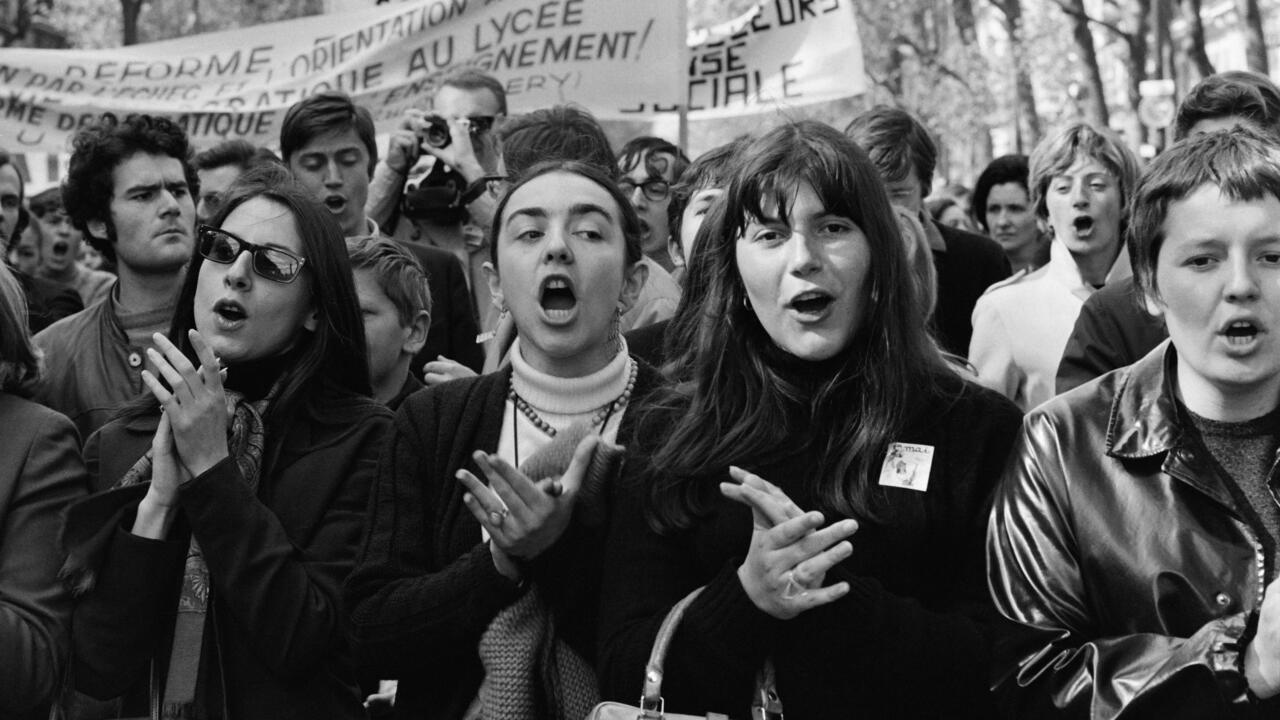
As students across France continue demonstrating against conditions in schools, the movement has drawn inevitable comparisons with the biggest student protests in the country's history – those of May 1968. While this date remains a rallying cry for many young French people, they are calling for change in a world that has altered profoundly in the past 58 years. Maryse Esterle was 16 years old in May 1968, finishing her second year at a girls' high school in Saint-Germain-en-Laye, a wealthy suburb to the west of Paris. She remembers when the student movement that had begun in universities burst into classrooms. "The boys turned up one day in early May. They came as part of a demonstration, there were several hundred of them. They arrived and they forced their way through the doors of the school, which some of the girls had opened. They didn't need to do any damage, they just pushed the gates and came inside. And that's how co-education came about, I'd say." At the time, single-sex schools were still the norm in France. Even at university, male and female students lived in separate dorms and were not allowed to visit each other. Sex education was non-existent, abortion was illegal and it had only been three years since women gained the legal right to work or open a bank account without their husband's permission. Esterle's parents both taught at the boys' school down the road. But while her father was hired as a permanent member of staff from the start, her mother remained on temporary contracts until she retired. "As I recall, the most important thing at the time was to put an end to this separation between boys and girls," Esterle says. "And to finally be able to live in a real society – a mixed society, like the one we live in now, where we interact between men and women, boys and girls, and so on. Something we were forbidden to do back then." Listen to a version of this story on the Spotlight on France podcast Spotlight on France, episode 152 © RFI A hopeful generation To be young in France in 1968 was to be caught between two worlds. Boris Gobille, a political scientist at the ENS Lyon university, who specialises in the period, explains: "On the one hand you had an irrepressible desire for emancipation, but on the other you were living in a society that was still very, very constrained." By this time, Charles de Gaulle had been president for almost 10 years. France was still governed by the generations who had lived through the Second World War, yet the number of people born after it had exploded: the country had 9.4 million 13 to 24-year-olds in 1968, compared to 6.3 million people aged 65 or older. Many of these young people were more educated than their parents – by 1968, there were roughly 2.5 times the number of university students there had been in 1960 – but with the age of majority set at 21, most of them didn't yet have the right to vote. They formed "a generation that was increasingly developing a culture of its own, one that was distinct to it, with its own cultural references, which were sometimes very different from those of their parents", Gobille says. "Be realistic, demand the impossible": one of the emblematic slogans of the protests seen on a bridge in Paris on 3 May, 1968. © GERARD-AIME/Gamma-Rapho via Getty Crucially too, they were growing up in prosperity. France was two decades into the "Trente Glorieuses", the post-war boom that lasted 30 years and saw the French economy grow by an average of 5 percent annually. "Back then, we weren't afraid of the future," Esterle recalls. "There were jobs to be had… We wanted to work better, but it was like we knew we could, or in any case that we'd have work, that there'd be a place for us at university if we wanted to go… Society was much more narrow, but career paths and social prospects were much more open." Economic opportunities fed into a sense that things were getting better, says Gobille. "There was still a sense of progress in the air. It wasn't an idea that had been shelved just yet, even if we shouldn't paint too rosy a picture of the time. There was still a great deal of inequality and exclusion… but it was nonetheless a context that offered far more hope. Today, the outlook offers far less hope." ‘Generational rage’ drives young Europeans to fight to be heard Difference in scale The May '68 protesters were ambitious in their claims. "Be realistic," went one notorious slogan, "demand the impossible." Faced with economic crisis, eroding public services, widening inequalities, a warming planet and the prospect of a far-right victory in next year's presidential election, today's protesters appear to be asking for less – more teachers, better classrooms, lighter timetables. But the students of '68 also started out calling for education reforms, Gobille points out, opposing selective university admissions and top-down teaching methods and demanding less rigid governance and a broader curriculum. These demands continued to feature in the protests even as they expanded to denounce Gaullism, consumer society, capitalism, imperialism and the Vietnam War. Similarly, as the current protests have continued, the slogans have broadened to take aim at social inequality, the war in Gaza, climate change, the far right and increasingly, police violence. This too is a parallel with 1968, when images of police dispersing young protesters with batons helped win sympathy from the broader public. Police disperse protesters by force at the Sorbonne university in Paris, 3 May, 1968. © Bettmann / Getty Images In a decisive development, the workers' movement converged with the students and launched strikes and occupations throughout the public and private sectors. By late May, some 10 million people were taking part – a third of France's workforce and a fifth of the entire population at the time. It remains the biggest general strike in French history to this day, and forced de Gaulle's government to make significant concessions to unions. Today's protests are on a far smaller scale. While trade unions have backed students, the joint strike and marches they called on 5 November drew around 1.5 million people according to organisers, and 575,000 according to authorities. In 1968, Esterle remembers feeling as if everyone was involved. "When I went out on the streets, especially in Paris, I had the impression that everything was changing. People were speaking to each other." Today, she says, that isn't the case. Video: The soundtrack to France’s school protests A rallying cry Young people today no longer represent the same demographic force. From 19 percent of the population of mainland France in 1968, teenagers and young adults have fallen to 14 percent – easily outnumbered by people aged 65 and above, who have gone from 13 to 22 percent. "The age pyramid has been completely reversed," notes Gobille. The youth of 2026 "live in a rapidly ageing society, where pensioners constitute a voting bloc unprecedented in history". France's tradition of organised action has also declined, with fewer people joining student or trade unions or political groups. In their place have arrived new, more diffuse forms of mobilisation, such as calls to action on social media, and with them more disparate messaging and greater potential for opportunism. "You have to bear in mind that for many of these young people, these are their first protests," Gobille says. He's been struck by both the joy they seem to be taking in them and the speed with which they have picked up activism skills. "All this shows that major events of this kind have a considerable power to politicise and introduce an entire young generation to politics, including protest culture." Protesters in the streets during a blockade of Sciences Po university in Paris on 7 October, 2026. © REUTERS - Sarah Meyssonnier He says something in the slogans at today's protests remind him of 1968. They're inventive and irreverent, albeit with a dark vein of humour that feels more Gen Z than Baby Boomer. Some of them draw the parallel directly: "October 2026 is the new May '68" or "Generation 6-7 is redoing May '68". Gobille isn't surprised. Like the French Revolution, references to May '68 regularly turn up at protests in France, cited as an example of a mass social movement successfully forcing change. May '68: a turning point France should remember Protesters in Nantes hang a banner reading "May '68, they're commemorating, we're doing it again" during a nationwide day of protest against the government's economic and social reforms, on 16 November, 2017. LOIC VENANCE / AFP The protesters of 1968 failed to overturn the government, but did transform the country's culture. "It's very inspiring if you yourself want to drive a major transformation in society and, in a sense, take control of your own destiny," Gobille says. Esterle, the May '68 veteran, says her 40-something daughter has often said she wished she could have been around for an era she sees as "exhilarating". "When I talk about it, I really feel as though I'm talking about a world that has disappeared," Esterle says. "And yet young people today – 16, 17, 18, 20-year-olds – they have aspirations. They're not the same as ours because they don't face the same problems, but they do have aspirations too, and that's where I feel close to them."
'We weren't afraid of the future': France's student protests today and in May '68
Full Article
Original Source
Read the full article at Rfi →KhanList aggregates and links to publicly available news content. We do not host full articles from third-party sources. Always verify important information with original sources.