
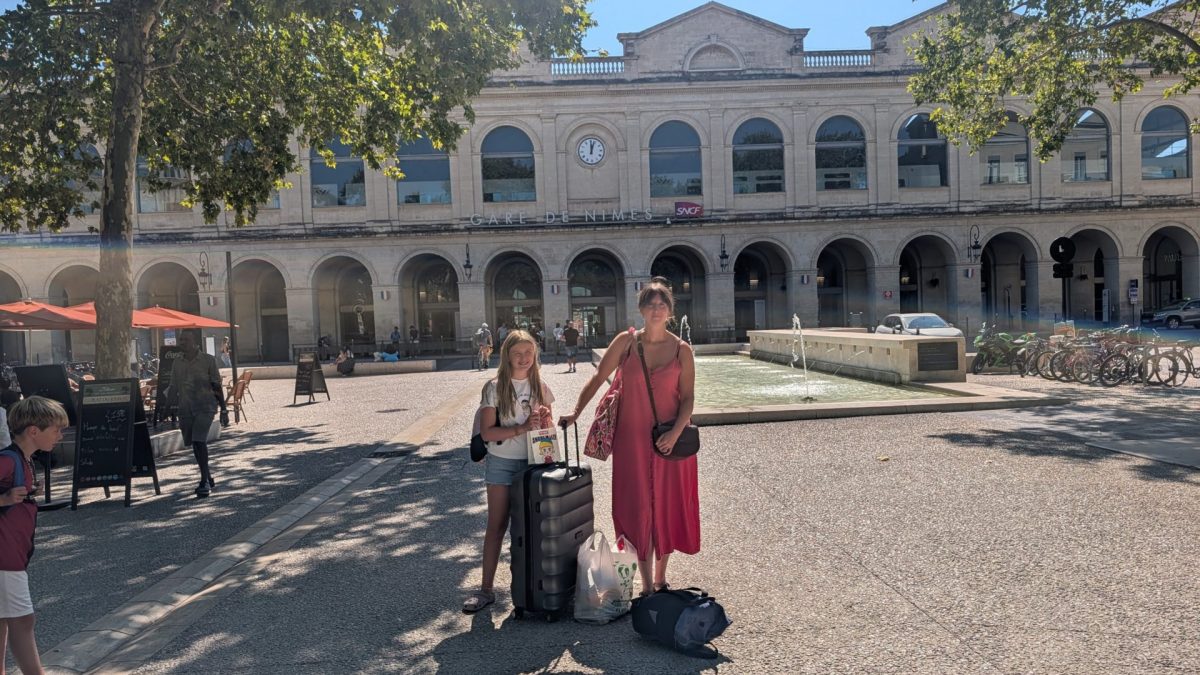
I love airports. The thrill of possibility, the tantalising menu of all the places you could be within a few hours (even if, in reality, it’s Belfast or Brussels). Except when I’m coming home – then, I’d rather be almost anywhere else. So this summer, I decided to change course. Using Interrail passes, I would avoid the deflating denouement of a family holiday by plotting a return journey that we’d all look forward to. The four of us could make our way back to London slowly, stopping along the way and enjoying the transition back to home routines. Shorts We’d flown into Menorca on ludicrously cheap easyJet flights during the strange summer of jet fuel uncertainty and hired a car to reach a farmhouse villa in the middle of the island. Villa Torralba d’en Salort is tucked off a quiet country lane next to a prehistoric settlement of the same name. We came to discover that Menorca is quietly embroidered with dozens of these Bronze and late Iron-Age relics, though with none of the crowds you’d see gawping at Stonehenge – they were nearly always empty. The villa dates to 1860, with a pool and views of nothing but drystone walls, fields, shrubs and a soaring date palm. Occasionally, a couple of peacocks and a sheep would wander curiously into the field below. Villa Torralba d’en Salort is in the middle of Menorca (Photo: Barty/Ian Barr/Vintage Travel) Otherwise, the only other soul we saw there was Vintage Holidays’ rep Tracey Boocock, who came to check in with invaluable recommendations, gathered from three decades of living on the island. Following her advice, we drove 10 minutes to the village of Sant Climent for the annual summer fiesta. The streets were festooned with bunting, and roads were covered with sand as jet black Menorquin horses decorated with rosettes and ribbons were paraded in front of boarded-up shops. Hundreds congregated at makeshift bars and food stalls before the culmination of the “jaleo” – when the horses rear up on hind legs in a kind of macho dance – in the main square. We left as darkness fell, but the party carried on into the night. One of the Menorquin horses at the Sant Climent festival (Photo: Sophie Lam) Our rural base was only around 15 minutes’ drive in either direction from the north and south coasts. So, each day – after a slow start of yoga, reading, a swim and late breakfast – we’d pack the car with towels, parasols and a picnic, then set off for our chosen beach. Tracey had recommended Es Grau in the north-east as a good spot for families. Set on the edge of a protected park of marshes and shallow bays, the seaside village reminded us of Cornwall and was delightfully tranquil on a cloudy day. We watched kayakers glide through the water as we sat outside Cafe Bar Es Moll, and felt stomachs rumble as the scent of frying seafood wafted out from the open windows of L’avi Bernadet tapas bar. On the southwest coast, we failed to reach Cala Macarella. Google Maps indicated we were only 15 minutes away from the aquamarine cove when two men in a roadside cabin sent us in a different direction: “Prohibido el paso de vehiculos!” – no cars allowed in the peak summer months. The tranquil beach at Es Grau (Photo: imageBROKER/Martina Katz/Getty Images) Instead, we carried on until the road ran out, and ended up beside Son Saura, a Caribbean-like sweep of creamy white sand trimmed by turquoise water, tussocky dunes and pine trees. We were not disappointed. Slow afternoons on picturesque beaches trailed into balmy evenings under festoon lights in town squares and a million stars on the terrace of our villa. At the end of the week, there was a feeling of excitement rather than dread as we waited in darkness on the unlit country road for a taxi to arrive at 5am. An hour later, we were boarding a huge Grimaldi ferry to Barcelona. From the top deck, we watched Mahon’s 19th-century fortresses, islands and villa-clustered coves recede in the gentle glow of sunrise, about as magnificent an exit as you could hope to make from a holiday. The air was warm, and passengers around us hushed both in tiredness and awe. Eight hours on board passed surprisingly quickly – the children had their faces painted and splashed in the top deck pool as Bob Marley’s greatest hits blasted from the bar. After lunch, Barcelona came into view, the next stop on our homeward itinerary. The ferry leaving Mahon harbour at dawn (Photo: Sophie Lam) We were staying in El Poblenou, the “new village” in the east of the city once full of textile factories, now reborn with vegan brunch cafes, Middle Eastern restaurants and ornate Modernist apartment buildings. A modern addition is the soaring Hoxton hotel, with a rooftop pool and taqueria. Our family room came with views of the Sagrada Familia’s newly unveiled spires and the Design Museum below. A bonus if you’re Interrailing is that guests can choose their check in and check out times for free – ideal if you’re arriving on an early train or overnight ferry – and if you’re staying in Hoxton hotels in other European cities, there’s a £20 discount on each stay. We loved going for a hassle-free, warm evening saunter towards the beach along the Rambla de Poblenou – so much nicer than the touristy La Rambla – stopping for croquetas and duck paella in Bar Nuri, and scoops of creamy gelato from the ornate, century-old horchata parlour El Tio Che. A ‘roomy’ room with Sagrada Familia view at The Hoxton Poblenou in Barcelona The next segment of our journey required a rush hour start at Barcelona Sants station for the first train of the day to France. The bustle ebbed and flowed efficiently – we scanned our bags and tickets then boarded a high-speed Renfe Ave train bound for Lyon, which departed bang on time. Settled in next to picture windows – we’d selected seats on the right to maximise the coastal views en route to Occitanie – my only regret was failing to organise a decent breakfast before boarding. The onboard cafe menu was much like trains at home – overpriced and unappetising. The views made up for it as we sped through rural Catalonia and into France, towards the coast. Border police boarded in Perpignan, eyeballing us all (a mix of German Interrailers, French couples and Spanish commuters) as they marched through the carriages. Then we were on our way again. For a glorious half hour or so, there were lagoons filled with flamingos on one side, the Mediterranean on the other, as unmistakably French towns and cities – Narbonne, Sète, Montpellier – flicked by between fields of heavy-headed sunflowers and ripe vineyards. After less than four hours, we disembarked in Nimes. We’d planned this stop out of curiosity to see what France’s answer to Rome might offer. It is also small enough to navigate on foot. The courtyard garden of Hotel Maison Albar L’Imperator (Photo: Marcela Grassii) Within 20 minutes we had walked from the station to the elegant Hotel Maison Albar L’Imperator, where rooms – which have hosted Picasso, Ava Gardner, Hemingway and more – are arranged around a tranquil courtyard. It was founded in 1929 by the Compagnie des Wagons-Lits, operator of luxury trains such as the Orient Express, to provide rail travellers suitably luxurious accommodation in the south of France. The Art Deco grande dame is now family operated as a contemporary luxury retreat. After a cooling dip in the pool (Nimes is said to be the hottest city in France), and a soak in the indoor spa pool, we went out to explore as the heat of the day began to cool. In the Jardins de la Fontaine, we watched hundreds of carp writhe in the spring-fed canals before powering up the steep, terraced gardens to climb the 140 steps of the Magne Tower, the only remnant of Nimes’ Roman walls. My thighs burned for days after, but the views from the top were magnificent. Down in the compact city, our children kept eyes peeled for brass and bronze crocodile markers in the pavements. The symbol of a crocodile chained to a palm tree was imprinted on celebratory Roman coins after the conquest of Egypt by Octavian (later Emperor Caesar Augustus). The Maison Carree is one of Nimes’ Roman relics (Photo: Sophie Lam) The Roman Arena is one of the best-preserved in the world, and looked almost heavenly in the dusky glow. The Corinthian style, 1st-century temple, Maison Carrée was another stupendous beauty, casually surrounded by drinkers outside a neighbouring bar. We loved being able to walk from one Roman treasure to another without battling any crowds or grappling with transport. Having learnt from our rookie error, we assembled a delicious picnic lunch at Les Halles market to take on our onwards TGV to Paris. On the fast InOui train – less than three hours – to the French capital, we decided that Nimes had been an unexpected highlight of our journey home. We’re already plotting where we’ll stop next time. How to do it The writer was provided with Interrail Global Passes, which offer flexible, borderless train travel between up to 33 countries in Europe, as well as some ferry connections, interrail.com. Avis offers car rental in Menorca from around £22 per day, avis.co.uk The writer paid €35 (£30) one way for ferry travel from Mahon to Barcelona with Grimaldi Lines, gnv.it Where to stay The writer stayed at Villa Torralba d’en Salort in Menorca, which costs from £956 per week for up to eight guests through Vintage Travel. She also stayed at The Hoxton Poblenou in Barcelona, which has double rooms from €206 (£175). And in Nimes, she stayed at Maison Albar L’Imperator, which has double rooms from €202 (£172) including breakfast. More information illesbalears.travel/en thisisbarcelona.com nimes-tourisme.com/en
We used Interrail to return from Menorca – it was the best bit of our family holiday
Full Article
Original Source
Read the full article at Inews →KhanList aggregates and links to publicly available news content. We do not host full articles from third-party sources. Always verify important information with original sources.