
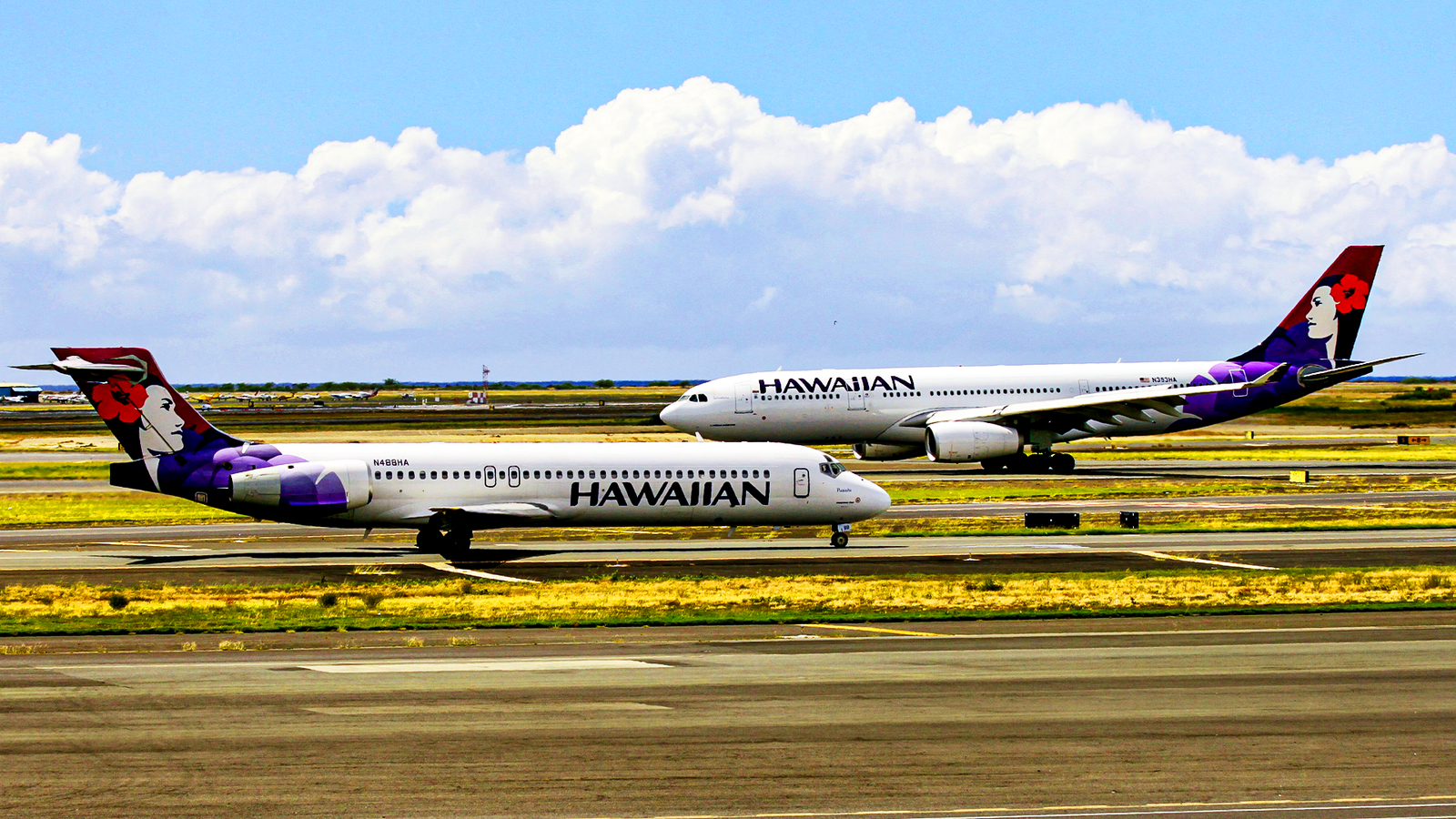
In Hawaii, a very important piece of aviation history is still flying between islands and continuing to serve passengers after nearly 30 years in operation. Using the Simple Flying Live Flight Tracker, we monitored registration N488HA through a 24-hour operating window, watching how the world's oldest surviving Boeing 717 churned through ten distinct sectors in a single day. Observing this specific airframe in real time lays bare the relentless operational demands that define interisland scheduling. As regional carriers squeeze maximum productivity from aging twin-jets, following line airframe MSN 55001 offers a rare window into how classic engineering handles ten rapid cycles of takeoff, climb, and descent in a single calendar day. The Start Point Of The 717 The history of MSN 55001 begins long before its current life in Hawaii, originating in 1998 as Boeing’s flight testbed registered as N717XB, as per AirFleets. The airframe served as the foundational platform for certifying the MD-95 derivative before commercial assembly ramped up in Long Beach. Following that, the MD-95 program was then rebranded as the 717. This pedigree makes the aircraft not just a standard regional transport, but the literal genesis of the entire 717 production line: technically only the second ever produced, but the first to enter regular service. Following its initial stint as a manufacturer test vehicle, the aircraft crossed the Pacific to fly commercial routes in the Southern Hemisphere. Airport-Data and Simple Flying aircraft analysis documents its tenure operating for Australian carriers Impulse Airlines and Qantaslink under registrations VH-VQA and VH-NXF. During this era, the twinjet proved its mettle on short-haul Australian domestic sectors, establishing the high-cycle durability that would later draw the attention of Pacific network planners. Eventually, the airframe found its permanent home in the Hawaiian island chain, where it was rechristened with its current registration N488HA and the traditional Hawaiian bird name Puaiohi. Operating under Hawaiian Airlines' colors, it has spent over two decades mastering the short, high-density sectors connecting Honolulu to neighboring island airports. Ultimately, surviving decades of corrosive maritime air and relentless pressurization cycles attests to the robust structural margins engineered into the original Douglas-derived airframe. Where Did The Aircraft Fly To? According to Simple Flying's tracker replay data, monitoring registration N488HA through Friday, October 9, revealed a punishing schedule that highlights the twinjet's unmatched short-haul efficiency. The day's operations commenced bright and early at Daniel K. Inouye International Airport in Honolulu (HNL), where the aircraft departed at 07:07 local Hawaiian Standard Time (HST) on flight AS1013 across the brief 21-minute hop to Lihue (LIH). Following a rapid ground turnaround, the airframe immediately operated the return leg as AS1024 at 08:13 HST, setting the fast-paced tempo for a tough 24-hour operating cycle. As midday approached, internal flight logs and tracking replay records show N488HA maintaining its relentless cadence across multiple islands without missing a beat. The aircraft cycled back to Lihue as AS1053 before returning to Honolulu, and quickly pivoted east toward Kahului Airport (OGG) on flight AS1096 at 12:43 HST. Each sector averaged 21 to 27 minutes airborne, showing how the high-thrust Rolls-Royce BR715 engines rapidly accelerate the airframe on short-stage climbs where traditional narrowbodies burn excess fuel during extended altitude transitions. Ground crews at each island destination successfully completed tight gate turnarounds, capitalizing on the aircraft's built-in airstairs to keep passenger boarding moving at peak efficiency. The evening rotation pushed the aircraft further across the island chain before concluding its demanding operating day late into the night. After completing another rotation through Lihue, N488HA operated flight AS1120 from Lihue down to Kailua-Kona (KOA) with a 45-minute airborne duration, followed by the return sector AS1157 to Honolulu. The final assignment of the day came as flight AS1132, departing Honolulu at 21:19 HST and touching down in Hilo (ITO) at 21:53 HST after a 35-minute hop. Across all ten sectors, the airframe accumulated roughly 4 hours and 42 minutes of total airborne time while enduring ten full pressurization cycles, a testament to the robust durability engineered into line airframe MSN 55001. Matching Perfectly To Hawaiian's Needs? According to Simple Flying aircraft analysis, the 717 was structurally over-engineered for short-haul durability, tracing its lineage directly back to the ultra-rugged McDonnell Douglas DC-9and McDonnell Douglas MD-80 families. The now more common modern composite narrowbodies are designed for long-range fuel efficiency, whereas the 717 features a heavy-gauge aluminum fuselage and exceptionally robust landing gear designed specifically to absorb the relentless shock of short-field landings and rapid turnaround cycles. This explains why legacy airframes like MSN 55001 can endure decades of high-frequency island hopping without any premature fatigue. The aircraft's powerplant performance is also custom-tailored for brief regional hops. As noted in manufacturer summaries, the twin rear-mounted Rolls-Royce BR715 turbofans deliver exceptional takeoff thrust and high climb gradients. On short sectors where an aircraft spends a disproportionate amount of its total flight time in transition, the BR715s allow the 717 to rapidly punch through low-level turbulence and reach efficient cruise altitudes before initiating an immediate descent toward neighboring island runways. However, this relentless operating tempo pushes mechanical systems to their absolute limits. Reporting from AirInsight has shown that Hawaiian's 717s frequently operate up to 16 cycles a day, meaning that meticulous inspections of pressure bulkheads, wing spars, and landing gear attachments are needed. This punishing, high-cycle reality highlights why the aircraft remains irreplaceable for island networks, especially because the routes it serves integrate into carrier codeshare operations. The Merger With Alaska After the landmark merger between Alaska Air Group and Hawaiian Airlines, operational oversight of inter-island flying underwent a profound realignment. Hawaiian’s historic fleet of 717s now operates under consolidated commercial frameworks, evidenced by flight numbers transitioning to Alaska Airlines' familiar AS prefix, such as the early morning AS1013 from Honolulu to Lihue. Despite the updated ticketing and codeshare designations, the day-to-day cabin experience and local ground operations are still deeply rooted in Hawaiian's established island culture. The unified network allows passengers connecting from mainland North American gateways on Alaska operated aircraft to seamlessly transition onto interisland 717 rotations under a single booking itinerary. Maintaining high-frequency regional connectivity is vital to sustaining economic mobility across the islands, so residents and visitors alike can travel between Honolulu, Lihue, Kahului, Kailua-Kona, and Hilo with minimal friction. Tracking these merged operations within the flight tracker feature highlights the sheer complexity of coordinating high-density regional traffic under a single parent holding company. With air traffic control vectors and ground turnaround teams managing up to 16 daily cycles per airframe, the integration of AS flight numbers is a visible marker of how traditional regional carriers are adapting to post-merger realities. How Long Will We See The 717? Despite their unmatched reliability on high-frequency interisland sectors, the global 717 fleet is rapidly approaching an inevitable retirement finale. According to Simple Flying analysis, major operators are preparing to sunset the type as airframe maintenance cycles grow more complex and fuel-efficiency standards shift toward next-generation narrowbodies. Delta Air Lines, which operates the world's largest 717 fleet, has steadily laid the groundwork to replace its aging twin-jets with fuel-efficient Airbus A220 aircraft across key domestic hubs. Meanwhile, in the Pacific, Hawaiian Airlines is mapping out its own generational fleet transition. As per Business Traveller, the airline's interisland 717 operations are slated to be phased out starting in 2028, with the carrier planning to transition those high-density short-haul sectors to Boeing 737-800s. Flight tracking logs for historic airframes like N488HA reflect this changing landscape; operational data show active tracked schedules tapering off after mid-October, signaling that these veteran aircraft face increasingly tight maintenance windows and scheduled deep-check rotations. The eventual departure of the 717 will mark the definitive end of the DC-9 bloodline, closing an era of commercial aviation defined by rugged, rear-mounted engine airframes built to withstand punishing, multi-cycle daily rosters. Tracking aircraft like MSN 55001, therefore, provides a living archive of how robust engineering and dedicated maintenance teams keep aviation history airborne day after day. A True Legend Of Hawaii Following registration N488HA through ten demanding sectors in a single twenty-four-hour window showed exactly why the 717 is so legendary among pilots, mechanics, and aviation enthusiasts alike. From its humble origins as Boeing flight testbed MSN 55001 to its decades of faithful service connecting Honolulu, Lihue, Kahului, Kailua-Kona, and Hilo, the aircraft embodies a masterclass in structural durability designed to conquer the brutal physics of short-stage, high-cycle operations. The 2028 threshold is fast approaching, when Hawaiian Airlines begins transitioning its 717 operations to Boeing 737-800s and Delta advances its A220 rollout, so monitoring every remaining flight of the world's oldest active 717 offers a poignant glimpse into an evolving commercial landscape. You can continue following live fleet telemetry via Simple Flying's tracking channels as these iconic twin-jets gracefully approach their final decades of service.
We Tracked The First Boeing 717 Ever Built For 24 Hours: Here's How Many Flights It Squeezed In
Full Article
Original Source
Read the full article at Simpleflying →KhanList aggregates and links to publicly available news content. We do not host full articles from third-party sources. Always verify important information with original sources.