
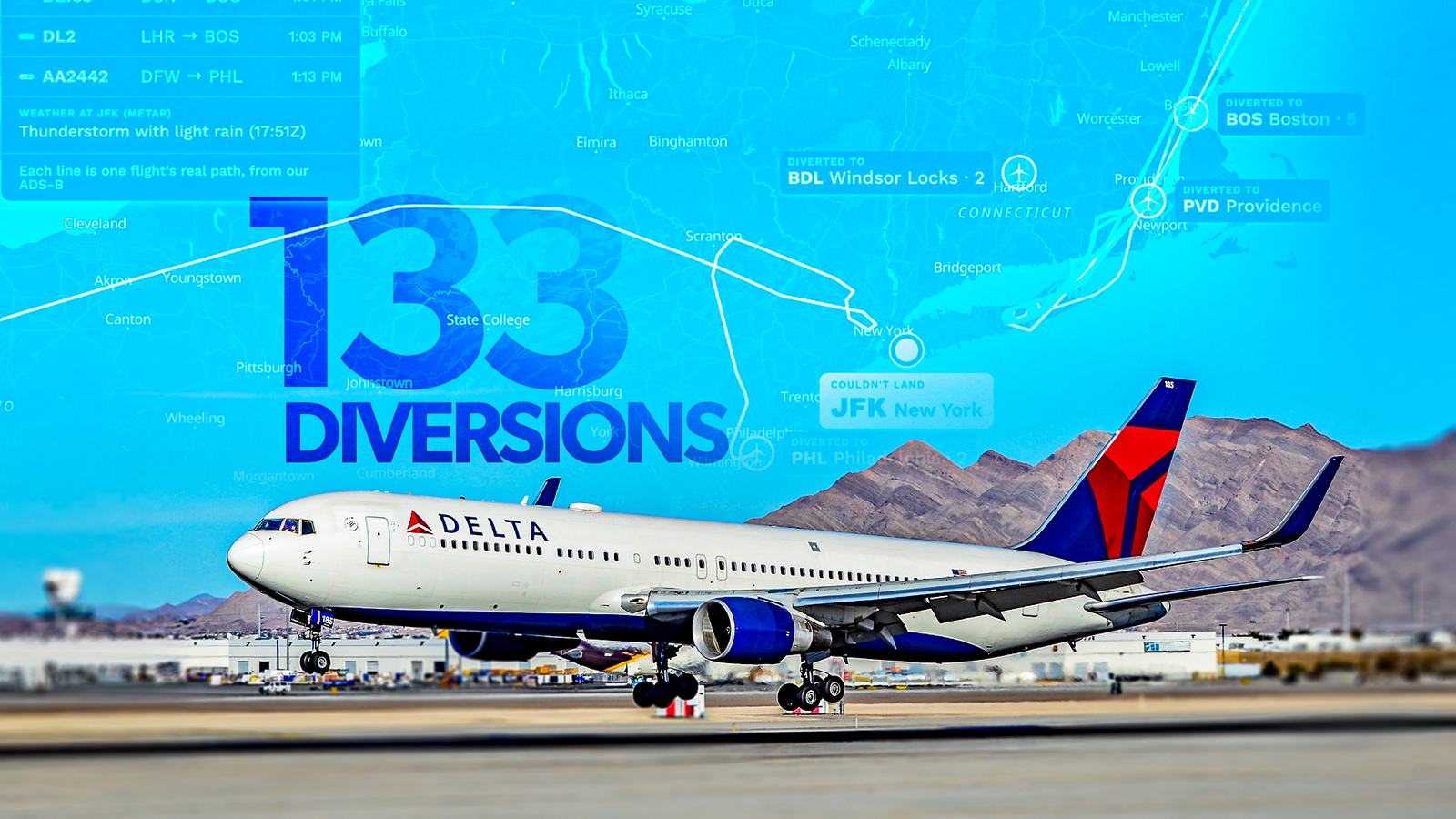
Published Nov 22, 2026, 1:00 PM EST Experienced ICAO English Language Proficiency Instructor for pilots and ATCOs and conference interpreter who is passionate about facilitating effective communication within aviation-related businesses. Possess a deep understanding of the aviation industry, including aviation regulations, terminology, and industry-specific communication protocols. Has been working at numerous airshows across Europe since 2014. Being an ultralight pilot in her free time, she also promotes safety and efficiency in aviation operations. Based in Italy and Malta Sign in to your Simple Flying account Flight diversions are often treated as isolated incidents, but a closer look at two weeks of aviation activity reveals a much larger pattern. Between November 6 and 18, 133 flights diverted from their intended destinations, and several airports saw multiple waves of diversions within hours. Some aircraft landed relatively close to their original destinations, while others ended up thousands of kilometers away. Simple Flying Flight Tracker data examined 63 diversion posts covering 133 flights, including 17 major diversion waves involving four or more aircraft from the same airport within an hour. From an 11-flight disruption at New York-JFK to a 13-aircraft scramble at San Francisco International Airport (SFO), the data reveals which airports absorbed the most diverted traffic, where airlines sent their aircraft, and which journeys experienced the most dramatic changes. November 12 Was The Busiest Day For Flight Diversions Credit: Nate Hovee | Shutterstock Thursday, November 12, was easily the busiest day in our tracking period, accounting for 35 of the 63 diversion posts. The disruptions were particularly concentrated around New York, where John F. Kennedy International Airport (JFK) saw an 11-flight diversion wave, along with numerous additional diversions involving transatlantic arrivals. The disruption was noticeable among international operators. Aircraft arriving from Europe were redirected to airports across the northeastern United States, with Boston Logan International Airport (BOS) becoming the most frequently used alternative. Other aircraft were diverted to Bradley International Airport (BDL) in Connecticut, Philadelphia International Airport (PHL), Providence, and, of course, Bangor International Airport (BGR) in Maine, which has historically been a major diversion hotspot for many transatlantic flights. The diversions affected flights operated by several major airlines, including American Airlines, Delta Air Lines, British Airways, Air France, Lufthansa, and KLM Royal Dutch Airlines The JFK disruption was not the only significant event that day. The neighboring Newark Liberty International Airport (EWR) experienced a four-flight diversion wave, while PHL saw eight flights redirected. LaGuardia Airport (LGA) also recorded four diversions. Together, these events demonstrate how disruption at several airports in the same metropolitan region can create a complicated situation for airline operations. But with so many aircraft needing alternative landing locations, which airports handled the most diversions? Two Biggest Diversion Airports Credit: billlinphotos | Shutterstock Boston was the most frequently used diversion airport during the tracking period, receiving 16 flights that had originally been scheduled to land elsewhere. Much of this traffic came from the November 12 disruption at JFK, when transatlantic arrivals were redirected to alternative airports across the northeastern United States. Boston's geographical position made it a prominent destination in the diversion data. Several flights originally scheduled to land at JFK were redirected there, including services operated by American, Delta, British Airways, Air France, Emirates, and KLM. The affected routes included arrivals from London, Amsterdam, Paris Charles de Gaulle, Barcelona, Milan, and Dubai. However, Boston was not the only airport dealing with repeated waves of unexpected arrivals. On the other side of the Atlantic, Katowice International Airport (KTW) in Poland came remarkably close to the top, receiving 15 diverted flights. The airport became an important alternative for aircraft originally scheduled to land at Krakow John Paul II International Airport (KRK), which experienced four separate diversion waves over four consecutive days. Back in the US, Fresno Yosemite International Airport (FAT) ranked third, receiving nine diverted aircraft, all tied to the major San Francisco disruption on November 18. Diversion Airport IATA Code Diverted Flights Boston Logan International Airport BOS 16 Katowice International Airport KTW 15 Fresno Yosemite International Airport FAT 9 Washington Dulles International Airport IAD 6 Los Angeles International Airport LAX 5 The geographical distribution is rather curious. Boston and Katowice were heavily affected by disruptions at nearby airports, while Fresno and Los Angeles benefited from their proximity to San Francisco. This raises another question: were these diversions isolated incidents, or were entire airports experiencing repeated operational disruptions? Krakow Experienced Four Diversion Waves In Four Days Credit: Simple Flying Krakow was one of the most interesting airports in the dataset, experiencing four separate diversion waves between November 6 and 9. Each wave involved at least four flights, with the aircraft redirected to several alternative airports across Poland and neighboring countries. The first wave occurred late on November 6, when four aircraft originally scheduled to land at Krakow were redirected. Three ended up at Katowice, while the fourth landed at Rzeszow-Jasionka Airport (RZE). The following morning, another six flights were diverted, with five heading to Katowice and one returning to Frankfurt. This included aircraft operated by Ryanair, Wizz Air, and Finnair, demonstrating that the disruption affected multiple airlines and aircraft types. The situation continued on November 8, when two further waves involved eight and five aircraft, respectively. Unlike the earlier events, these diversions were distributed across a wider selection of cities, including Warsaw, Wroclaw, Gdansk, Brno, and Ostrava. The final wave arrived on November 9, when another six flights were redirected, five of which landed at Katowice. Date Diverted flights Main alternative airports November 6 4 Katowice, Rzeszow November 7 6 Katowice, Frankfurt November 8 (wave 1) 8 Katowice, Warsaw, Wroclaw, Gdansk, Rzeszow, Ostrava November 8 (wave 2) 5 Wroclaw, Warsaw-Modlin, Brno, Lodz, Ostrava November 9 6 Katowice, Warsaw Katowice's 15-flight total is particularly revealing because it shows how an airport can become an important alternative landing point during repeated disruption at a nearby facility. However, Krakow was not the only airport to experience a concentrated wave of diversions. On November 18, events unfolded on the opposite side of the Atlantic, producing the largest individual diversion wave recorded in our dataset. San Francisco Recorded The Biggest Single Diversion Wave Credit: Simple Flying On November 18, SFO saw the largest individual diversion wave in our tracking period, with 13 flights redirected in about an hour. Nine aircraft landed at Fresno, while another four were sent to Los Angeles International Airport (LAX). The scale of the event was striking because it involved both domestic and international services. Among the affected aircraft was Korean Air flight 23 from Seoul Incheon (ICN), which landed in LAX instead SFO. Other long-haul services included United Airlines flight 862 from Hong Kong, which also diverted to LAX, and United flight UA34 from Osaka Kansai, which followed the same route. Domestic arrivals were affected too. JetBlue flight 633 from BOS and AA76 from JFK both landed at Fresno. DL668, arriving from JFK, was among the aircraft redirected to LAX. The nine-flight Fresno total made it the most frequently used alternative airport during the San Francisco event. The November 18 San Francisco diversion wave: Diversion airport Flights Share of wave Fresno Yosemite International Airport (FAT) 9 69.2% Los Angeles International Airport (LAX) 4 30.8% Total 13 100% Fresno's role and location are noteworthy. Although it is considerably smaller than San Francisco and Los Angeles, it absorbed most of the diverted aircraft in this event. This shows how diversion planning can extend beyond a region's largest airports, depending on operational circumstances and available alternatives. However, the San Francisco wave was not the only event involving unusually long journeys to alternative airports. Some aircraft in our dataset ended up nowhere near their original destinations. Three Flights Experienced Particularly Long Diversions Credit: Bjoern Wylezich | Shutterstock Although many diversions involved relatively short journeys to nearby airports, several flights in our dataset experienced substantially longer route changes. The most dramatic example involved KL677, which was operating from AMS to Calgary International Airport (YYC). On November 9, the Boeing 787 operating the service landed at Keflavik International Airport (KEF), in Iceland, approximately 3,200 miles (5,132 kilometers) short of its intended destination. This was the longest diversion recorded in our dataset. The distance illustrates just how significant the operational consequences of a diversion can become when an aircraft is already deep into a long-haul journey. United Airlines flight UA114 experienced the second-longest diversion. The service was scheduled to fly from Papeete International Airport (PPT), in French Polynesia, to San Francisco, but instead landed at Honolulu International Airport (HNL). The aircraft arrived about (2,400 miles) 3,857 kilometers short of San Francisco, leaving passengers in Hawaii instead of the intended Californian destination. The third-largest diversion involved easyJet flight 7883, operating from AMS to Tenerife South Airport (TFS). Instead of reaching the Canary Islands, the aircraft landed at Paris Orly Airport (ORY), approximately 1,750 miles (2,814 kilometers) from its intended destination, much closer to the departure airport. The flight was unusual because it involved a European short-haul operator and a diversion just within 300 miles (about 500 km) of the departure point. The three longest diversions recorded: Flight Airline Planned route Actual landing Distance from destination KL677 KLM Royal Dutch Airlines Amsterdam–Calgary Keflavik 5,132 km UA114 United Airlines Papeete–San Francisco Honolulu 3,857 km U27883 easyJet Amsterdam–Tenerife Paris Orly 2,814 km These examples demonstrate that a diversion does not necessarily mean landing at the nearest available airport. Long-haul operations can involve complex considerations, and aircraft operating across different regions may have to use alternative airports far from their original destinations. But how representative are these individual examples of the overall diversion picture? What 133 Diversions Reveal About Airline Operations Credit: Sundry Photography | Shutterstock The 133 flights recorded between November 6 and 18 provide an interesting snapshot of how quickly disruption can spread across airline networks. Simple Flying's tracking identified 63 separate diversion posts, including 17 major waves in which at least four aircraft were diverted from the same airport within an hour. The dataset also contained 45 long-haul diversion posts and one short-haul diversion involving easyJet. It is important to distinguish between the number of posts and the number of flights. A single diversion-wave post could cover several aircraft, while individual long-haul diversions were also reported separately. Some long-haul flights were included in the larger waves, meaning the figures should not be added together as independent flight totals. ADS-B tracking independently confirmed the landing airports for every flight included in the spreadsheet. Simple Flying Flight Tracker's social channels regularly publish individual diversions and larger waves of disrupted flights as they happen. They offer a useful way to follow unexpected changes to airline operations in real time. The most interesting finding isn't that 133 aircraft landed somewhere other than their planned destinations. It is how concentrated some of the disruption became. Boston absorbed 16 diverted flights, Katowice received 15, and Fresno handled nine aircraft during a single event at San Francisco. With individual waves involving as many as 13 aircraft, the data reminds us that an airport's operational importance can change dramatically when another facility is disrupted.
We Tracked 133 Diverted Flights In Two Weeks: Here’s Where They Ended Up
Full Article
Original Source
Read the full article at Simpleflying →KhanList aggregates and links to publicly available news content. We do not host full articles from third-party sources. Always verify important information with original sources.