
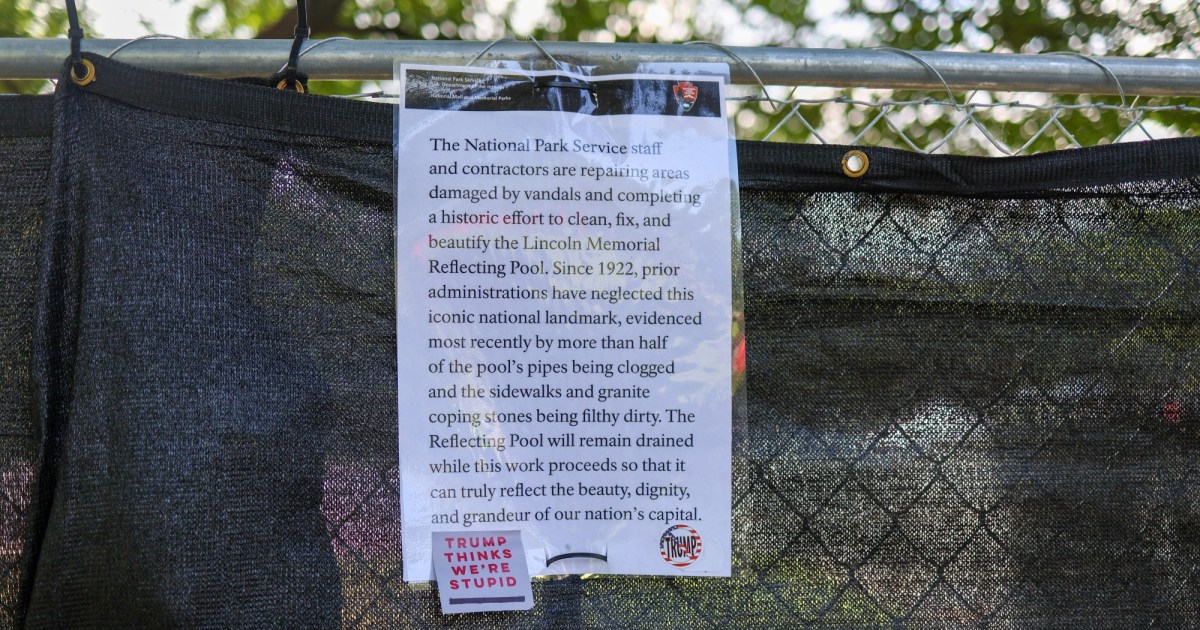
The Reflecting Pool remains drained and fenced off, with a signs attributed problems to vandals, not botched repairs.Robyn Stevens Brody/AP Get your news from a source that’s not owned and controlled by oligarchs. Sign up for the free Mother Jones Daily. Donald Trump’s beloved White House ballroom is moving ahead—at a reported cost of $900 million and counting—thanks to a 5-4 ruling Monday from the Supreme Court. The ballroom is just one of a slew of active or would-be construction sites where the president is hoping to leave his mark on Washington. But for now, it’s an exception. Many of Trump’s other pet projects are in limbo, stalled by botched construction and legal challenges. Congress has declined to appropriate billions of dollars the administration wants for so-called “beautification” efforts in DC, but the White House has used money from elsewhere in federal budget, including roughly $100 million collected as National Park entrance fees, to pay for the work. A mile west of the White House, the Kennedy Center remains closed—a tarp obscuring the facade where a federal judge ordered Trump’s name removed. Trump’s plans for the performing arts center, including custom marble armrests, more shows like “Cats,” and his name on the wall, have so far failed. His dismay seemed to animate a recent court filing in which the Justice Department threatened that the center could be demolished if Trump’s plans remained blocked in court. A mile or so south, the Lincoln Memorial Reflecting Pool sits drained and fenced off—months after the president trumpeted its grand reopening. Following its renovation, the pool closed due to algae blooms and peeling “American flag blue” liner. In late July, the Justice Department acknowledged the peeling resulted from flawed work by a contractor that had received a no-bid contract, worth more than $15 million so far, from the Trump administration. That admission came in a court filing dropping felony charges against an alleged vandal who Trump had blamed for the damage. Trump recently claimed the reflecting will re-open, again, within weeks. But his track record on this topic suggests skepticism is warranted. Across the Potomac River via Memorial Bridge, the administration hopes to construct what critics have dubbed the “Arc de’ Trump.” The plan for that 250-foot monument, which Trump has said is for “me,” received initial approval this summer from a key federal commission packed with Trump allies, and backing from the Trump-controlled National Park Service. But the proposal has faced stiff legal opposition, in part because the arch would block views of Arlington National Cemetery, leaving its future is uncertain. Even less likely to be built is the so-called “National Garden of American Heroes.” That’s the statue garden featuring sculptures of 250 Americans that the president hopes to plant along the Potomac near the Jefferson Memorial. Trump first floated the statue garden in 2020 as a sort of anti-woke answer to the removal of statues of Confederates, slave owners, and other historical figures around the country. Congressional Republicans allocated funding for the project, and the administration initially hoped to complete it by July 4 of this year—in time for the semiquincentennial. Trump’s team also set up a nonprofit and began seeking corporate donations for the plan. The same foundation is also raising funds to build a luxury golf course on a flood-prone island in the Potomac, where Trump has claimed construction will start soon. But July 4 has come and gone, and the statue garden is nowhere close to ready. Sculptors have called the plan “unworkable” due to limited statue-making capacity. And the site also sits in a location where new “commemorative work” cannot be built without additional congressional approval. Congress has not approved this specific plan for the garden, meaning a lawsuit seeking to block the effort might well succeed. Trump has, however, planted statues elsewhere. He put a new statue of Christopher Columbus on the White House grounds—take that, Indigenous Peoples’ Day. And in Freedom Plaza, a park just southeast of the White House on Pennsylvania Avenue, the administration in April installed 14 statues. These include a large equestrian depiction of Caesar Rodney, a signer of the Declaration of Independence. That statue had sat in storage since 2020, when it was removed from a perch in Wilmington, Delaware, due to Rodney’s status as a major slaveowner. We reported in July that Trump’s Interior Department paid $527,000 for rushed construction of the pedestal on which it now stands. That’s around twice what the department had estimated the statue base should cost. “The work was expedited to ensure it is done before our nation’s 250th,” an Interior Department official told Mother Jones. Back by the White House are other public works projects the administration rushed to complete by July 4. The National Park Service spent $17.4 million through a no-bid contract to repair two ornamental fountains. The contract, first reported by the New York Times, was secretly awarded to Clark Construction, the same firm that is building the ballroom. The fountains now work. But they are hard to see because of the 13-foot steel fences the administration installed around Lafayette Park. That fencing was supposed to be temporary, but the administration has now proposed permanently fencing off the park. For now, the whole park, including the refurbished fountains, remains closed to the taxpayers who paid for it.
We Toured Trump’s DC Vanity Projects. It’s a Mess.
Full Article
Original Source
Read the full article at Motherjones →KhanList aggregates and links to publicly available news content. We do not host full articles from third-party sources. Always verify important information with original sources.