
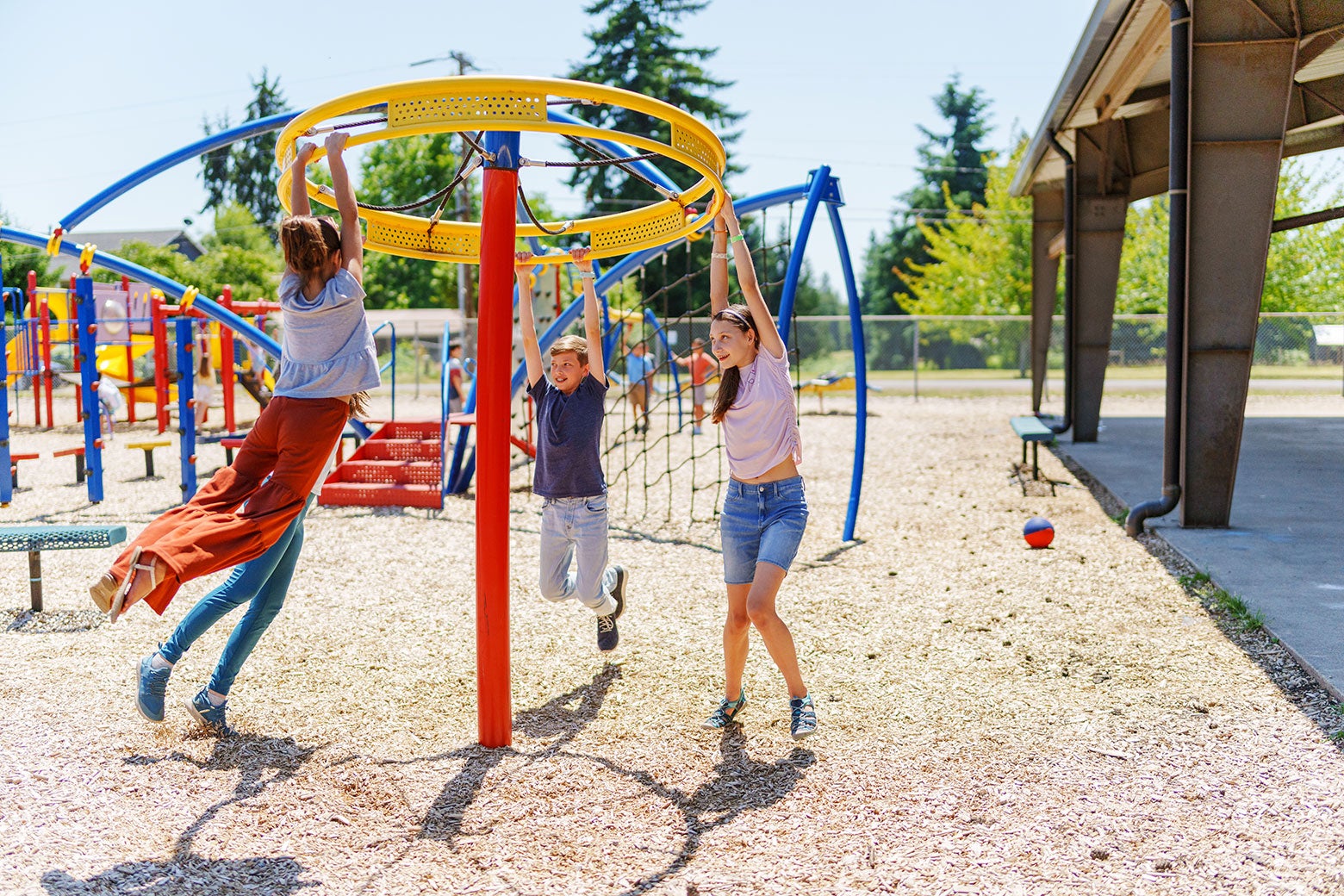
Users The Case for Letting High Schoolers Goof Off In a school day dominated by screens, recess could help teenagers focus, connect, and even learn. Getty Images Plus Sign up for the Slatest to get the most insightful analysis, criticism, and advice out there, delivered to your inbox daily. “Tag! You’re frozen!” I hear my 5-year-old son proudly exclaim, nearly out of breath. He has finally caught his 7-year-old sister. My oldest, who is 14, ducks behind our raised garden beds, where orange marigolds and sprawling tomato branches shield her from his view. I savor every second of summer moments like this, where my kids spend hours outside. But as they—and the estimated 54.4 million children enrolled in K–12 schools in the United States—transition from open-ended summer days to structured school days, they’ll be spending less time outside or socializing freely with friends. Many children will have just 20 minutes set aside for recess daily, if they’re lucky. Time for recess is dependent on state laws, district policies, and school discretion. Young people and educators are returning to school amid national anxiety over a learning recession that researchers suggest dates back to 2013. This is converging with concerns about youth mental health, the outsourcing of thinking to artificial intelligence, and the proliferation of social media and smartphones impacting attention spans and self-esteem. Many advocates and researchers believe recess helps relieve the stress young people face while also fostering learning, creativity, resilience, leadership, and conflict-resolution skills. Physical activity and movement, like playing freeze tag or shooting hoops during recess, can improve information processing, executive function, attention, and memory, research suggests. As the Centers for Disease Control put it, “students who are physically active tend to have better grades, school attendance, classroom behaviors, and cognitive performance.” This May, the American Academy of Pediatrics published new guidance on recess titled “The Crucial Role of Recess in School,” its first update to the policy since it was originally issued in 2013, before we could have foreseen iPads, Chromebooks, and screen-based learning taking over our children’s academic and social lives. The guidance now says recess should be part of the school day for kids all the way through 12th grade, encouraging pediatricians to “press for state laws protecting equal access to daily recess and educate parents to advocate for the benefits of recess for all children and adolescents.” “We’re told, ‘Oh no, your kid needs an iPad in kindergarten.’ No, they don’t. They do not,” Denisha Jones, the executive director of Defending the Early Years, a nonprofit that advocates for playful and experiential approaches to childhood education, told me. Jones believes that to learn, children, and really people of all ages, need opportunities to play, create, and move. But we also have things like Netflix Playground bombarding us. One might dream that Netflix was putting some of its enormous resources toward building or updating actual playgrounds across the country. Alas, Netflix Playground is an app for children 8 and younger, where kids can play games featuring characters from Sesame Street and Peppa Pig. Netflix says the app makes it “easier to say ‘yes’ to playtime.” To combat the inundation of screen-based pastimes, programs like the one from the National Center for Families Learning, Let’s Learn Together Outside, a family outdoor-learning program first developed about a decade ago, have seen a surge in interest. That one works primarily with families of children ages 3 to 5. “We were trying to reach adults who are not comfortable being outside. Because if they’re not comfortable, then they’re not going to want to take their kids out,” Jordan Dospil, a senior content specialist at NCLF, told me. “We really wanted to start with baby steps to get people used to outside and then go into letting your kids take the lead and learn from them.” Mary Beth Stevens, an NCLF senior training specialist, expanded on how the outdoors can open itself up to communication skills and foster a love for learning. “The literacy strategies are all about developing oral language,” she told me. “The parents learn the value of those interactions with their children. The importance of spending time truly talking, not just directive talk … but open-ended questions, using songs and rhymes, storytelling, descriptive language.” This year, my daughter starts high school. Like many teenagers, she spends about seven hours inside a school building without recess. In Rhode Island, where we live, state law guarantees at least 20 minutes of recess only through sixth grade. Some days in middle school, during gym class, my daughter went outside and walked the perimeter of the school. But even that outdoor time was sometimes withheld when her classmates “behaved poorly”—a common disciplinary tactic that the national guidance recommends against. For some young people, recess may be one of the few stable opportunities they have to safely move and play with friends. Nearly a quarter of U.S. children live in a neighborhood without a park or playground, and a similar share lack sidewalks or walking paths, according to recent federal data from the CDC. So when that time is not promised at school, they might lose out on cognitive, social, physical, and community benefits. A 2023 study of 153 low-income California elementary schools found that students in larger and lower-income schools received less recess than those in smaller and relatively higher-income schools. The researchers, Hannah Thompson and Rebecca London, also point to earlier national research showing racial disparities in recess access. “Students of color and those in low-income areas routinely have less recess time than students in wealthier and whiter areas,” Thompson and London wrote in EdSource. There is evidence suggesting that physical activity offered during the school day is associated with better reading outcomes for third graders, especially in the lowest-income schools. Giving students who face socioeconomic barriers reliable opportunities to move their bodies during the school day is especially important, according to the study that was published in 2017. Across the country, access to recess remains a patchwork, shaped by how laws are enforced. This year, Oklahoma doubled its requirement for elementary students to 40 minutes of recess a day, while Pennsylvania recently began requiring 30 minutes for students in full-day kindergarten through fifth grade. Passing a law is one thing; knowing whether schools are following it is another. “There are no tracking systems,” London, a sociology professor at the University of California, Santa Cruz, and the author of Rethinking Recess: Creating Safe and Inclusive Playtime for All Children in School, said. She added, “I think the piece of it that’s really important is it gives parents something to fall back on. They can go back to their classroom teacher or their principal and say, ‘My child’s having recess withheld, and that’s against the law.’ ” Recess is just as important for middle school and high school students, yet they are often left out of policies that mandate it. In 2024, Medford High School in Boston grappled with chronic absenteeism. The principal’s solution? A “movement break” for students to engage in social and physical activities daily. The percentage of chronically absent students fell from 36 percent in 2024 to 20 percent by the end of the 2025–26 school year. Along with giving tweens and teens something to look forward to, recess encourages movement, builds social confidence, and fosters a sense of community, which are all vital to healthy development. These breaks are a welcome respite from long stretches of sitting and screen-based learning, which is common in some classrooms despite questions about its efficacy. A 2025 review of studies on kids and teens ages 5 to 18 found that short, active breaks can help students stay on task and improve classroom behavior, giving teachers more time to teach. The AAP guidance also highlights research that challenges the outdated assumption that more time devoted to classroom instruction equals more learning. “Wakeful rest” is a necessary element of learning that should happen after taking in new information, the AAP explains. The brain needs a break from additional cognitive demands so that memories can begin to stabilize and topics covered can be retained. (In sitting down to write this piece, as a 35-year-old adult, I’ve walked away from my laptop to putter around my yard, scribble in my notebook, and walk my dog several times so my brain doesn’t feel like goo.) Wakeful rest can include activities such as daydreaming, drawing, listening to music, or chatting with friends, which can promote learning. Aisha Isabel, 23, is the program director at Youth in Action, a Providence organization that works to “address power imbalances that stifle the potential of youth, especially young people of color,” by building youth leadership and creating more equitable public institutions and systems. She helps facilitate the Outdoor Equity program aimed at helping young people of color find belonging in outdoor spaces through hiking, camping, and kayaking, while advocating around environmental racism and access to nature. For Isabel, recess during her younger years was essential. “I always need breaks and discussions to be able to absorb material, and the only time I was able to have that was at recess,” she said. “We would know we had a test after recess, so we’d practice or study together or just talk about it casually, in a way that helped us absorb it—not in a very structured, sit-down way, because that doesn’t help me.” I’m grateful my kids play freeze tag or walk to the neighborhood park with friends after school. That freedom helps them decompress, build resilience, and develop healthy habits for life. Every young person deserves that freedom during the roughly 180 days a year they spend in school, too. “I think it’s important for adults who hold the structure to ask: How can joy come back into these systems? Because so much of school is sitting behind one another, standing and walking in lines, and learning in very specific ways,” said Isabel. “I would say there are ways to be creative and learn just by being outside. I say this often to adults: Joy isn’t a reward. Joy can be something we draw on when we’re going through obstacles.” Education Teens
We Took Something Crucial Away From Teenagers. That Was a Huge Mistake.
Full Article
Original Source
Read the full article at Slate →KhanList aggregates and links to publicly available news content. We do not host full articles from third-party sources. Always verify important information with original sources.