
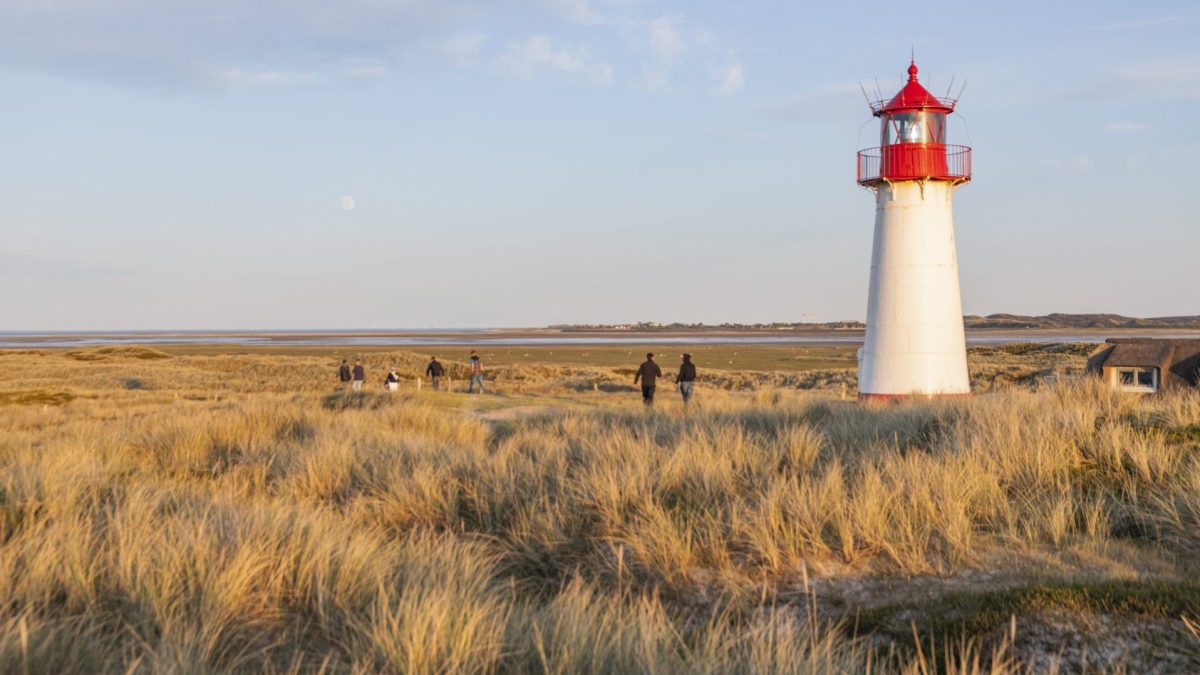
My children, aged eight and six, have become adept at long-distance rail journeys in recent years. They’ve travelled to Sweden, Greece and the Alps from the UK during our attempts to avoid short-haul flying. Germany has often been somewhere to pass through, changing trains in Hamburg or Berlin. But this summer, as part of a longer trip, we decided to stop for a few days on its northernmost island, Sylt, inspired by new rail connections. One of the best things about overland journeys are the possibilities en route. We take the Eurostar from London St Pancras to Brussels, and spend two nights in the city with friends, exploring the parks in the late summer heat. It is a long day from Brussels to Westerland, Sylt’s principal town. But, as of this July, there are direct connections from Berlin, Frankfurt and Hamburg, making the journey far simpler than it once was – although engineering works the weekend we travel mean an extra change at Essen, from where it is seven and a half hours non-stop to the island. The new trains include a large family space (Photo: Volker Emersleben/Deutsche Bahn AG) The great thing about travelling by train, rather than by car, say, or plane, is that the kids are not confined. These new routes to Sylt have a large family space, with step-free access, a children’s play space and plenty of room for prams. There is also a great buffet car, with a kids’ menu (€9.90/£8.49) and table service, which feels upmarket when you’re used to trains in the UK. The land flattens out and the sky widens as we race north. Germany is not somewhere I associate with islands. But Sylt is one of the many Frisian Islands, a narrow archipelago that echoes the shape of the coast like an exoskeleton, stretching from Denmark, through Germany, and down to the Netherlands. Sylt itself spreads out like a gull in flight, arching its wingtips north and south to form thin spits of land that run each way for several miles. It is thicker at the body, the head being the town of Westerland. A lighthouse at one wingtip marks Germany’s northernmost point, with Denmark just across the water. There is no road onto the island. One either takes the train or drives onto a train and crosses that way. The seven-mile causeway, opened in 1927, was feared by locals when it was proposed for bringing outsiders to the island. While the crossing made the island more accessible, Sylt still retains an air of exclusivity. We see few foreign tourists, but within Germany the island has garnered a reputation as an enclave of the rich. Since the playboy set descended on it in the 1960s, it has been known as being where wealthy Germans go to party. Affordable housing for locals can be extremely difficult to come by. In Westerland, cocktail bars and oyster shacks line the strip along the sands (Photo: Tiago Bonato/Peter Bender/Sylt Marketing) You can see why. It is a pretty place, with many miles of beaches and plenty of buildings that are still thatched in the traditional Frisian style. In Westerland, the strip along the busy main sands is crammed with cocktail bars and oyster shacks. At Sturmhaube, a restaurant and hotel in the village of Kampen, with views to both coasts, we have an excellent meal of plump local oysters, grown off the coast, and chanterelle risotto. Its kids’ menu has been put together with care and includes options such as homemade chicken nuggets and pastas. We have a tour of the brewery in the cellars, guided around the gleaming vats by master brewer Pascal Neumann. The pilsner is award-winning and delicious on warm, late-summer evenings. But another side to the island does exist, one of wild dunes blanketed with sea grass and purple heathers. We stay in Steger-Hüs, a functional apartment block on Sylt’s south side. It is clean and spacious and a short walk from a beautiful, secluded beach. On this western coast, where the island pushes up against the North Sea, the shore shelves deeply. The surf is good here. Many of the beaches charge a small fee (around €4/£3.40), but walk a little along the shore and you can get a huge swathe to yourself. Many beaches charge a small fee, but walk on a little and you’ll escape any crowds (Photo: Tiago Bonato/Peter Bender/Sylt Marketing) Between the islands and the mainland is the shallow, Unesco-listed, Wadden Sea, a vital habitat for birds and other wildlife. When the tide goes out, the mudflats stretch for miles – from some of the Frisian islands, it is possible to walk over to the mainland. One blustery evening we join a mud walk, led by National Park Guide Werner Mansen, the warm mud oozing between our toes as we dig around for lugworms and sea snails. Another day we catch a boat from Hörnum harbour, at the south of the island, to go and see the seals. Several hundred of them are hauled out on a sandbar twenty minutes off the coast, their fluffy pups flopping about among them. Two surface a metre from the boat, their great dog-like faces scrutinising us, nostrils flaring. We are thrilled. We leave on the train four days later, back across the causeway, heading for Sweden and new adventures. We have sand in our hair and salt on our skin, glad to have got to know an island of such contrast. Getting there The writer was a guest of Sylt Marketing (sylt.de/en/) and the German National Tourist Office (germany.travel). Take the Eurostar to Brussels, then a train to Cologne (around one hour, 50 minutes, from £18 each way). One-way tickets from Cologne to Westerland (Sylt), including Deutsche Bahn’s ICE L service from Hamburg to Westerland, start from £34.25 each way. The Hamburg to Westerland route has two return services per day. Staying there Steger Hüs, a three-bedroom holiday flat, starts from £137 per night in the peak season, plus booking, laundry and cleaning fees, steger-hues.de More information Seal-watching tours £84 for max of two adults and three children, adler-schiffe.de/nordsee/ab-sylt/ Sturmhaube Kampen brewery tours from £25pp, sturmhaube.de Mud flat walks from £12 per adult, £9 per child/teen, sylt-wattwanderungen.de
We took Germany’s new family-friendly train to an upscale holiday island
Full Article
Original Source
Read the full article at Inews →KhanList aggregates and links to publicly available news content. We do not host full articles from third-party sources. Always verify important information with original sources.