
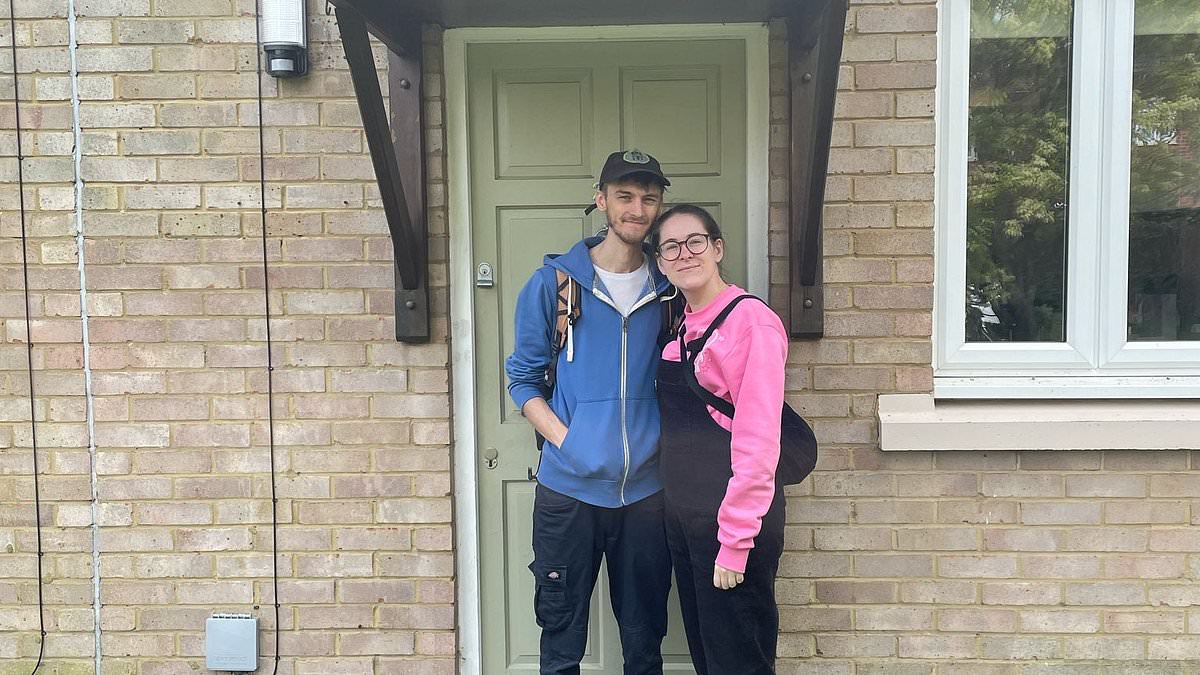
When Sam Price and Katie Downham decided to buy their first home 19 months ago, they were in no doubt it had to be a house and not a flat.They wanted a property they could categorically call their own and one in which they could see themselves remaining in for years to come without outgrowing.Sam, 29, a product designer and Katie, 28, a quality and service support agent for an electronics firm, bought their home in Richmond, south-west London, in April 2025.They paid £395,000 for the two-bedroom house having managed to save up a 20 per cent deposit without any help from the Bank of Mum and Dad.They are locked into a five-year fixed mortgage deal with a 4.36 per cent interest rate on a 40-year repayment term and currently pay £1,393 a month.Katie says they wanted something that had the potential to be their forever home, rather than merely a stop gap.'We pushed to buy a more forever home with room to grow due to the difficulty to get on the ladder and costs surrounding buying like moving, solicitors and stamp duty,' she says. Forever home: Katie and Sam bought their house in London at 26 and 27, paying £395,000 having managed to save up enough for a 20 per cent depositNeither wanted to buy a flat. Sam says his experience of renting prior to buying meant he was determined not to be beholden to a landlord and understood that buying a leasehold flat, for example, would technically still come with one in the form of a freeholder.Flat owners in Britain's cities have had a torrid time in recent years, as leasehold complications, service charges and cladding have made their properties a challenge to sell or even remortgage.Nearly two in five London flats during the year to August changed hands for less than their previous purchase price, according to analysis by E Surv Chartered Surveyors.This excluded brand new properties and looked at flats that had been owned for between five and ten years. 'I wanted to escape the world of renting having lived all over London,' says Sam. 'Owning our own home means we now have the freedom to re-do a kitchen, hang pictures or paint a room a mad colour. 'We were both wary of buying a leasehold flat having heard negative things on social media and from friends. 'We were aware of some of the cladding issues impacting flats and the extra costs. 'A friend of ours was recently forced to pay £1,000 for new fire doors by their management company.'Although we do have friends that are happy with their flats, we felt a house was the only option to feel our home was truly ours. 'We wouldn't want to have to ask a freeholder permission to do something to our property and we also have our very own garden.'Katie and Sam are part of a growing trend that is seeing first-time buyers skip the traditional starter flat in favour of homes they can grow into.Houses accounted for 83 per cent of first-time buyer purchases in October 2026, according to Barclays mortgage data. This is up from 77 per cent two years prior.In contrast, the proportion of first-time buyers opting for flats has fallen from 23 per cent in October 2024 to 20 per cent last year and now down to 17 per cent this year, according to Barclays.Separate research from the bank also found a quarter of non-homeowners want their first purchase to be their ‘forever home’, rising to 29 per cent among Gen Z. The main motivations cited are having certainty over their living situation, enough space for changing needs and avoiding the stress of moving again. Cost is also a contributing factor, with 17 per cent saying that they don’t want to purchase a flat due to the cost of service charges and leasehold fees.While Katie and Sam say their two bedroom house isn't big, they say it's large enough for the two of them and potentially for an additional family member in the future.'We feel this house is suitable for the long term,' says Sam. 'If we do have children we think we will only have one.'The decision to buy their potential forever home also came down to cost. Both Katie and Sam said they were aware that stamp duty costs could be much higher were they to move again.As first-time buyers they didn't have to pay stamp duty on the first £300,000 of their purchase price.It meant, in order to buy the £395,000 house they had to fork out £4,750 on stamp duty.Had they bought a flat in a more central location as a starter home with the view to buying a house a few years later, they would have had to budget for yet another stamp duty bill.Plus, as homeowners, the stamp duty on a £395,000 house without the first-time buyer relief would have jumped to £9,750 under current rates.On top of the stamp duty they would also have another round of legal fees to pay, surveyor fees on top of all the other costs that often come when moving home, including removals, repairs, redecoration and new furniture.'We wanted to avoid all the admin fees of buying and selling a house,' says Katie.'Although we didn’t find the buying process too bad, there were some stressful parts and we had to spend a lot of money during it.'Aside from not having to move again, Sam and Katie may have also made a better long-term investment in buying a house over a flat.Higher mortgage rates, rising service charges and anti-landlord taxes alongside concerns over building safety and cladding have all combined to obliterate demand for flats. UK flat prices have only risen 7 per cent on average over the past decade while the average house is up 36 per cent, according to Zoopla. The gap between the average house price and flat price has risen from £108,096 in 2016 to £192,533 in 2026. The gap between them is at a 30-year high and seemingly getting wider with every passing year.The previously popular buyer pool for flats comprising first-time buyers and buy-to-let investors can no longer be relied upon by those trying to sell their apartments.The average number of flats for sale per agent between 2019 and 2024 has always hovered between eight and nine, according to Zoopla now it's up to 12.4 per agent.On average, 67 per cent of flats don't sell within six months of being listed, Zoopla revealed. That compares to 47 per cent of houses that don't sell within six months.Britain's second biggest mortgage lender, Nationwide Building Society, seems to agree that flats are no longer a safe investment.Yesterday it launched a new product enabling first-time buyers to buy a home with just a 1 per cent deposit whilst borrowing up to six times their gross annual salary.That in theory could mean someone earning £50,000 a year could buy a £300,000 home with just £3,000 in savings as long as they are prepared to fix for five years at 5.99 per cent.However, the mutual said it will only lend on existing houses and excludes all flats as well as all new build homes in general.How to find a new mortgage Mortgage rates have jumped as conflict with Iran has driven up inflation expectations and dashed hopes of interest rate cuts.If you need a mortgage because you are buying a home, or your current fixed rate deal is due to end, you should explore your options as soon as possible. This is Money has a long-standing partnership with fee-free broker L&C, to provide you with expert mortgage advice.Use This is Money and L&Cs best mortgage rates calculator to show deals matching your home value, mortgage size, term and fixed rate needs.Or use L&C’s online Mortgage Finder to search thousands of deals from more than 90 different lenders to discover the best deal for you.Mortgage service provided by London & Country Mortgages (L&C), which is authorised and regulated by the Financial Conduct Authority (registered number: 143002). The FCA does not regulate most Buy to Let mortgages. Your home or property may be repossessed if you do not keep up repayments on your mortgage
We skipped the starter flat and went straight for our 'forever home': Why first-time buyers are shunning apartments for houses
Full Article
Original Source
Read the full article at Dailymail →KhanList aggregates and links to publicly available news content. We do not host full articles from third-party sources. Always verify important information with original sources.