
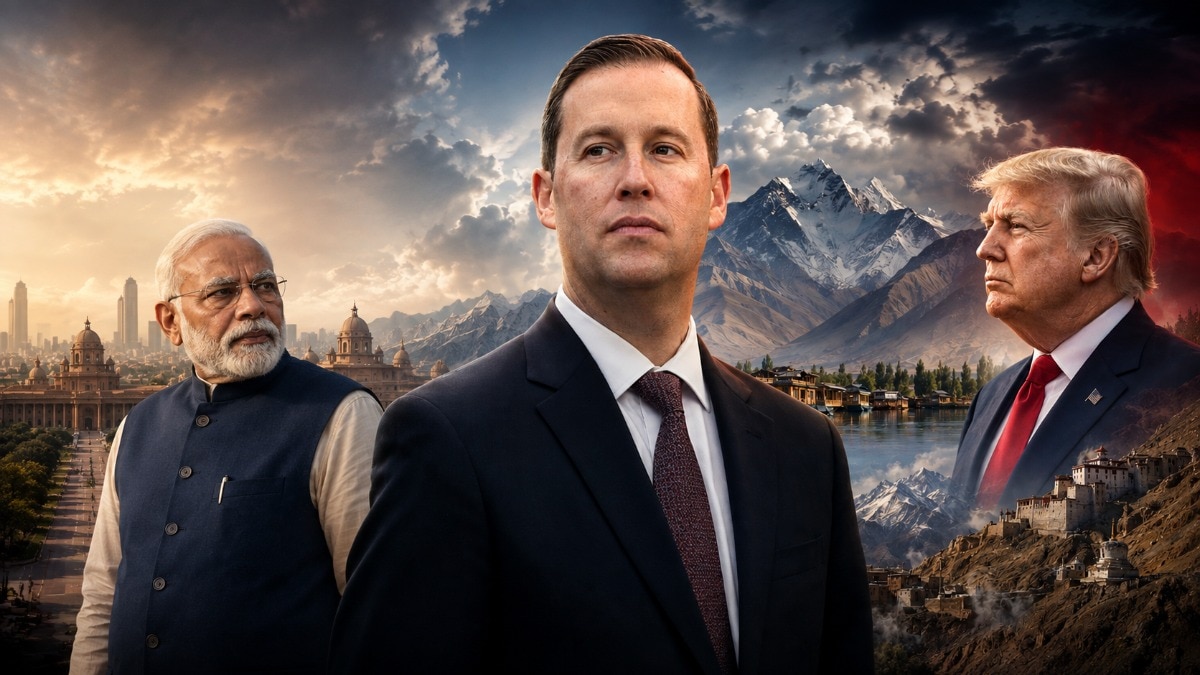
Ambassador Sergio Gor called Kashmir "an important part of India" — a sharp break from Washington's neutrality. Now in Ladakh, with a Dalai Lama meeting quietly shelved, Michael Kugelman, Senior Fellow for South Asia at the Atlantic Council, joins Geeta Mohan, Group Editor, Foreign Affairs, India Today Global, to decode the optics, the timing, and the China factor behind it all. Q: Let’s begin with the fact that Kashmir being called an important part of India is significant because while it does not seem like there’s a major policy shift in Washington, D.C., there certainly is a change in the way the language has been spoken, and in the way that America, or the American ambassador particularly, is viewing Kashmir and India.A: Absolutely. I mean, this is very significant. If you look at the words alone, it is not U.S. policy to describe Kashmir as an important part of India. I mean, the U.S. policy for quite some time has essentially been not to take a position, to stay out and say it’s something for India and Pakistan to decide. In that sense, what he said was significant, though indeed, as you suggest, it’s not clear if this reflects a new U.S. policy. I myself do not think it does.I think we need to keep the broader context in mind that ever since Ambassador Gor arrived in New Delhi to take up his post as ambassador, he has tried to do everything he can to get the U.S.-India relationship back on track, and he’s injected a more positive tone into the relationship. I mean, every public statement he makes is glowing in praise for India and their relationship. So in some ways, we could see this visit that he made to Jammu and Kashmir, and his comments about Kashmir, as part of a broader charm offensive that he is trying to lead. Now, I think the question is, does Gor and his advisers, do they know that when he makes a comment like he did, that that would indeed suggest a significant change in U.S. policy? I’m sure he’s got very well-informed advisers, and the fact that he made the comment is significant. But there could be a walk-back, quite frankly, and especially given that the Pakistanis have, of course, now formally complained.They called in the U.S. charg d’affaires to complain. We know that the Trump administration really seems to want its relationship with Pakistan to work for now. And once it realizes the damage that has come to the relationship with Pakistan, who knows? Maybe the U.S. side will essentially walk back what Gor had said. But bottom line, a literal read of those words he said, very significant, because it reflects the position that the U.S. has not taken for many years.Q: But, Michael, let me go to your first point, where you’re talking about his advisers. Do you think he’s aligned with the position that the White House, that the U.S. administration has normally taken on Kashmir, particularly the White House of today, would take when that question will be posed to them on Sergio Gor’s statement?A: Yeah, well, the mystery deepens here when you look at this very question, because as you know, Gor is very close to President Trump, and he’s one of, he’s long been, or for quite some time, he’s been one of President Trump’s most trusted advisers in Washington, going back to his previous role. So that gives added significance to these words that he had to say when in Srinagar. But if you look at what President Trump has said, you know, last year, not long after Operation Sindoor, President Trump said that he would like to offer to help India and Pakistan, quote, “solve the Kashmir dispute.”And so given that that’s the position that President Trump has said, which again is unusual for a U.S. president to say, that seems to contradict Gor’s position, which suggests that there’s no dispute, there’s no issue. Kashmir’s a part of India, which of course is India’s position. So it’s all very foggy, quite frankly.And you know, I would also say this, this administration is very unconventional. I would also argue very candidly that it is not the most disciplined when it comes to messaging and inconsistency. So I think that we ultimately shouldn’t place too much stock in what Gor said.And one would expect that if there really is going to be a change in U.S. policy toward Kashmir, that there would be some type of formal statement or acknowledgement of that, which there has not been.Q: Well, that again, you know, because we have seen President Trump talk about at one point in time, say, or offer mediation. And on the other hand, we have Sergio Gor, I don’t think he’s understood the import of the word “important part” or the term “important part of India” for New Delhi, for Washington and for Islamabad. Because yes, Pakistan is indeed riled at a time when Pakistan has gone out of its way to engage the Trump administration.A: Yeah. And honestly, this makes Pakistan look not very good because, you know, we all know what Pakistan has been doing since the Trump administration took office, right? It has, it has, for the second time, it has resorted to all forms of flattery.It has made all types of concessions to the United States. It has held many high-level engagements with senior U.S. officials. There’s been a lot there.It is trying to appeal and pitch itself to the United States in terms of offering up its critical minerals and so on. And then you have this comment from Gor on an issue that is so incredibly important for Pakistan. And as you know, many Pakistani leaders have called Kashmir Pakistan’s jugular vein.I mean, this is, you know, from a policy standpoint in Pakistan, one of the most important issues out there. And then Gor goes out and makes a comment that appears to reflect very closely the Indian position.Q: And not to forget, not to forget, Michael, that he’s not just ambassador to India. He’s the special envoy to South Asia and Central Asia. That’s a bigger role.That means he does have a say on America’s position when it comes to Pakistan and India, not just India.A: Right. And it’s through that second position as special envoy to South Asia that he reports directly to Trump. And that’s important to note.I mean, as ambassador to India, in principle, he reports to the secretary of state, who is also the national security advisor. But as a special envoy, he reports directly to Trump, who is indeed, as we’ve discussed, a very close someone who Trump places a lot of trust in. So this is why this is not just—I mean, I may sound like I’m contradicting myself.We shouldn’t overstate on one level the comment made by the ambassador. But there is significance in the words simply because of who Gor is.And as you know, the two hats he wears and because of how close he is to President Trump.Again, let’s see if we hear if there’s some follow-through. Let’s see if the U.S. Embassy in India releases a statement with the clarification. I haven’t seen anything yet, but that’ll be an interesting signpost for the next few days.Q: Absolutely. In all probability, we will hear an official position from the White House and the State Department. But it’s not the first leg of his journey that’s just very interesting.It’s the second part of the journey that’s actually more interesting because he’s in Ladakh, Michael, and that’s sensitive because over here you can still—the White House or Washington, D.C. can still tell Pakistan or explain it to Pakistan. How do you explain to Beijing his visit to Ladakh and particularly the fact that he was actually going to meet the Dalai Lama? We hear he’s no longer going to meet the Dalai Lama.And I’ll ask you about that. But the visit itself.A: Yeah, I mean, I think that it’s, from a U.S. standpoint, first of all, we don’t know, at least to this point, we don’t know who Gor will be meeting with in Ladakh. Will he be meeting with local officials?Is he just going for tourism? We really don’t know that yet.So I think that how this trip plays out will really determine how exactly the U.S. would explain or justify this visit to a Chinese audience.But I suspect that the U.S. side would essentially say that this is just part of an extended trip that the U.S. ambassador to India is making as in his writ. And in that sense, you know, the U.S. side would gloss over the fact that, you know, from China’s perspective, this is a disputed territory. And again, until we know who exactly he’s meeting with or what the visit, what the main reason for his visit is, it’s really hard to get a sense as to what’s happening.But symbolically, this is a very significant visit because it is the first time, so far as I know, that a U.S. ambassador or really a U.S. official, a senior U.S. official, is visiting Ladakh since the events of August 2019 when you had the Article 370 revocation. So it’s a first in that sense. And that makes it a pretty significant trip.Q: Well, that’s right. A first by U.S. ambassador. But more importantly over here, Michael, the fact that there was initially information that he will be meeting with His Holiness the Dalai Lama, a Tibetan spiritual leader, who certainly is a red line for Beijing.And now we’re told he’s not going to meet. So it does seem like there’s one country that they do not want to rattle at this point in time when the leaders of China and U.S. are to meet in September. That’s Trump and Xi Jinping.A: Yeah, absolutely. I agree with that. I mean, first of all, the Trump administration has taken a very ambiguous position toward China.It hasn’t really stated a clear policy. And it seems to alternate between viewing China as a competitor and as a country that the U.S. would like to reach some sort of understanding with. And, you know, even President Trump has treated China with kid gloves, taking a cautious approach.And I think that one of the main reasons for that is recognition of and respect for China’s leverage because of the power of its economy and its control of, you know, supply chains and its critical minerals and rare earths and all of that. So in that sense, I think we could see this Ladakh visit as fitting right into that. And I think that the idea here is, on the one hand, to visit Ladakh, you know, to show, you know, solidarity, friendship with India, whatever the case might be.But by avoiding the meeting with the Dalai Lama, there’s a recognition of China’s red line and the decision not to do something that could provoke a fresh crisis in U.S.-China relations not long before this expected meeting of Trump and Xi. And, you know, Trump not wanting to or the U.S. government not wanting to face the risk of China responding or retaliating in some way that could undercut U.S. economic interests is because of all that leverage that China has because of the clout of its economy in the global sphere. So I’m not that surprised, quite frankly, that this meeting with the Dalai Lama is reportedly not going to happen.Q: But this is kind of a shift when it comes to the White House and their previous policies on Tibet and the spiritual leader. We’ve seen lawmakers time and again actually go and meet with and call on the Dalai Lama, primarily and particularly more so from the Democratic Party than the Republican Party, Michael. But it has happened in the past.Here he’s a serving ambassador, and so things become more complicated and sensitive. Both sides might not acknowledge it, but you do see that this is Chinese pressure, don’t you?A: Yeah. Well, I mean, from what I recall in terms of recent U.S. engagements with the Dalai Lama, they were members of Congress. They were not members of an administration in terms of recent encounters.So that’s an important distinction to make. So I think that, again, this is not that surprising. I don’t know the extent to which China has pressured the United States not to engage with the Dalai Lama. I can’t speak to that. But my sense is that this is what Gor plans to do on this trip to Ladakh. It’s a very successful balancing act that he’s carrying out or trying to carry out.Going to Ladakh, making clear the importance of the U.S.-India relationship by going there, but at the same time holding back from doing something that could provoke China in a really big way.Q: OK. Now, zooming out a little, because we’re talking U.S.-China at a point where Trump administration really does not want to upset Beijing ahead of a crucial meeting. But China also is very important, not just when it comes to supply chains or when it comes to engagement, when it comes to the economy, but also when it comes to the wars.It’s not just this part of the world, but also West Asia. At this juncture, not having China on your side is a bigger problem than having China on your side.A: Yeah, absolutely. And, you know, I mean, China, I mean, we hear so much about U.S.-China competition. But China actually, as you know, I’m sure, remains a critical trade partner for the United States, one of its biggest trade partners.There’s a lot going on there. And indeed, given what’s going on with the war in Iran, China’s buy-in for peace process is very significant because of its own ties with Iran, China’s relations with Russia, which are complex and a bit shaky and hard to figure sometimes. But they do have a partnership, and that’s something that the U.S. recognizes as well. So I think that there’s a lot of incentives for this administration not to do anything that could provoke China, so long as Beijing itself does not do anything to provoke the United States. And certainly this administration, like previous ones, has been increasingly concerned about some of the maneuvers and provocations that China has been carrying out in the South China Sea and so on. But otherwise, I think there’s a view that it’s important to try to keep a hands-off approach.Now, if we were to role-play and assume that there’s a scenario under which China stages a provocation along the LAC, much like what we’ve seen so many times in the past, what would the U.S. response be to that? Well, it’s an interesting question. One would assume reflexively that the U.S. would immediately come to support India in terms of expressing its support for India in any type of contingency. But given how strange diplomatic relations have been over the last year-plus, with the U.S. and India having a tough time in their relationship, U.S.-China still a competitive relationship, but one in which tensions have eased a bit, one cannot necessarily predict with certainty how the United States will respond.So bottom line is that things are different now than they had been before the Trump administration came back to office. And I think it’s important to keep that in mind as we look at how the U.S. goes about its maneuvers in thinking about how to engage with China.Q: Final question to you, Michael, before I let you go. Gor’s visit to Kashmir and then to Ladakh. I mean, Kashmir, fine, but Ladakh and then asking for a meeting with the Dalai Lama, do you think in hindsight the team and his advisers could have done better?A: Well, I mean, it depends on what the objective was. If the objective of this trip to Kashmir and to Ladakh was to take steps to try to improve the U.S.-India relationship, you know, I think that there’s been success. And I don’t think that Gor not meeting with the Dalai Lama, I don’t think is something that’s going to really cause a stir in New Delhi.I think that on the whole, there’s a view that the fact that he was in Kashmir, said the things he did, went to Ladakh is helpful for the relationship moving forward. But if there are other objectives that the U.S. had for this visit, then maybe then one could be more critical. But, you know, it’s unclear to me.I don’t think there’s been any type of official messaging, no type of official statement from the U.S. Embassy about this visit, or at least nothing substantive. So it’s sort of hard to make a judgment or make a call about whether the trip fell short. But if the U.S. wanted to avoid a situation where its longtime policy toward Kashmir could be called into question and where Pakistan could get upset, if the U.S. wanted to avoid outcomes like that, well then, yes, then there was a failure. Because we’ve seen that those are the exact outcomes that have played out because of that one sentence that Gor uttered about Kashmir being an important part of India. - EndsPublished By: indiatodayglobal Published On: Aug 21, 2026 22:23 IST
"We Shouldn't Overstate the Comment, But It Is Significant Because of Who Gor Is"
Full Article
Original Source
Read the full article at Indiatoday →KhanList aggregates and links to publicly available news content. We do not host full articles from third-party sources. Always verify important information with original sources.