
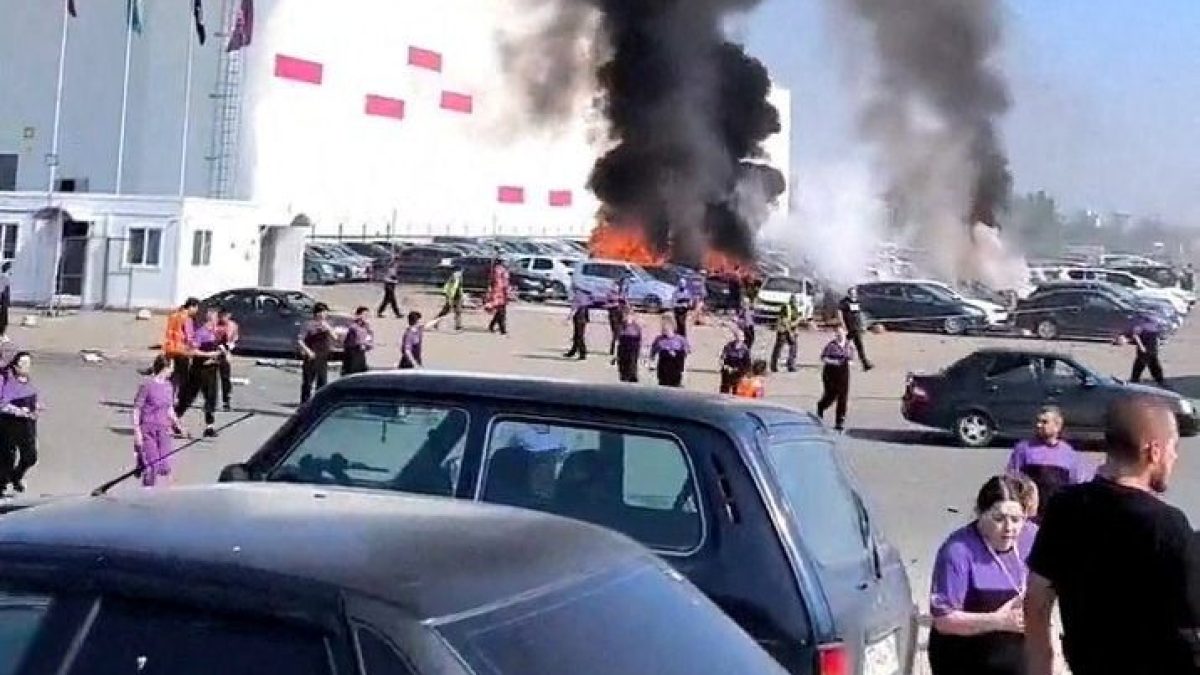
Ukraine’s attacks on oil refineries across Russia, followed by its campaign against warehouses operated by e-retailer Wildberries – “Russia’s Amazon” – appear to have changed the conversation inside Russia. The war suddenly seems a lot closer to home for many. Earlier this week, Russia’s state television channel Vesti broadcast an interview with Sergei Sobyanin, the mayor of Moscow. The interviewer asked whether some of the capital’s resources should be redirected to support the war economy. Shorts Sobyanin’s response was blunt: “If there is no functioning peacetime economy, there will be no tax revenue, no household income and the political situation will be completely different… Destroying everyday life and a normal economy would mean destroying the country itself.” It was a statement that would have been highly unusual even a month ago. On 18 July, Kyiv began targeting Wildberries warehouses across Russia, which Ukraine describes as dual-use infrastructure: commercial facilities that also serve as logistics hubs for its military. So far, nearly two dozen Wildberries warehouses have been attacked, including ones outside Moscow, St Petersburg, in the Volga region and as far away as the Ural mountains. Social media platforms and messaging channels are now filled with videos showing explosions and thick black smoke. Russians filming them often react with anger and profanity, while some of those who claim to have lost their stock have shared their stories online, crying as they describe their destroyed businesses. Smoke rises over St Petersburg following a drone strike targeting logistics facilities operated by Wildberries (Photo: Getty) If Kyiv’s aim is to bring Vladimir Putin’s war closer to ordinary Russians, it appears to be working. Olya, a mother of two who owns a dacha south of Moscow, told The i Paper: “This summer the war truly came to us.” Olya lives in a village near one of Moscow’s air defence installations. “Once, for three nights in a row, we heard explosions every 5-10 minutes,” she said. “We heard the drones, too. It’s a frightening sound. I lay in bed clutching both of my children thinking that if we are hit, this is the end.” Olya says she never supported Russia’s so-called “special military operation”. “I knew all along that the war would come to us,” she added. “It is impossible to bomb Kyiv and other Ukrainian cities and believe there will be no response. A war cannot be one-sided.” A pensioner living in a small town in the Urals, who asked that their name not be used, expressed a similar view. “I feel sorry for the people who lost their businesses and livelihood,” she told The i Paper. “They work hard, they want to look after their families. But you have to remember who started it all. If you poke a hornet’s nest, you cannot be naive to think the hornets won’t defend themselves.” “Ordinary people suffer because one heartless, resentful man is using them for his own personal ambitions,” she added. “I am ashamed of all the pain and suffering he has caused.” A Wildberries warehouse in Krasnodar before and after strikes on 5 August (Photo: Vantor/AFP) Russian consumers are feeling the pinch. Wildberries and its rival Ozon are used by around 90 per cent of the population. People all over the country, especially those who live in remote areas, depend on local delivery hubs of these online retailers for many of their shopping needs. State media has, meanwhile, tried to downplay the damage caused, but some 185,000 vendors have reportedly received compensation. Putin has notably not publicly commented. On 5 August, Russia’s central bank revised its forecast for 2026 inflation from 4.5-5.5 per cent to 6-7 per cent, driven by the rise in fuel prices, showing the impact of Ukraine’s attacks. Not everyone is worried, however. Katya, not her real name, is the CEO of a small manufacturing company in Yekaterinburg, in the Urals. Katya considers Russia’s military campaign in Ukraine a matter of national security and thinks that war means war and that the Wildberries attacks are just an example of an “enemy’s targets was hit”. She says that many Russians are tired of the conflict and think it’s time to take the gloves off and intensify their attacks on Kyiv. Across state-owned TV channels, the common view now being expressed is that the US and Israel get to do what they like in the Middle East, while Russia is being singled out as a pariah. Some commentators on evening talk shows regularly discuss using tactical nuclear weapons. Many Russians who consume state television today have little personal memory of the fear surrounding the Cold War arms race. Meanwhile nuclear talk has become so routine that it has lost its gravity. The Yars intercontinential nuclear launchers during a military parade in Moscow last year. Some in Russia are regularly talking up the idea of a tactical nuclear strike on Ukraine (Photo: Getty) Andrey Kolesnikov, a Russian political commentator, argues that Russians have adapted to the war and are taking fuel shortages, problems with mobile data and drone attacks in their stride. “Of course, there is war fatigue, and the difficulties caused by the war are making many things drag on,” he said. “At times, this fatigue turns into frustration, but there is little one can do about it. All that remains is to adapt and take another step towards accepting the ‘new normal’.” But even so, he said that most Russians are desperately longing for peace, “so desperately that some participants in sociological surveys are willing to support a tactical nuclear strike that would cut through the Gordian knot of the war”. Kolesnikov said the logic is: “Ukraine will have to surrender, the West will not dare to respond with nuclear weapons, and after our ‘victory’ we will live in peace, just as we did before the war.” It’s a worrying reality, and shows how powerless some Russians feel. As the war comes closer to home, it increasingly feels like something they have to endure – without any ability to influence it.
‘We poked a hornet’s nest’: For Russians, Putin’s war suddenly feels far too close
Full Article
Original Source
Read the full article at Inews →KhanList aggregates and links to publicly available news content. We do not host full articles from third-party sources. Always verify important information with original sources.