
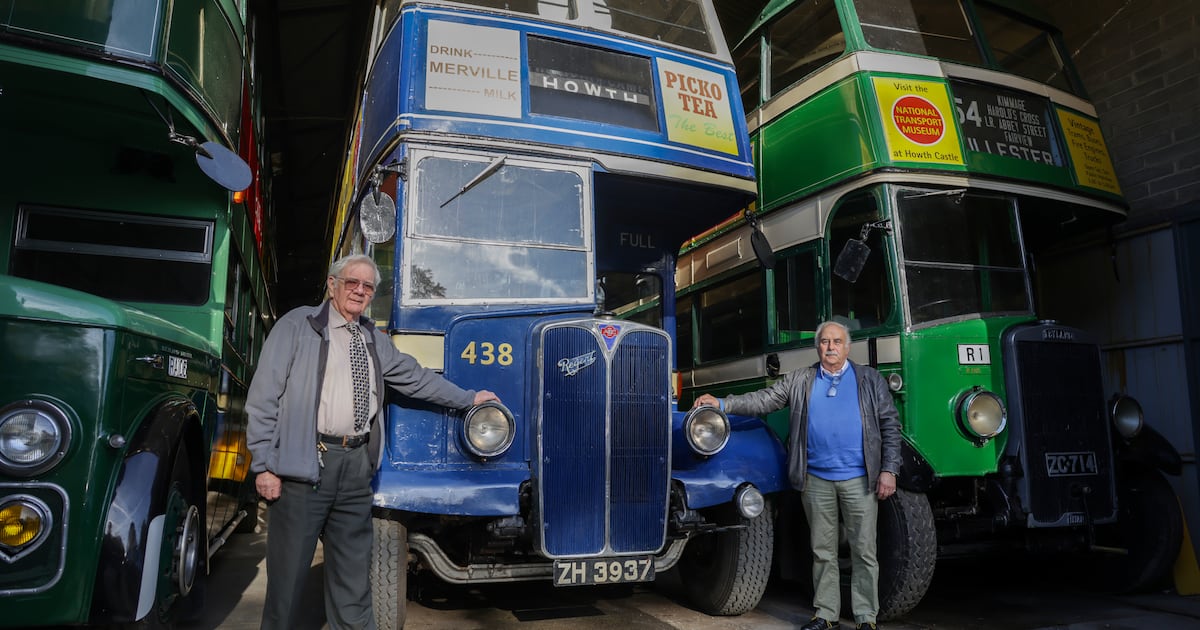
Unique collection has been paying ‘peppercorn rent’ under 1980s agreement with Howth Castle due to end in 2028John Kelleher and Bill Garrioch, directors of the National Transport Museum of Ireland. Photograph: Enda O'Dowd/The Irish Times The National Transport Museum is home to horse-drawn carriages used at Boland’s Mills, some of Ireland’s earliest motorised fire trucks, an old Dalkey tram and many historic Defence Forces vehicles. Based at Howth Castle in north Co Dublin since 1985, the museum’s goal is to restore and retain Ireland’s transport history. However, it is facing an uncertain future, with the lease on its premises having less than two years to run.The volunteer staff fear the museum’s stay of more than 35 years in Howth could end at that stage and they are desperate to secure its future. A failure to find a new home could, they say, result in its collection having to be sold off.READ MOREJohn Kelleher, a director of the museum, says it has been paying a “peppercorn rent” since moving from a location in Co Wicklow to outhouses at the side of Howth Castle. A few years after the move, the then owner of the estate, Christopher Stephen Gaisford-St Lawrence, known locally as the Captain, drew up an agreement for it to stay, with a small percentage of museum revenue paid to occupy the buildings.“It is a unique collection,” Kelleher says, walking between some of its trams. He knows everything about every single tram, truck, armoured car and bus in the museum. The only thing he does not recall is exactly how many vehicles it has. “Hundreds,” he says, adding that it is the “most comprehensive collection” of vehicles in the State.John Kelleher and Bill Garrioch are directors of the National Transport Museum of Ireland. Photograph: Enda O'Dowd/The Irish Times The museum’s volunteer staff have painstakingly restored most of these by hand, with the former Dublin United Tramways Company tram number 253 a good example.The 74-seater tram, built in Inchicore in 1928, served on the Lucan tramline until it was converted to a bus route. It was moved to the Dalkey line in 1940, operating there until the line was retired in 1949 and the trams were sold off.The 253 eventually came into the possession of St Joseph’s Convent, Dún Laoghaire, where it stayed for nearly 40 years. It was converted into a classroom and later used as overflow accommodation during retreats, Kelleher says.Exposure to the elements caused the tram’s condition to deteriorate. It was donated to the museum in 1987 and restored by staff and young people at a Fás workshop in Broombridge.Kelleher says the trams and buses are a hit with visitors, with some remembering them in operation along the city lines.For now, the vehicles sit in the outhouses and warehouses the museum occupies beside Howth Castle. But, like the vehicles stored inside of them, the premises would need significant repair work and restoration if the museum is to stay where it is.[ The Times We Lived In: Dublin trams that went off the railsOpens in new window ]Investment is needed to repair visible holes in the roof and to prevent mould and damp from damaging the exhibits. The museum is reticent about spending to address these issues due to the uncertainty about whether its stay will extend beyond October 2028.Even though the buildings are cramped and moving between the vehicles is a challenge at times, taking them elsewhere would be a mammoth task and one the staff would sooner avoid, if possible. Kelleher says two years would be a “very short time” in which to have to shift the collection. He says museum staff have spoken to management of the Howth Estate, now owned by the Dublin-based investment and development company, Tetrarch Capital, but no assurances have been received.A spokesman for Tetrarch declined to comment, but it is understood the company does not believe negotiations with the museum have begun regarding a new lease.Should a move become necessary, Kelleher says he has no idea where the museum would go, but the preference would be to “stay in Dublin” and ideally in Fingal. [ Arsonists blamed for burning rare vehiclesOpens in new window ]Talks with the local authority on finding a permanent home and a more visible location have been ongoing for years, with various Government departments also involved.In an ideal world, Kelleher says he would like to see the museum incorporated into a State body in a similar way to how the National Museum of Ireland houses art originally part of the RDS collection.He offers Scotland, whose national transport museum is located in a purpose-built premises, the Riverside Museum in Glasgow, as an example.Fingal County Council says it has tried to help the museum find “a new location within Fingal” but a suitable option has not yet emerged. It plans to continue engaging with the operators in an attempt to identify a premises “to meet their needs and ensure that the museum remains in Fingal”.“The big problem is uncertainty,” Kelleher says. “We need a commitment. The last thing we want is to be told at the last minute that we are out.”IN THIS SECTION
‘We need a commitment’: National Transport Museum fears closure as lease nears expiry
Full Article
Original Source
Read the full article at Irishtimes →KhanList aggregates and links to publicly available news content. We do not host full articles from third-party sources. Always verify important information with original sources.