
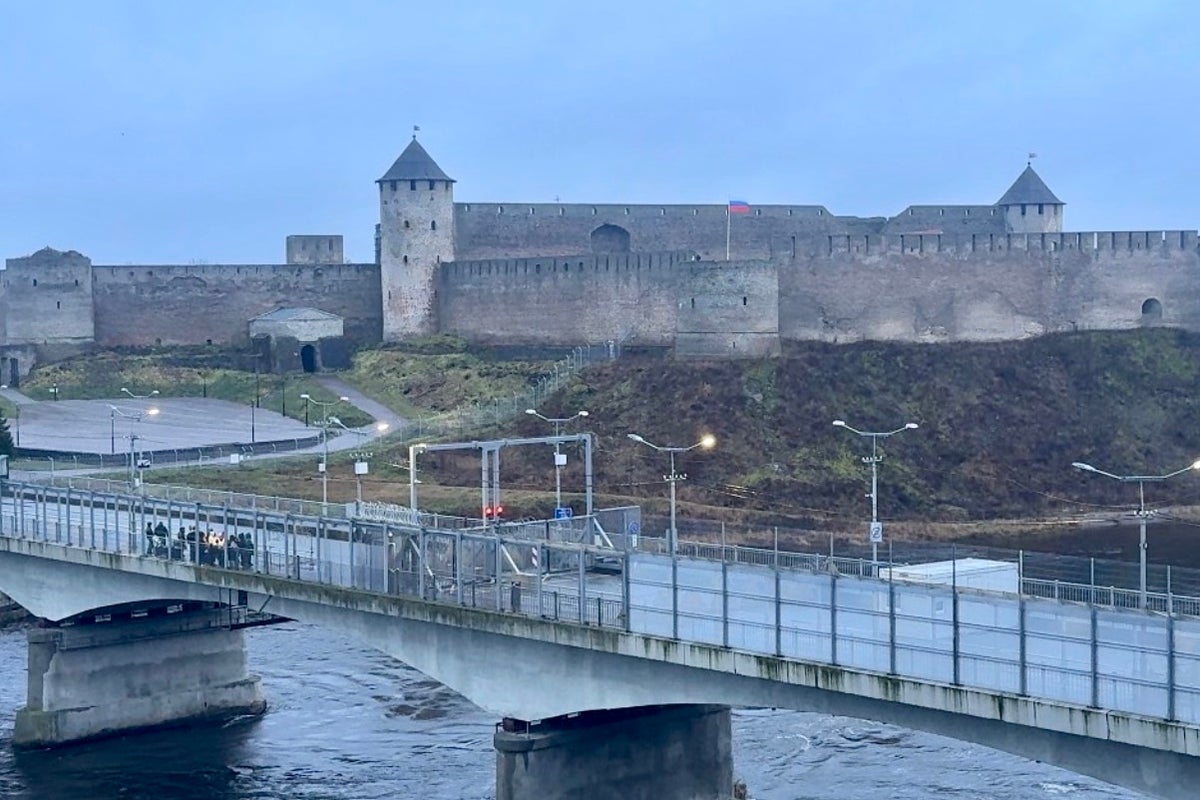
On a cold morning in late November, a line of people is steadily forming on the “Friendship Bridge” crossing the Narva River that connects Estonia with the Russian border town of Ivangorod. Bundled up against the sub-zero temperatures, with many dragging suitcases or pushing children in prams, these men and women are leaving the Estonian city of Narva at one of the few remaining open land borders with Russia. Some may be visiting relatives in St Petersburg, others are Russians returning home, while a few are crossing into their eastern neighbour for a few hours’ shopping. In a few days, these crossings will no longer be possible after Estonia announced it will close its border with Russia from December 1 for at least six months. Foreign Minister Margus Tsahkna said the government made the decision to halt road border crossings because Russia is acting “more and more aggressively” towards not only Estonia, but to Europe as a whole. He warned that Russia “has been boiling Europe as a frog, turning up the heat”, and said Estonia has run out of patience. Eerik Purgel, from the Estonian Police and Border Guard at the Narva-Ivangorod crossing (Annabel Grossman/The Independent)Mr Tsahkna pointed to Denmark, where in the past few days a Russian official has been expelled over an alleged plot to assassinate Ukrainian-American rapper Albert Vasiliev.“They are waging the full package of attacks against Europe,” Mr Tsahkna said. “Russia has pushed all the limits,” he said. Estonia announced plans to close the border following a suspected arson attack on drone company Threod Systems, close to the capital city Tallinn, which Estonia blames on Russia. Mr Tsahkna said this was the “trigger” to closing the border, but not the main reason. He said: “It's about Russian attacks against Europe … terror attacks and sabotage attacks.” He added that as a bordering country Estonia needed to send a clear message, as Europe is “wide open” to Russia at the moment.Pedestrians gather at the border crossing on 'Friendship Bridge' connecting the Estonian town of Narva with Ivangorod in Russia (Annabel Grossman/The Independent)“I think that European people should finally understand that Russia is… attacking Europe, dividing us, dividing our societies, playing with our fears.”At the Narva-Ivangorod border crossing, Eerik Purgel, from the Estonian Police and Border Guard, said the attack on the drone factory is just one of many provocations from Russia. Estonia believes that Russian Secret Services have been crossing the border to recruit, and have been deliberately sending groups of migrants up to the border to test their neighbour. At the end of last year, Estonia accused three Russian border guards of illegally crossing into their territory on a hovercraft across the Narva river. Mr Purgel said: “We understand who the neighbour is and what are the dangers behind this neighbour.“As we faced the provocations in the last year, we have actively been preparing for whatever provocation might be happening next.” Estonia's foreign minister Margus Tsahkna at the Warsaw Security Forum last month (Getty)Estonia is one of only three European Union countries that still allow road border crossings with Russia – the other two being its Baltic neighbours Lithuania and Latvia. Finland, which shares a 1,343km-long border with Russia, closed crossings in 2023 after accusing Moscow of sending a surge of migrants that posed a serious threat to national security. Mr Purgel estimates that at present only around 500 people cross the border at Narva every day, down from roughly 1,500 a day a few weeks ago. Before Covid, he puts this number at 25,000. Estonian police data shows that of the 760,000 people who crossed the Estonia-Russia border this year, some 307,000 were Russian citizens, 175,000 were Estonian, and 54,000 were Finnish. Narva, which is located in the northeast of Estonia, is the country’s third largest city, home to around 60,000 residents. Around 95 per cent of the population are native Russian speakers and many have family ties across the border. The city of Narva sits across the border from Ivangorod, geographically closer to St Petersburg than Tallinn (Datawrapper/The Independent)Two imposing fortresses face each other across the Narva River. On the Estonian side sits the 700-year-old Narva castle with its 51-metre tower, on the eastern bank is the Russian Ivangorod Fortress, built in the 15th century during the reign of Tsar Ivan III.Moscow responded angrily to the news of the border closure, denying involvement in the suspected arson attack on the drone factory and accusing Estonia of trying to erect a new “Iron Curtain” along its border. It said Russia would respond with “the necessary political and diplomatic measures in response to safeguard its national interests”, should Tallinn go ahead with its plans.Border police at the crossing above Narva River (Annabel Grossman/The Independent)On Monday, Russia’s Foreign Ministry accused Estonia of hostile actions “bringing the situation to the brink of open war”, claiming that Estonia had been “tacitly” allowing Ukraine to use its air space for drone flights to carry out attacks on northwestern Russia.Estonia’s foreign ministry released a statement insisting: “Estonia has never allowed, and will never allow, its territory to be used for military operations by another country.”Mr Tsahkna said that the closure of the land border crossing between Russia and Estonia will be reconsidered in six months: “If we see that there can be peace with Russia in the future … we will review the decision.”
‘We must prepare for our dangerous neighbour’ - On Estonia’s closing border with Russia
Full Article
Original Source
Read the full article at Independent →KhanList aggregates and links to publicly available news content. We do not host full articles from third-party sources. Always verify important information with original sources.