
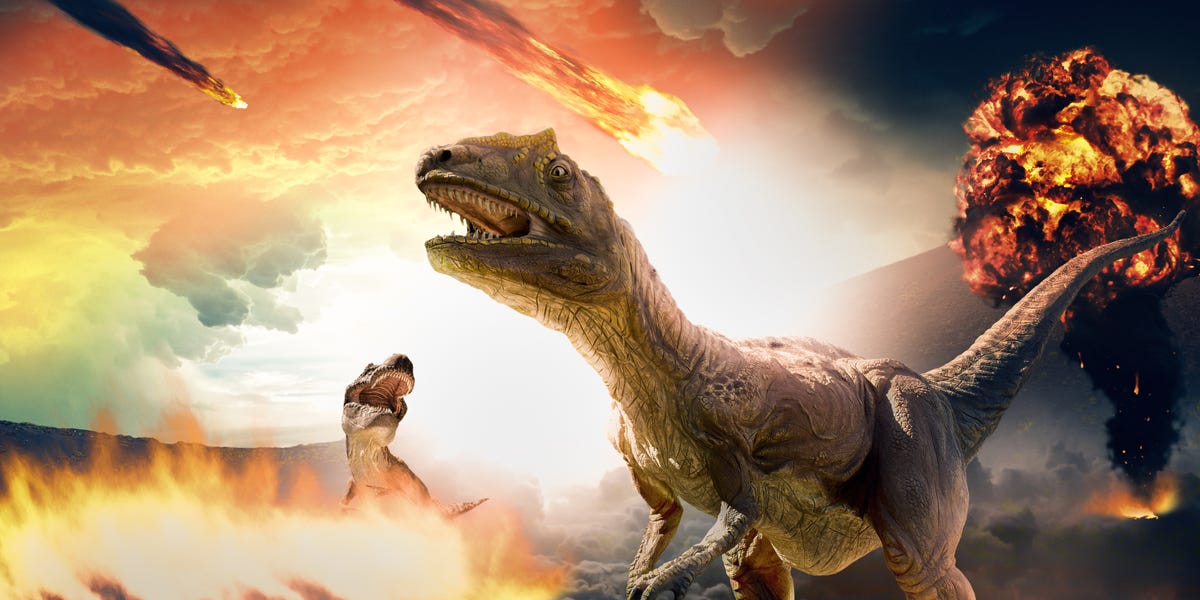
3 min readIf the story of life on Earth was divided into chapter titles, the planet’s five known “mass extinctions” would no doubt feature prominently. Stretching from the end-Ordovician (or Ordovician-Silurian) extinction 440 million years ago all the way to the end-Cretaceous extinction that forced all land-based dinosaurs to exit stage left, these dramatic, page-turning periods of biological upheaval each functionally wiped the slate clean for a new era of a life to take hold.And while we usually think of these extinction events as abrupt changes—things certainly don’t get much more abrupt than an asteroid smacking the Yucatán at roughly 16 miles per second—new research presented at the Geological Society of America’s meeting in Denver suggests that a majority of these “mass extinctions” never happened, or at least not as we perceive them. To arrive at this bold conclusion, Shuzhong Shen at Nanjing University in China used an AI model called OneStrata (a reference to stratigraphy, or the study of rock layers) trained on fossil data to bring our fuzzy understanding of these past events into sharper focus.“The canonical ‘Big Five’ mass extinctions have long been regarded as the principal drivers of Phanerozoic marine biodiversity history. This paradigm, however, was built upon taxonomic range compilations and stage-level time bins that cannot resolve ecological dynamics operating on timescales of thousands to tens of thousands of years,” the authors write. “Here we present OneStrata, a transformer-based AI foundation model that learns a shared probabilistic representation of geological time directly from fragmented stratigraphic observations.”As Nature explains, OneStrata does this in much the same way that a large language model trains on texts to predict the next word in a sentence. But instead of texts, OneStrata relies on a huge dataset of fossil information called OneStratigraphy. Typically, stratigraphers group fossil specimens into time spans of millions of years. While this effectively blurs the overall timeline, especially at shorter intervals, it allows researchers to work with the large body of information more easily.For years, Shen and his colleagues have leveraged groundbreaking technologies in an attempt to improve the resolution of these fossil timespans from millions of years to just tens of thousands of years. In 2020, for example, Shen and a team of Chinese scientists used a supercomputer to approach a resolution of roughly 26,000 years. Their dataset included 11,000 marine fossils from more than 3,000 stratigraphic sections, creating a new diversity curve that stretched from the Cambrian to the Triassic—roughly 300 million years.The 2020 study showed that the Late Devonian mass extinction, around 360 million years ago, unfolded gradually, with biodiversity declining over roughly 50 million years. By comparison, most life vanished during the End-Permian mass extinction in just 63,000 years.This new study uses OneStrata to predict where millions of fossils—from tens of thousands of different sites—will fall in the record, producing a resolution of merely 1,000 years. The analysis indicates that three of Earth’s five mass extinctions—the Late Devonian, end‑Triassic, and end‑Cretaceous extinctions—actually occurred over millions of years. However, Shen notes that this is a biodiversity curve, and it’s possible that species were actively going extinct while others were quickly taking their place.Even the definition of a “mass” extinction is subject to debate. As New Scientist notes, estimates of the number of mass extinctions range from three to as many as 20. Many experts believe we’re currently living through a sixth mass extinction due to anthropogenic climate change.Millions of years in the future, maybe even the devastation of today will be little more than an indecipherable, blurry chapter in Earth’s ongoing stratigraphic story.Darren lives in Portland, has a cat, and writes/edits about sci-fi and how our world works. You can find his previous stuff at Gizmodo and Paste if you look hard enough.
We May Be Living Through a Sixth Mass Extinction—but Scientists Think Some of the First Five Never Happened
Full Article
Original Source
Read the full article at Popularmechanics →KhanList aggregates and links to publicly available news content. We do not host full articles from third-party sources. Always verify important information with original sources.