
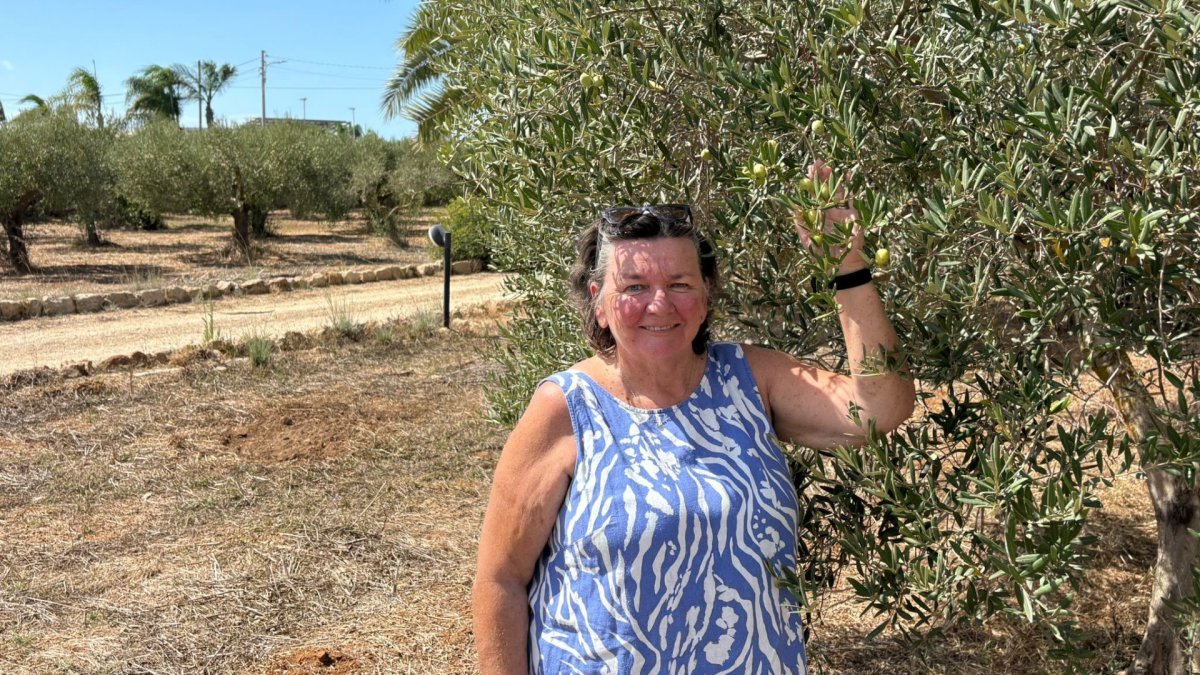
Around half a million people leave the UK to live abroad each year. A survey by the British Council showed 72 per cent of 18- to 30-year-olds would consider living and working overseas, with cold weather, the high cost of living, extortionate childcare, a lack of work-life balance and even poor romantic prospects among their motivations for leaving the country. The i Paper’s Expat Files follows Britons who have taken the leap and settled elsewhere, detailing the ups and downs of their journeys.Nichola Hynes, 62, left London in 2019. She and her husband James, 62, moved to sunny Marsala, in Sicily, where she bought a villa with an olive grove. But the dream was not quite the reality. Here she shares her journey. Each day, this stunning place reminds me how London is dirty, grey and dangerous. Marsala is sunshine, sea air and blue skies. Moving here has allowed me to fulfil my rustic, lifelong dream of living in a beautiful rural area and having olive trees. Some of these olive trees are over 60 years old, and in the early morning, if it has rained overnight, the air is fresh, and you can smell the fennel and rosemary. Harvest season is fun, and tasting the oil as it comes out of the press is one of the best things ever. Shorts As a child, I would spend summers on my great-uncle’s farm in Ireland. I’ve always been more drawn to the countryside, so having so much space is fabulous. In London, I had just enough outside space to park my car. We were based in southwest London, close to the Surrey border, where James had been a partner in an accountancy and insolvency practice for 38 years. Prior to moving, I held many different roles: English teacher and translator, financial advisor administrator, gaming and betting industry manager and sommelier. Now, I manage the olive grove and handle a few holiday rentals in the area. I learned to look after olives after working with a contadino (local farmer) who had managed the plot for the past 20 years. We discovered Marsala by chance in 2014, on a rainy day in San Vito lo Capo when we went for a drive. We immediately fell for the place. There is something romantically magical about the sunsets, which, through the Garibaldi Gate and along the main road that leads up to the cathedral and the town, take on a sepia aura from the tufa stone. The people are warm and welcoming, and the food and wine cannot be beaten. We came back several times before deciding to buy here. I have approximately 190 olive trees and another 30 wild pomegranates, prickly pears, almonds, figs and wild fennel in the land surrounding our villa with a pool. We started looking for a home in 2017. Originally, we wanted an apartment in the centre of Marsala but could not find one we liked that did not need extensive work. Then I happened to see a photograph of our home in an agent’s window and asked to view it out of curiosity. The price was 10 times our cash availability, but I offered 50 per cent cheekily and left it on the table. Two weeks later, I was contacted by the agent, who said that with an increase of a minimal amount and closure within six months, the buyer would accept. The villa has a guest wing with three large double bedrooms, a large granny annexe and covered terraces. I had just put a brand new kitchen in our London three-bed house with terrace and repainted both inside and out so it was ready for market. We sold it quickly. Three months later, I travelled to Marsala in my little Italian sports car. We have been residents in Marsala since 2019, and in three years I can apply for Italian citizenship. Our rural villa on the outskirts of town in the UK would cost £1m; we paid much less for the Marsala villa, but I prefer not to share the cost. It still needs a lot of work, including a major storage rethink and new bathrooms, but we have put in a new kitchen, pool, hot tub and garden office, and I have since adopted 12 dogs from local pounds. But things are changing; the hot summers are terrifying, and I worry that it will only get worse. I now treat our olive grove more as a hobby these days. The stress levels aren’t worth the hassle for such low production. Climate change has been drastic over the past few years. We had much higher temperatures earlier in the year. It rained once on Palm Sunday and then nothing more until mid-September. The ground is so dry that the water evaporates rather than soaks in. My well dried up. In 2020, my harvest was 700kg of olives with a render of 22 per cent; last year, we harvested 310kg with a render of 16 per cent. If the well is dry, the trees don’t get watered, but drought also causes other problems; I have just had to buy a new immersion pump, as the one I had before burned out. While the cost of living is very affordable in Marsala – everything is half as expensive as in London, from groceries to eating out – labour costs have doubled in the post-Covid-19 era. Two workmen for three days is €600 (£505). Milling costs increase year on year; the stainless steel 50-litre tanks have gone from €60 (£50) in 2020 to €100 (£84) this year, and the green bottles are €2 (£1.60) each. This year, I’ll give my oil surplus to charity, as shipping to the UK now costs €6 (£5) per litre and I would have to charge €30 (£25) per litre to break even. Aside from the hidden costs, the biggest problem with moving from London to the far west of Sicily is bureaucracy. Luckily I am fluent in Italian now, so I can manage most problems, but very little English is spoken by civil officers, which often ends in reams of documents being printed off and highlighted for every appointment with the local council, health office and tax man. The lifestyle in Marsala is less stressful than London, far slower and more relaxed. Covid showed us that my husband could work remotely, and he travels back to the UK once every three to four months for a week. He can easily manage his team from the garden office, which is fully equipped. The cost of living compared to the UK is around half, but the produce is far superior and we eat seasonally. I have a local market gardener who supplies me with my fresh fruit and veggies; the fish is the daily catch, and we eat far less meat, so we are far healthier. Obviously, local wines are far more reasonably priced. We tend to eat out twice a week. From March to late October, we eat outdoors at the villa watching the sun set behind the Egadi Islands. We take time to enjoy the space and fresh air that we did not have in London, in spite of climate change.
We left the UK for Sicily – our villa with a pool would be worth a million at home
Full Article
Original Source
Read the full article at Inews →KhanList aggregates and links to publicly available news content. We do not host full articles from third-party sources. Always verify important information with original sources.