
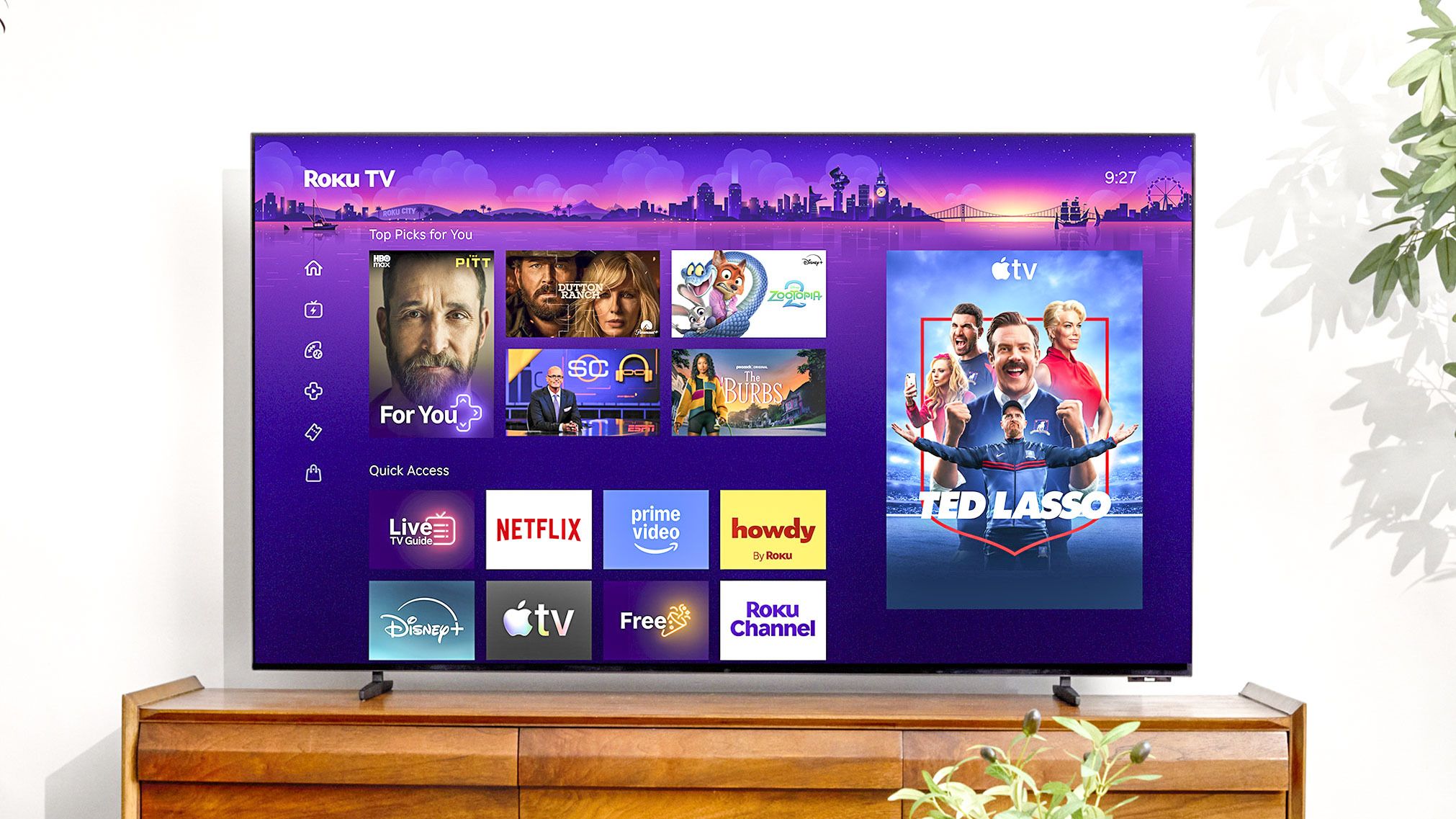
(Image credit: Roku) Roku is rolling out its first OLED TV, and stock is already lining shelves alongside rival sets from LG, Samsung and Sony. With its competitors having a generous headstart in the OLED sales race, Roku certainly has some catching up to do.But outside of sales, there’s another arena in which Roku might have to catch up: OLED performance. Sony, Samsung and especially LG have had several years to tinker with their secret formulas for self-emissive success. Despite using similar hardware as some of the best OLED TVs on the market, Roku’s engineers haven’t yet shown us what sort of performance they can get out of the tech.We’re still cracking away at our full-length Roku Pro Series OLED review, but in the meantime, I wanted to give folks a sneak-peek at some of our findings. Here’s how Roku’s brand-new OLED compares to two of the most popular models on the market. Meet the new Roku Home Screen | Roku - YouTube Watch On Roku Pro Series OLED test results: At a glanceOur test results for the LG C6 and Samsung S90H were taken when each of these TVs were set to Filmmaker, their most-accurate picture mode. The Roku Pro Series OLED does not come with Filmmaker mode, so its SDR results have been measured in Movie mode, while the HDR results below were taken in HDR Dark with its Display Brightness set to Brighter. Swipe to scroll horizontally Header Cell - Column 0 Roku Pro Series OLED LG C6 Samsung S90H SDR Brightness(10%, in nits) 331 360 226 HDR Brightness (10%, in nits) 574 1,365 1,497 Delta-E(lower is better) 2.3 1.6 1.6 Rec. 2020 Gamut Coverage 70.7% 75.8% 77.8% Given the Pro Series OLED's range of picture modes and brightness-related settings, it's quite possible to produce slightly brighter (or dimmer) results when measuring these test patterns.However, when comparing the numbers on the chart above, it's worth noting that the C6 and the S90H were measured with a similar set of constraints. As a result, these figures should give you some idea of the key differences in performance when a clean, accurate picture is in play.While there's not much of a difference between peak HDR brightness on the C6 and S90H, there is a sizable gap between those sets and the Pro Series OLED, at least when it comes to small, concentrated areas of brightness. These are known as specular highlights, and due to their self-lit pixels, OLEDs are particularly good at leveraging highlight brightness for added depth.Get instant access to breaking news, the hottest reviews, great deals and helpful tips.The inherent liveliness of an OLED's eye-popping micro-contrast is good news for the Pro Series. Its peak highlight brightness may not be as high as its competitors, but because these objects are being shown on a display capable of perfect black levels, its 500 to 700 nits of HDR brightness appears brighter than it would on an LCD/LED-based TV.Its 500 to 700 nits of HDR brightness appears brighter than it would on an LCD/LED TV.But don't get it twisted: The C6 and S90H are nevertheless the brighter TVs. HDR movies, shows and games will pop on these sets more than they will on the Roku Pro Series OLED.In SDR — particularly in an accurate picture mode like Movie — the Pro Series hangs tough with its rivals. No OLED TV can safely offer the room-filling, full-picture brightness you might see on a high-powered Mini-LED or RGB LED TV, but for everyday content like cable TV and YouTube videos, the Roku Pro Series offers a similar presentation as the C6 and S90H. It also delivers a finely tuned, accurate picture in Movie mode.Lastly, let's chat color. The Pro Series OLED's limited brightness partially explains its limited HDR color range, as its simply not bright enough to produce some of the dimmer, subtler shades you'll see on the LG C6 and Samsung S90H.It's an entry-level OLED, after all (Image credit: Roku)Technically speaking, the C6 and S90H are mid-range models, as they're each sandwiched between entry-level and flagship OLEDs in both brand's respective lineup. One could easily make the argument that, as an entry-level OLED, the Roku Pro Series isn't fairly matched up against this pair of rivals.The pricing bears this out. The 55-inch Roku Pro Series is currently $999 on Amazon, while the 55-inch C6 and S90H are each $1,499.A closer match-up would be between the Pro Series OLED and the LG B6 — LG's most-affordable OLED TV in 2026. On Samsung's side, the S85H OLED represents the brand's cheapest mainline OLED TV this year.For what it's worth, the 55-inch B6 and S85H are priced between $999 and $1,199 at the time of publishing, which is closer in line with Roku's most-affordable OLED. In the coming weeks, we'll be taking a closer look at how the Roku Pro Series OLED compares to LG and Samsung's entry-level sets. Follow Tom's Guide on Google News and add us as a preferred source to get our up-to-date news, analysis, and reviews in your feeds. More from Tom's GuideI ditched LG's webOS smart platform for Roku and I'll never go backCheaper OLED TVs might finally be on the way — here's when they could arriveIt’s been nearly 5 years since I bought an LG OLED TV — will these 3 gripes stop me from buying another? Michael Desjardin is a Senior Editor for TVs at Tom's Guide. He's been testing and tinkering with TVs professionally for over a decade, previously for Reviewed and USA Today. Michael graduated from Emerson College where he studied media production and screenwriting. He loves cooking, zoning out to ambient music, and getting way too invested in the Red Sox. He considers himself living proof that TV doesn't necessarily rot your brain.
We just tested the Roku Pro Series OLED — here's how it stacks up against the LG C6 and Samsung S90H
Full Article
Original Source
Read the full article at Tomsguide →KhanList aggregates and links to publicly available news content. We do not host full articles from third-party sources. Always verify important information with original sources.