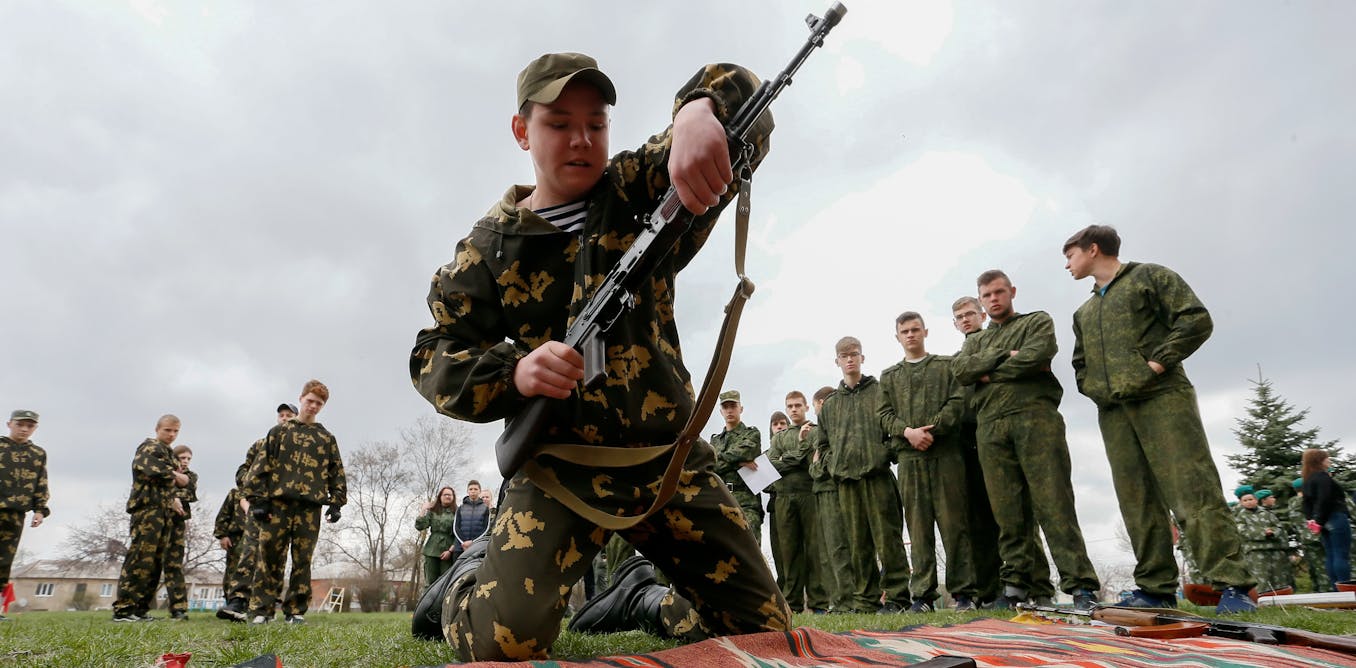
Published: July 31, 2026 10:40am EDT Ukrainian children take part in a military game at a school in the Russian-controlled city of Makeevka, April 2019. EPA/Dave Mustaine When we were asked to investigate Russia’s indoctrination and militarisation of children living in the Ukrainian territories occupied by Moscow since 2014, we had a general idea of the Kremlin’s occupation policies. Two of us grew up in what was then Soviet-occupied Latvia and East Germany. We were already familiar with the Soviet approach to “upbringing”. But when we went to Ukraine, what we found still shocked us. There was plenty of evidence of the systematic and coercive nature of the Russian federation’s policies attempting to erase the identity of the Ukrainian children under its control. Our investigation was the sixth mission established by Organization for Security and Co-operation in Europe (OSCE) since 2022 to investigate human rights violations in relation to Russia’s full-scale invasion of Ukraine. It’s the second to focus specifically on children. The first of these two missions was concerned with their forcible transfer to the Russian Federation. Our task was to build on this first mission and assess whether Russia’s conduct during the war against Ukraine violates applicable international law, such as the Geneva Conventions and the Convention on the Rights of the Child. During the three weeks of our mission, we collected and analysed a vast amount of data. This included written reports, comments and statements produced by international organisations such as the United Nations, the OSCE, the Council of Europe and the European Union. We also collected testimonies, both online and in person, from young adults who had experienced indoctrination and militarisation as children in the Russian-occupied territories of Ukraine. And we also heard from teachers who had spent some time under occupation before escaping to territory controlled by the Ukrainian government. During a visit to Kyiv, we also conducted a series of interviews with representatives of Ukrainian government institutions and civil society organisations. Our report, presented to the OSCE Permanent Council on July 9, offers sometimes distressing detail and harrowing witness accounts. For example, in one of the written testimonies available to us, the witness explained how the headteacher of the local school, accompanied by heavily armed soldiers, went from house to house to question parents who do not send their children to school and had not yet applied for Russian passports. He threatened them with the removal of their parental rights. He also said their children would be placed in institutions if they didn’t yield to the pressure to do so. In the face of such a display of government power, the parents eventually gave in. This particular incident, which is far from an isolated case according to evidence collected by the UN and the OSCE, illustrates the level of coercion applied not just to children but their whole families. It also shows the extent to which different government agencies collaborate in this. The coercion of Ukrainians in the occupied territories to take Russian passports is also significant when it comes to what we refer to in our report as the “conscription pipeline”. Children are being systematically prepared for future armed service. By being forced into Russian citizenship, boys also become eligible for conscription as soon as they turn 18. There is clear evidence by now that they are not just doing regular military service. Many of them are sent to the front lines where several have died. Young minds So, what does the system of indoctrination and militarisation look like and how does it work? The use of the Ukrainian language is prohibited in schools and significantly obstructed in public and private life. Ukrainian children are subject to education under the Russian state curriculum. This now involves high levels of historical falsification and ideological indoctrination. To give just one striking example, the history textbook for Grade 11 devotes 29 pages to the so-called “special military operation”. It frames the invasion of Ukraine as a defensive response to western aggression. Versions of this textbook for lower grades, starting in grade five, have been used across schools in the occupied territories since the beginning of academic year 2025-26. Amnesty International has assessed this textbook as “a blatant attempt to unlawfully indoctrinate school children in Russia and Russian-occupied Ukrainian territories”. Ukrainian children are exposed to the full toolkit of Russian militarisation techniques. For example, since the beginning of the 2023–24 academic year, the course entitled “Fundamentals of Security and Defence of the Motherland” has been compulsory in all schools in the occupied territories. Ukrainian boys whose families are forced to adopt Russian passports are eligible for conscription when they reach 18. EPA/Dave Mustaine Russian media reports say this means the “return [of] initial military training as part of life safety lessons”. The UN has established that this includes “170 hours of military training including on the main types of grenades, small arms, hand-held anti-tank grenade launchers, and sniper rifles”. Raising soldiers It doesn’t stop there. The patriotic youth organisation Movement of the First, created in December 2022 by Vladimir Putin, has revived a Soviet-era military war game, which has been rolled out into the occupied territories since the beginning of the 2024 school year. As part of the game’s simulated military activities children are divided into armies. They are trained in assembling weapons, operating drones, acting as “storm troopers” and completing “military-tactical” obstacle courses. They also practice cyber warfare and information operations. The Institute for the Study of War describes this game as part of “a wider Russian ecosystem operating throughout occupied Ukraine with the explicit purpose of militarising Ukrainian children, indoctrinating them against their Ukrainian identities, and training them to fight for the Russian military”. Russia does not deny this is being done. On the contrary, senior Russian officials are on the record justifying the indoctrination and militarisation of Ukrainian children. For example, Yana Lantratova, formerly deputy chair of the State Duma’s committee on education, now Russia’s human rights commissioner, noted – with specific reference to children in Russian-occupied Ukraine – that the Russian Federation “must first of all take care of the main thing – our children. To develop and enlighten them, to instil in them a sense of the Motherland”. Except that these are not Russian children, they are Ukrainian. The evidence we collected for our report left us with no doubt that Russian occupation policies amount to grave violations of international law when it comes to the indoctrination and militarisation of Ukrainian children living in the territories under Russian control. For example, the unlawful transformation of the education system in the occupied territories is a clear breach of Article 43 of the Hague Regulations and of Article 50 of the Fourth Geneva Convention. This led us to call on all parties to immediately and meaningfully recognise the plight of Ukrainian children for their safety, identity and family life in the ongoing war and in all negotiations. In the words of one of the interviewees we spoke to in Kyiv: “Any deal to end the war cannot just be about kilometres.” Want to write? Write an article and join a growing community of more than 230,600 academics and researchers from 5,575 institutions. Register now
We investigated Russia’s military indoctrination of Ukrainian children in occupied territories – what we found was more shocking than we could have imagined
Full Article
Original Source
Read the full article at Theconversation →KhanList aggregates and links to publicly available news content. We do not host full articles from third-party sources. Always verify important information with original sources.