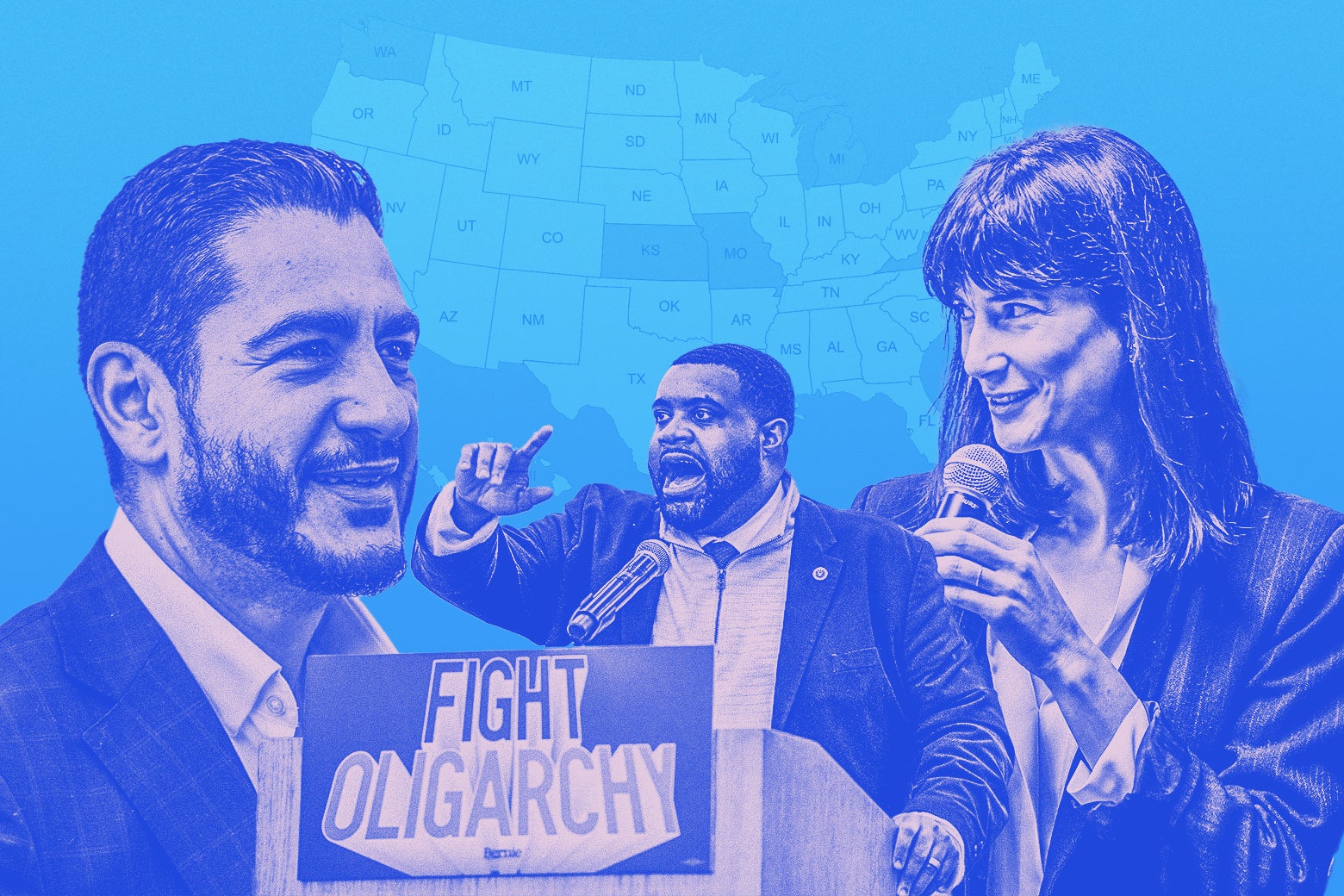
The Slatest Centrists faced off with progressives in Democratic primaries across the country last night. Who won? Photo illustration by Slate. Photo by Anna Moneymaker/Getty Images, CSarah Rice/Getty Images, and Finn Gomez/Getty Images This story is adapted from the Slatest newsletter. You can sign up here to get it in your inbox every day. Hello! I’m back from a matrimonial break with a pep in my step and a shiny new ring on my finger. But politics news waits for no one, so let’s dive right in: The progressives-vs.-establishment battle for control of the Democratic Party drags on. Last night’s marquee race, the U.S. Senate primary in Michigan, was a bit of a letdown for both sides. Abdul El-Sayed, a progressive, beat the centrist Rep. Haley Stevens, but by an unexpectedly narrow margin. The story was much the same in other primaries across the country: real wins for the left tempered by plenty of evidence that the party’s center is still alive and kicking. Political journalists often sieve through elections for clear takeaways, which make for better stories (and punchier headlines). But yesterday’s results, from El-Sayed’s narrow victory on down, don’t point in any single direction. Unsatisfying though it may be, voters in different places picked different candidates for reasons that go beyond ideology; the only way to declare this a win for centrists or progressives would be to ignore part of the story. Instead, let’s explore where each faction prevailed—and where they fell short. Progressive strength: El-Sayed’s close win, in which he underperformed the polling, in some ways undersells his achievement. He fought Michigan’s Democratic powers that be to a draw-plus-1 despite being vastly outspent. AIPAC, the pro-Israel lobbying group, showered almost $30 million on Stevens’ candidacy. But progressives flexed muscle elsewhere too. Michigan state Rep. Donavan McKinney, a democratic socialist, ousted Rep. Shri Thanedar, the latest Democratic incumbent to fall to a lefty challenger. The establishment also whiffed in Kansas, which held primaries yesterday as well. State Sen. Cindy Holscher, who supports a data center moratorium and accuses both Democrats and Republicans of having “sold out” the working class, won the gubernatorial primary over a candidate who had the moderate sitting Democratic governor’s support. A decade ago, these kinds of progressive wins in purple and red states would have qualified as a political earthquake. Now it’s just Tuesday. Moderate resilience: Elsewhere in Michigan, though, establishment Dems struck back. Jocelyn Benson, the sitting secretary of state, easily won the Democratic primary for governor and is favored in November. State Sen. Jeremy Moss handily beat a progressive in a safely blue House district. And it was Stevens, not El-Sayed, who won most of the rural and working-class parts of the state where Democrats have lost ground in the Trump era. The pattern continued in other states. Former Rep. Elaine Luria, a moderate Navy veteran, won the primary in a Virginia swing seat she narrowly lost to a Republican in 2022. On the opposite coast, Rep. Marie Gluesenkamp Perez of Washington easily put down a progressive challenge. And in Kansas, Adam Hamilton, a pastor who talks about bipartisanship, will take on Republican Sen. Roger Marshall in November. Is Hamilton likely to win in a state that overwhelmingly backed Donald Trump? No. But he could force the GOP to spend money there, which means less to spend elsewhere. The upshot: Progressives increasingly talk about the Democratic establishment as sclerotic, even moribund. Tuesday’s results make those forecasts of imminent death look more like wish-casting. The center fails (to coordinate): Still, establishment Dems really have stepped on several rakes this year, and last night’s primary in a Michigan swing district offered another example. Two moderates stubbornly stayed in the race, effectively drawing votes from each other as William Lawrence, a lefty activist, won with a plurality. A blue wave in November might well carry Lawrence to victory; Trump only narrowly won the district in 2024. But the seat could be harder to hold in 2028, which may be a less Democrat-friendly environment. Sure, party leaders can try to chalk up this result to a one-off mistake. But redistricting in GOP-led states has made the race for the House a bigger lift for Democrats, and every seat counts. A major progressive face-plant: In Missouri, former Rep. Cori Bush flopped in her bid to reclaim her old seat, losing by 22 points to the same AIPAC-backed candidate who ousted her in 2024. Bush had her liabilities—Joe Biden’s Justice Department investigated her over campaign spending—but still boasted support from Bernie Sanders and other progressives. Swing and a miss. What’s next? The fight for Democrats’ future continues on Tuesday in another Midwestern state: Wisconsin. Polls show that the leading Democratic candidate for governor is Francesca Hong, a democratic socialist who over the years has adopted some of the left’s least electorally palatable positions, including abolishing the police and even canceling Thanksgiving. Hong has since backpedaled on some of those stances. (She told Politico today that Thanksgiving is, in fact, her favorite holiday.) And the fact that polls wildly overestimated El-Sayed may bode well for Hong’s more moderate rivals. But as my colleague Jim Newell writes, the real question isn’t whether lefty candidates can win primaries; it’s whether they can beat Republicans in general elections, especially in purple states like Michigan and Wisconsin. For El-Sayed, that test is just beginning. We’ll soon find out whether Hong will get the same chance. Tolga Akdoğan OK, that’s enough election talk for one day. Now I’ll hand things over to my colleagues, who have some ideas for how you might enjoy the rest of your night. Dan Kois in action in the Chili’s test kitchen. Maria Paoli Have a nostalgic night out: Many restaurants are struggling these days—with one red-hot, surprising exception. Buoyed in part by mozzarella-stick-seeking Gen Zers, Chili’s has transformed from a ’90s relic to the hottest restaurant chain in the country. The intrepid Dan Kois visited Chili’s test kitchen to learn the secrets of its success. And speaking of the ’90s … The internet longs for a time before tech—and it’s expressing it in some questionable ways. ICYMI host Kate Lindsay and showrunner Daisy Rosario dig into what’s really behind all the nostalgia floating around the internet these days. Plus: Kois pops in to talk about how he channeled the best of that ’90s spirit in Party Like It’s 1996, his six-week series of challenges designed to help us recapture the lost art of hanging out. (If you sign up before Aug. 14, you can do the challenges along with him!) Ground yourself with some compassion: Slate senior editor Tony Ho Tran takes a spin as Prudie and dishes out some exceptionally heartfelt advice. He counsels letter writers on how to handle a cheating brother, discuss religion with a devout friend, and avoid spiraling over the fear of being single forever. If you’re looking for words of wisdom, Tony’s got you covered. Some juicy wordplay: How many words can you make with the letters N, U, E, P, G, and R? For every four you complete, you’ll unlock a new pair of letters to use with your existing set—and you have just one shot to find the longest word you can make with them. The longest words in yesterday’s game were LAYAWAY, PAPALLY, and PAYWALL. See if you can figure out today’s! And with that, you’re done! Congrats on making it to the back half of the week, and see you tomorrow. Get the best of news and politics Sign up for Slate's evening newsletter.
We Have Found the Only Correct Interpretation of Tuesday Night’s Election Results
Full Article
Original Source
Read the full article at Slate →KhanList aggregates and links to publicly available news content. We do not host full articles from third-party sources. Always verify important information with original sources.