
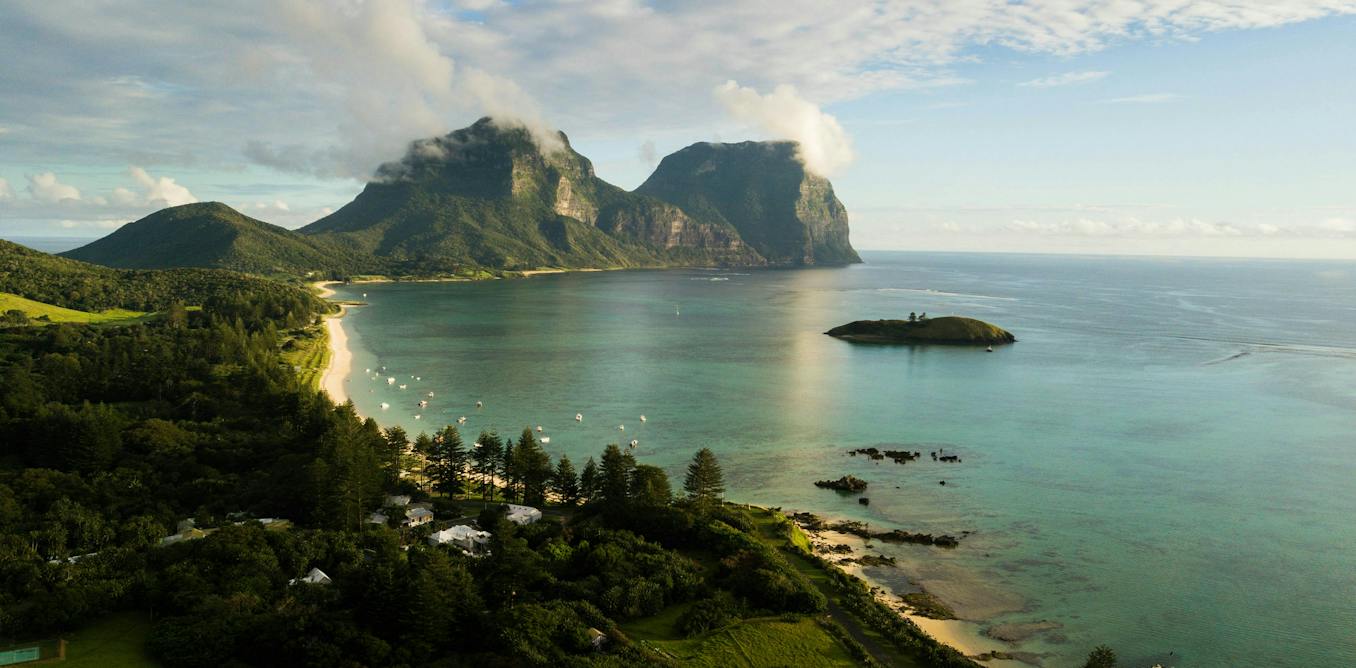
Lord Howe Island sits about 600 kilometres off the New South Wales coast, a crescent of rainforest and sea cliffs that draws visitors for its spectacular beaches and its unique birdlife. Few realise they are standing on the weathered remains of a volcano. And that volcano has family. Lord Howe is part of a chain of islands, called “seamounts”. It is the only island above sea level – the rest are submerged in the Tasman Sea. Roughly 650 kilometres west runs a second chain, the Tasmantid seamounts, tracing almost the same path. Two nearly identical chains side by side in the middle of a tectonic plate is unusual. For the first time, in a new paper published in the journal Gondwana Research, we can answer how this happened. Tasmantid and Lord Howe hotspot chains in the Tasman Sea. Each seamount is plotted with a label indicating its age in millions of years. Author supplied. A blowtorch under a moving tectonic plate Most volcanoes occur where tectonic plates meet. There are a few exceptions, Hawaii being the most famous: a plume of hot rock rises from deep inside the Earth and melts its way through the middle of the Pacific plate. As the tectonic plate drifts overhead, the plume burns a new hole in it, then another, like a blowtorch under a moving sheet of metal, until a chain of seamounts is formed. That is exactly what the Tasmantid and Lord Howe chains look like. Both chains get steadily younger towards the south, tracking the northward drift of the Australian plate over the past 40 million years. Two branches connected by one plume Our new study found the Lord Howe and Tasmantid seamount chains are connected by the same mantle plume. A single plume rises from Earth’s deep mantle and gets deflected by a slab of old seafloor, which sank at a subduction zone – where oceanic seafloor is recycled into the Earth’s interior – then stalled about 500 kilometres down where the mantle abruptly becomes stiffer. The plume cannot go through the dense slab, so it bends around it, escaping through gaps on either side. Two branches reach the surface – two chains of volcanoes form. Three separate lines of evidence back this up. The first is a simulation of Earth’s interior. We did not set up our models to reproduce the Tasman Sea – the plates and plumes evolve on their own. Despite this, the plume splitting observed in the models happened to reproduce the 650 to 900 kilometres spacing we observe for the Tasmantid and Lord Howe seamount chains remarkably well. It was sustained for roughly 70 million years. Numerical simulation of a mantle plume splitting around a ribbon of subducted material in the Earth’s mantle. The second is reconstructing the last 200 million years of plate motion, mapping where old seafloor sank beneath the Tasman Sea. It reveals a ribbon of slab material with gaps on either side, exactly where the model says each branch should rise. The third is the chemistry of lavas taken from each chain. Lead isotopes in both chains carry a fingerprint that takes more than a billion years to develop – far too long to have come from the nearby subducted slab, which has only been down there 60 million years. It confirms that the material erupting at the surface has been brought from the deep mantle and delivered to both chains. Plate reconstruction of the last 200 million years which shows when the Pacific plate gets subducted in the Western Pacific. The fate of the plume One of the most interesting discoveries is that we can predict what will happen to the Tasmantid and Lord Howe seamount chains millions of years into the future. In the simulation, branching does not last forever. As the slab obstructing the plume sinks deeper into Earth’s mantle, one branch is uncovered and becomes dominant, while the other shuts down. The Lord Howe seamount chain is producing smaller eruptions since about 23 million years ago, while the Tasmantid volcanoes are producing larger eruptions over the same time. So our prediction is that the Tasmantid chain becomes the main conduit and Lord Howe will eventually terminate many millions of years from now. Implications beyond the Tasman Sea Volcanic hotspots are among the tools geoscientists use to work out how continents have moved, because a plume stays roughly fixed while plates slide over it. If a chain can be one branch of a plume that shifts as it encounters subducted slabs, then our reconstructions of absolute plate motion may need refining. It also changes the canonical picture of the deep Earth, where plumes are usually drawn as a straight conduit from Earth’s deep mantle to the surface. Here, we show plumes are dynamic and evolve as they encounter obstacles within the Earth’s mantle. The same mechanism may explain other closely spaced chains, including Yellowstone in the United States. Some volcanic hotspots that look ordinary today may also have branched in their past. Seismic images beneath the Tasman Sea are still blurry, so we need higher resolution images to discern each of the branches. We also need more rock samples from these underwater volcanoes to better constrain the geochemistry of the eruptions and whether any recent eruptions have occurred in the southern Tasman Sea.
We found the hidden force that created two chains of underwater volcanoes running side by side
Full Article
Original Source
Read the full article at Theconversation →KhanList aggregates and links to publicly available news content. We do not host full articles from third-party sources. Always verify important information with original sources.