
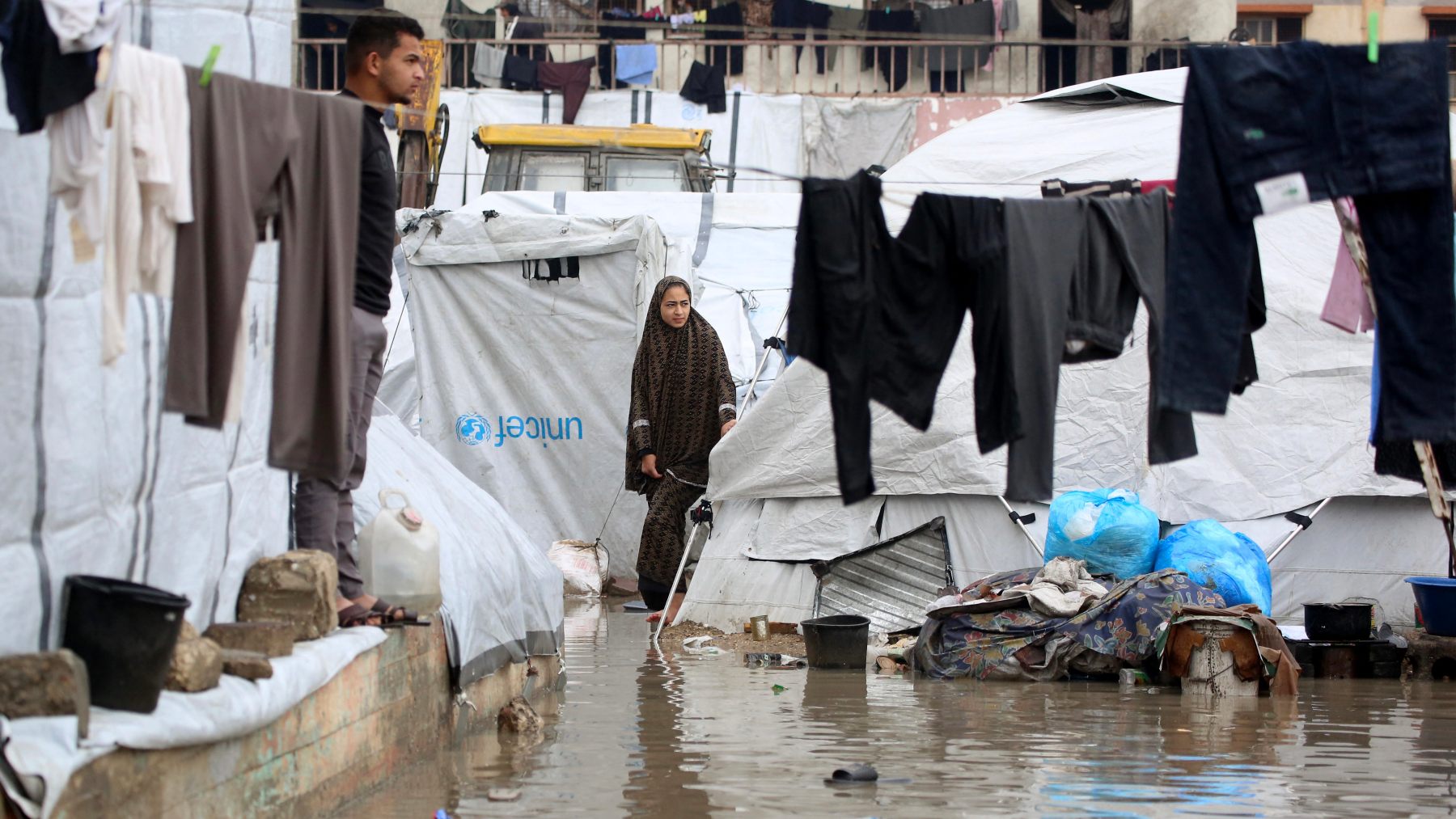
Mansour al-Sakni, 33, watched helplessly as rainwater flooded the makeshift shelter on the roof of a building in Gaza City's al-Tuffah neighbourhood, where he lives with his wife and four children. The family had replaced their old tarpaulins with new ones just two weeks ago. Sakni had sold two water barrels so they could buy new sheets to keep them dry and sheltered. But when the first winter storm swept across the Gaza Strip, the canopy offered little protection. “We woke up and found ourselves surrounded by water. The children were crying. I did not know what to do, and I started crying too,” Sakni told Middle East Eye. “We stood inside the tarpaulin shelter waiting for the rain to stop so we could try to push the water out of the room.” New MEE newsletter: Jerusalem Dispatch Sign up to get the latest insights and analysis on Israel-Palestine, alongside Turkey Unpacked and other MEE newsletters Sakni lives in a 30 square metre room with tarpaulin walls which have been damaged by the weather. “I sold the two water barrels to buy new tarpaulins to protect my family from the rain and wind, but it was no use. Last night we were again flooded by the rain,” he said. Before the war, Sakni earned a living selling newspapers. Now, he has no steady income and the family relies fully on food given out by the community kitchen, known locally as a takiya. His 10-year-old daughter Jana suffers from bad eyesight. She requires glasses, but Sakni can’t afford to buy any. A friend gave him 200 shekels to buy a pair, he said, but he used the money to purchase wood to reinforce the shelter instead. “We are poor people in Gaza. We want to live. We do not want to die from the bombing or the cold. Enough. Have mercy on us.” Displaced Palestinians try to clear floodwater outside their tents amid heavy rain in Gaza City’s al-Remal neighbourhood, 7 November 2026 (Omar al-Qattaa/AFP) Sakni said he was wounded by shrapnel in 2024 while standing in a queue outside a bakery on al-Nasr Street. The fragment struck his back, he said, and the injury causes him severe pain in cold weather. Heavy rainfall flooded thousands of tents across Gaza on Saturday, leaving displaced families exposed to cold, rising water and the risk of further damage to already weakened buildings. Gaza's Civil Defence agency said it had received about 1,500 distress calls in 10 hours after the rain began early on Saturday. At some shelters, water rose by 30 to 40 centimetres, Al Jazeera reported. Civil Defence spokesperson Mahmoud Basal said: “What we feared has actually happened. A few shelter centres were completely flooded, and everyone inside them has now been forced out into the unknown.” ‘The rain came inside’ For Nasmeh al-Khatib, 26, the storm brought back the fear of losing her home and the uncertainty that has defined life since her husband was killed during the family's displacement in Gaza City in 2024. Khatib lives with her two-year-old daughter, Alina, in her family's home in Mashrou Amer in northern Gaza. Five families are sheltering in the partially destroyed building. The house was struck in October 2025, days before the ceasefire, she said. It once had four floors, but three were destroyed. The families now live on the ground floor, which she fears may also be unsafe. “We have covered the house with tarpaulins, but every time it rains, we are flooded,” Khatib told Middle East Eye. A displaced Palestinian woman heats a pot as children look on outside their tent in Gaza City amid rain and cold winter conditions, 28 December 2025 (Omar al-Qattaa/AFP) She said heavy rain and strong winds battered the building overnight, bringing down the sheets used to cover openings and allowing water to enter. Thunder also frightened the children, who woke believing the sounds were from bombs. “My two-year-old daughter cried throughout the night. She asks me, ‘Mum, why is the rain inside the house and not outside? I don't like the rain'," Khatib said. The family has solar panels, but the electricity repeatedly cut out and returned during the night. She said parts of the walls and floor began giving electric shocks, while lights and phone chargers stopped working. “We do not know what to do. All our belongings are wet. Since morning, we have been trying to seal the holes in the walls and tie the tarpaulins in any way we can,” she said. “We know that everything we are doing is in vain and that when it rains again, we will be flooded once more. We need a solution to this suffering.” Winter crisis The storm has exposed the vulnerability of hundreds of thousands of displaced Palestinians living in tents, makeshift shelters and buildings damaged during Israel's ongoing genocidal war on Gaza. Gaza's emergency committee said more than one million displaced people face winter-related risks and that the territory needs about 200,000 tents, as well as heating supplies, Al Jazeera reported. ‘Complicit’: World Medical Association criticised for rejecting calls to suspend Israel Read More » The United Nations Office for the Coordination of Humanitarian Affairs (Ocha), in a report published on 5 November, said people in Gaza still needed approximately 121,000 tents and 561,000 tarpaulins as of 1 November. It said available stocks included about 2,800 tents and 76,000 tarpaulins, while no emergency shelter kits were available. Ocha said the entry of timber needed for shelter kits continued to be rejected by Israeli authorities. It also warned that restrictions on supplies, delays in approvals and funding shortages could mean some materials would not arrive until the second half of the winter. The Norwegian Refugee Council said on 5 October that Israeli restrictions on the entry of shelter materials and funding shortfalls were likely to leave 1.65 million people facing a fourth winter in worn-out tents and war-damaged buildings. Aid organisations have also warned that many displacement sites are at risk of flooding. Shot in class: Gaza's children return to school under Israeli fire Read More » Ocha said in an October report that an estimated 950,000 people were living at displacement sites facing medium to high flood risks, including more than 400,000 at high risk. The latest storm also damaged buildings already weakened by bombardment. Gaza's Civil Defence said residents were evacuated from a partially collapsed building in Nuseirat, while two people were injured when a wall collapsed in northern Gaza, according to the Palestinian news agency Wafa. Civil Defence officials have said their ability to respond is limited by shortages of equipment and supplies. Raed al-Dahshan, director of Civil Defence in Gaza governorate, told Al Jazeera that the agency did not have “a single tarpaulin or a single tent” to distribute to families affected by the flooding. For families such as Sakni's and Khatib's, the problem is not simply the arrival of winter rain, but the absence of a safe place to shelter from it. “I am tired of this life,” Sakni said. “We want the world to find a solution for us."
‘We do not want to die from the cold’: Gaza families struggle as rain floods shelters
Full Article
Original Source
Read the full article at Middleeasteye →KhanList aggregates and links to publicly available news content. We do not host full articles from third-party sources. Always verify important information with original sources.