
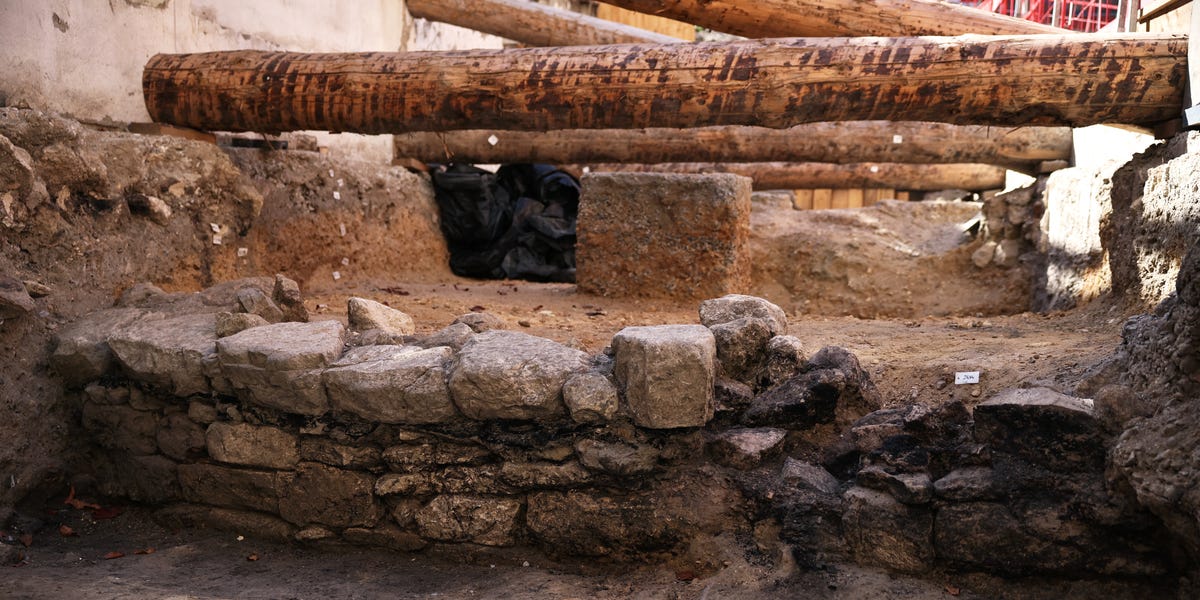
3 min readHere’s what you’ll learn when you read this story:Archaeologists revealed a 65-foot-long wall buried under a teaching hospital next door to Notre Dame.Experts believe the find is from Lutetia, a Gallo-Roman settlement that was the predecessor of modern Paris.The physical evidence of Lutetia confirms historical writings and may settle debate about its original location.In 50 B.C.E, Julius Caesar wrote about a fortified settlement at a spot along the Seine River where Paris is located today. And now, archaeologists may have finally found it. The discovery could settle a centuries-old argument: where exactly did Gallic Lutetia, the first settlement in what is now Paris, stand?Crews excavating the courtyard of the Hôtel-Dieu teaching hospital—just across the Rue d’Arcole from Notre-Dame—uncovered a Gallo-Roman wall of stone and timber roughly 65 feet long and six feet tall. The hospital sits on the Île de la Cité, the largest of the Seine’s islands in Paris. Preliminary carbon-14 dating places the wood between 200 and 10 B.C.E., directly in the timeframe of Lutetia’s existence.“We may be looking at one of the most important remains ever discovered for understanding Gallic Lutetia,” France’s Minister of Culture, Catherine Pegard, said in a statement. “While scientific caution requires further verification of its function and chronology, the convergence of evidence is currently particularly remarkable.”Historians long suspected that Lutetia was centered on the Île de la Cité, but some archaeologists questioned the lack of physical evidence.Excavations began in February, ahead of the hospital site’s redevelopment, under David Couturier of the city’s Department of the History of Architecture and Archaeology, working with France’s National Institute for Preventive Archaeological Research. The team hoped to find traces of an ancient settlement. It may have found Lutetia itself.“It’s dizzying to find oneself here and to discover what is probably the origin of the city of Paris,” said Paris mayor Emmanuel Grégoire, according to Le Monde.The only existing contemporary written description of ancient Lutetia is in Julius Caesar’s book about his time in Gaul, Commentarii de Bello Gallico (Commentaries on The Gallic Wars). Caesar wrote that he traveled to Lutetia in 53 B.C.E. for an assembly. He returned the following year, and during the Battle of Lutetia he recorded how the Parisii burned their own fortification rather than surrender it to Rome. Caesar said only that the settlement sat on an island in a bend of the Seine, linked to the banks by bridges.The area around the wall, which was found 12 feet under the courtyard of the city’s oldest hospital, shows signs of a violent fire. The charred remains of a wooden building sit beside the wall. Together the wall and the wooden remains point to a major fortification—and, possibly, to Lutetia.“The wall’s architecture—with its large blocks and systems of interlocking beams—very quickly reminded us of a wall built in the Gallic tradition,” said Dorothée Chaoui-Derieux, heritage curator at the Île-de-France Regional Archaeology Service. “Evidence of fire damage and pottery dating to the time of Caesar reinforced this hypothesis: What if we had finally found physical traces of the fortification of Lutetia, as described in ‘The Gallic Wars’?”Tantalizingly, the excavations also exposed a Gallic spearhead at the base of the wall.“This discovery fills an archaeological gap,” said Stéphane Deschamps, regional curator of Archaeology for DRAC Île-de-France. “The location of Lutetia has been debated for centuries. Due to the lack of tangible evidence on the Île de la Cité, some had even hypothesized that it was located in Nanterre. Today, with this wall and its context, we may well hold the key to the mystery.”Tim Newcomb is a journalist based in the Pacific Northwest. He covers stadiums, sneakers, gear, infrastructure, and more for a variety of publications, including Popular Mechanics. His favorite interviews have included sit-downs with Roger Federer in Switzerland, Kobe Bryant in Los Angeles, and Tinker Hatfield in Portland.
We Didn’t Always Have Paris. Archaeologists Just Discovered the Lost City That Was There First.
Full Article
Original Source
Read the full article at Popularmechanics →KhanList aggregates and links to publicly available news content. We do not host full articles from third-party sources. Always verify important information with original sources.