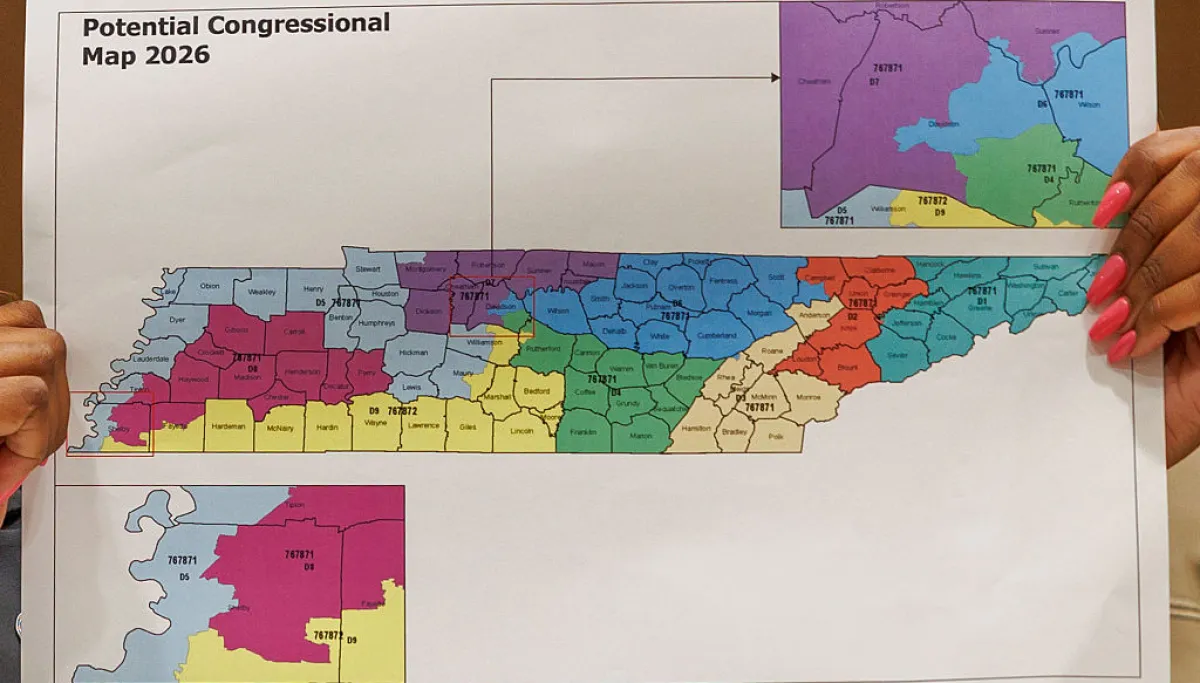
Democrats gerrymander just as much as Republicans, but Democrats claim their party has the moral high ground because, according to liberal journalists, Democrats have tried to “ban gerrymandering.”This claim has a dozen things wrong with it — for instance, Democrats tied their gerrymandering legislation to other measures including banning voter ID — but the fundamental problem was that nobody agrees on what gerrymandering is.For instance, the Democrats’ “gerrymander ban” would have required states to tie together black-majority precincts that may be geographically distant. This is, by any normal definition, a racial gerrymander. To Democrats, this was “banning gerrymanders” because presumably they limit their definition of racial gerrymandering to efforts to reduce minority representation. …Also, the section @sahilkapur calls a "gerrymandering ban" actually MANDATES race-based gerrymandering, to create majority-black districts, which is how you got stuff like the district below…. pic.twitter.com/JqjfMpELzu— Tim Carney (@TPCarney) March 9, 2026 I proposed a gerrymandering ban in February, and laid out 5 rules: Require states to respect existing county, city, and town borders. Many states have rules like this. The rule has the virtue of generally, though not perfectly, keeping people with similar interests together. The bigger benefit is that this constraint makes it harder, not impossible, for partisans to draw an unfair gerrymander. Encourage compactness. If a more compact map, which respects county lines as much, would yield less partisan imbalance, that should count as evidence that the less compact map is a partisan gerrymander. End mid-decade redistricting. Expedite any legal challenges to a given map, and make it illegal for states to redistrict mid-decade except in the most extreme circumstances. Make all Voting Rights Act rules on redistricting subordinate to the above rules. Allow districts to vary in population by up to 10% if necessary, with respect to existing boundaries. This had a mixed response, including many objections: We shouldn’t even care about city/county lines. County lines especially have no real meaning for anyone’s life. Every district should be drawn in a way that maximizes the competitiveness. The fewer safe seats the better.— J. Smith (@jrichardsmith) April 24, 2026 Again, we don’t agree on what counts as a gerrymander.Sean Trende, a political scientist with plenty of experience drawing legislative districts, had an essay at the American Enterprise last week that explores the ambiguity of the term:“Defining a gerrymander is not easy, nor is it scientific. It’s a question that involves deep theoretical questions and policy questions, and voters should be wary of anyone who oversimplifies it. The Supreme Court could not have resolved this debate without making the type of arbitrary choice that it is ill-equipped to make, but that legislatures handle well.”I recommend the essay. One question he wrestles with: Is a congressional map unfair if it favors one party over another? Behind that question is a debate: Should the maps aim for political fairness and competitiveness, or just for cultural coherence?Trende’s main question is whether intention matters when calling something a gerrymander. He says yes, and I agree.I think progress can be made on banning gerrymandering, but I do think we need a more shared definition of the word before we can get far.
We can’t ‘ban gerrymandering’ if we don’t agree on what gerrymandering is
Full Article
Original Source
Read the full article at Washingtonexaminer →KhanList aggregates and links to publicly available news content. We do not host full articles from third-party sources. Always verify important information with original sources.