
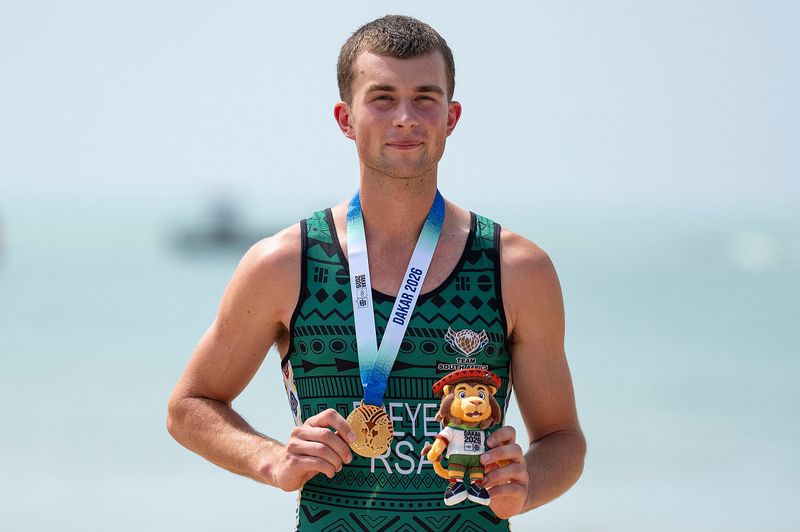
It was only five months ago that South Africa’s sole rower at this year’s Youth Olympics in Dakar, Senegal, learnt how to compete in coastal beach sprints. Having never competed internationally prior to the Youth Olympics, 16-year-old Callum Dreyer went into the competition completely unranked and among the youngest competitors in the field. Believing in his talent and sheer determination, Callum’s coach, Avlyn Gallwey, and father, Martin Dreyer, aimed for Callum to progress past the time trials into the Last 16. But after placing fourth in the time trials and recording the fastest time in the Last 16 to progress to the quarterfinals, Gallwey began to believe that Callum could go all the way. “In the back of our minds, we believed that Callum had the talent and the ability, but having never actually stood on any kind of stage to do a knockout race, other than in training, we didn’t want to put too much pressure on him,” Gallwey told Daily Maverick. “You don’t want to say, well, this is our expectation and now there’s all this pressure. But we did have the belief that he could do it.” Callum Dreyer of South Africa races towards the water during the coastal beach sprints men’s semifinals at Saly Beach West at the Dakar 2026 Youth Olympic Gamess on 3 November 2026. (Photo: Nic Bothma / OIS) On finals day, 3 November at Saly Beach, history was made when Callum won three head-to-head races in 50 minutes to become the inaugural men’s solo champion. Additionally, his final golden run also set the benchmark for future Youth Olympics competitors, with Callum clocking 2:15.65, the fastest time of the entire men’s solo regatta. Battling fellow rowers, exhaustion and high temperatures, the young rower started the day edging Czechia’s Ondrej Zizka by 0.14 seconds in the quarterfinal. He then claimed a dominant win over Hungary’s Adam Moor in the semifinal before defeating Spain’s Diego Molina Martinez by nearly 30 seconds in the final. “I couldn’t believe it. It was surreal,” Gallwey said. “He was completely unranked. We had no idea how he would fare against this international competition. We knew he had the talent and the determination and the ability, but to see him just grow as the competition went on was an absolute privilege.” Callum Dreyer (right) with his coach Avlyn Gallwey after winning rowing’s coastal beach sprints men’s solo finals at Saly Beach at the Dakar 2026 Youth Olympic Games on 3 November 2026. (Photo: Nic Bothma / OIS) A dynamic derivative Coastal beach sprints only emerged as a rowing discipline in 2015 with World Rowing aiming to attract more spectators back to the sport. It was added into the Olympic programme in 2023 and will debut at the Los Angeles 2028 Olympic Games alongside flat-water rowing. Gallwey likens the difference between the two disciplines to that between Test cricket and T20. Flat-water rowing is the traditional format, with athletes racing over a straight course. Coastal beach sprints, by contrast, are shorter, faster and more dynamic, bringing the action closer to spectators on the shore. A race starts with athletes sprinting 50 to 60m down the beach to their boats. They row backwards and slalom around two buoys. They then turn at a buoy 250m out and return through the surf, leaping out and running up the beach to press a buzzer that stops the electronic timer. Each boat has two handlers, one man and one woman who help hold, launch, direct the boat and bring it safely through the surf. At the Youth Olympic Games, Gallwey was Callum’s coach, manager and woman handler. His father, Martin, was the male handler. “It’s a mad dash,” said Gallwey. “It’s a combination of sprinting, rowing, being able to read the surf or the waves and it’s just action and dynamic and exciting.” Callum Dreyer (right) and his boat handlers, manager and coach Avlyn Gallwey (left) and his father, Martin (centre). (Photo: Nic Bothma / OIS) ‘He was made to row’ Callum began rowing at Hilton College, where he attends school, about 15 months ago. Initially trying out various sports, he was encouraged by friends and coach Ernie Steenkamp to give rowing a try. It was during the Henley Midmar Rowing Camp that Callum was introduced to coastal beach sprints. Afterwards, his dad contacted Gallwey to ask if he could join her Sunday training sessions. Gallwey coaches all coastal beach sprints for KwaZulu-Natal (KZN) and sits on the South African coastal rowing committee. She is also vice-president of the KZN Rowing Association. She began coaching Callum in the discipline five months ago, unaware at the time that South Africa had an allocated spot at the Youth Olympics. “He was made to row. He’s an exceptional young man, but also an amazing athlete. He could probably have done any sport, but luckily for us he chose rowing,” she said. South African 16-year-old Callum Dreyer first started rowing only 15 months ago. (Photo: Nic Bothma / OIS) Callum initially had his sights on competing provincially and nationally, going on to win the South African Schools Rowing Championships in March. His Youth Olympic qualification came through the provincial regatta in Eastern Cape, followed by selection camps and trials that tested his endurance and simulated beach racing using rowing machines. Callum continues training in flat-water at Hilton College while his coastal beach sprint sessions take place on Sundays at Vetch’s Beach, in front of the Durban Ski Boat Club. When asked about Callum’s potential in future, Gallwey said he had the ability and desire to achieve in both flat-water and beach sprints. “He has huge potential going forward and I think he can achieve on the flat water and the beach. I’m hoping that he will go to Under-19 world champs for the flat water next year,” Gallwey said. “Make no mistake, Callum still loves the flat-water of fine boat, and you can do both.” A family of winners Throughout the competition, the goal was to make the top 16 and take one race at a time. Callum had just five months of beach sprint training behind him, while many of his opponents had years of experience. But, according to Gallwey, Dreyer carried a quiet confidence, believing he could reach the quarterfinals. “Callum, he’s very quiet and determined, but he’s calm under pressure. He has confidence and he shows a maturity far beyond his years,” Gallwey said. “On the Saly Beach in Dakar, it didn’t matter if he was behind. He just still believed and he carried on with his determination and sheer will and his ability.” Callum Dreyer’s final golden run set the benchmark for future Youth Olympic competitors, clocking 2:15.65, the fastest time of the entire men’s solo regatta. (Photo: Nic Bothma / OIS) South Africa’s sole rower at the Youth Olympics, Callum Dreyer rests after reaching the finish line during the coastal beach sprints men’s solo quarterfinals at Saly Beach at the Dakar 2026 Youth Olympic Games on 3 November 2026. (Photo: Jonathan Nackstrand / OIS) For Gallwey, Callum’s athleticism and winning mindset all make sense when looking at his family. His father, Martin, is a seven-time Dusi Canoe Marathon winner and mountain biker, while his mother, Jeannie Dreyer, is an ultra-endurance mountain biker who won the women’s category in back-to-back editions of The Munga – a 1,084km non-stop race from Bloemfontein to Wellington – in 2016 and 2017. She finished second overall in 2016 and sixth overall in 2017. “His family are all athletes and they have achieved, so for Callum, achieving was something that was possible and tangible,” Gallwey said. “He’s seen his parents achieve. He’s seen what they can do and I think that brought him up to know that he can achieve whatever he sets his mind to. Having the athletic ability on top of that has just made it great.” DM
WATER WINGS: SA rower wins Youth Olympic gold just 15 months after picking up an oar
Full Article
Original Source
Read the full article at Dailymaverick →KhanList aggregates and links to publicly available news content. We do not host full articles from third-party sources. Always verify important information with original sources.