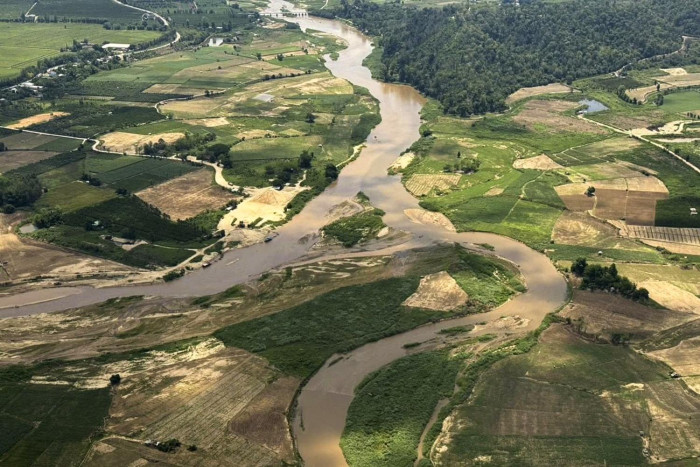
An aerial photograph taken by the Pollution Control Department on June 9, 2025, during a survey of the Kok River shows how it has turned deep red due to chemical contamination. The river originates in Myanmar's Shan State before flowing into the Mekong River in Chiang Saen district, Chiang Rai. Pollution Control Department A series of emerging reports in recent weeks concerning tight water supplies and river pollution in central and northern Thailand mean the nation is now facing a challenging water security situation, experts say.The reports include a Thai-owned waste management plant in Saraburi province that has allegedly been polluting canals with heavy metals, a case of transboundary water pollution in Chiang Rai province caused by unregulated mining activity in a neighbouring country, and a local protest against the construction of a Chinese-owned mining plant in Kanchanaburi province due to fears of pollution. Department of Royal Irrigation spokesman Thanet Sombon said the department has had to focus on both the quantity and quality of water supplies. He said water pollution presents another challenge to the department's task of ensuring there is sufficient year-round water consumption for households, and the agricultural and industrial sectors. Mr Thanet said the department aims to expand the country's total irrigated area to 38.89 million rai by 2037, raising the water storage capacity above 86.229 billion cubic metres. At present, 35.91 million rai are covered by irrigation systems, with a storage capacity of about 83.849 billion cu/m. This represents about 60% of the country's total potential irrigated area. The remaining 21.40 million rai, or 40%, is planned for development after 2037. Meanwhile, to support the running of plants located in the Eastern Economic Corridor (EEC), Mr Thanet said 16 irrigation projects are underway. They are set to be finished by 2037 on the budget of 48 billion baht, increasing the water volume by 542 million cu/m, he added. A budget will also be allocated to six projects to increase the volume of water in Pra Sae reservoir in Rayong province and Bang Pra reservoir in Chon Buri province, Mr Thanet said. This is expected to add another 155 million cu/m of water volume in the reservoirs. Another 28-billion-baht budget includes the controversial Klong Wang Tanod reservoir construction project in Chantaburi province. Some 55 million cu/m of water from the dam is expected to feed the Pra Sae reservoir, linking up with other water networks in the eastern region. A budget of 12 billion baht will be allocated to seven projects to increase water storage capacity in two reservoirs in Chachoengsao province and two more reservoirs in Chon Buri province, together with increasing water storage in canals. All of these combined should be able to store in excess of 296.60 million cu/m. The rest focus on increasing the water storage capacity in Klong Bang Pai, Chon Buri. The EEC is expected to be the industrial base of AI data centre investment despite local people's concerns about the huge consumption of water volume and energy. Any investment in the sector requires environmental impact assessments (EIA/EHIA) be conducted in advance. Sitang Pilailar, a lecturer from the Department of Water Resources Engineering, Kasetsart University, voiced her concern the issue of water security has yet to be made a national agenda item despite the fact that it affects people's health and jobs. The government's water policy mainly concerns the sourcing of natural water. As a result, the quality of the water has been overlooked even when water pollution has increased mostly from industrial activities, such as when industrial plants discharge wastewater into a natural water source, Ms Sitang said. "When water is not safe, neither food nor people are safe. We are now at the point where all stakeholders must take action to deal with polluted water. Strong law enforcement must be taken to plants that discharge untreated water into the rivers or canals," she said. Ms Sitang said local administrative organisations should play a key role in regulating factories located within their jurisdiction to curb emissions and safeguard the environment. Pianporn Deetes, executive director of advocacy group Rivers and Rights, said transboundary river contamination is not simply an environmental issue, but rather a national and regional security issue. It directly threatens water security, food security, public health, and regional stability. When rivers that sustain millions of people become contaminated, the costs are measured not only in damaged ecosystems but also in economic losses, declining public trust, and long-term health consequences, Ms Pianporn said. Delayed or inadequate action only compounds those costs. That is why this crisis must be treated as a national priority and a regional diplomatic priority, she added. "I have not lost hope in the Thai government or in other governments that share responsibility for addressing this crisis. What is needed now is stronger political leadership and a genuine commitment to cooperation. Thailand has the legal tools, diplomatic channels, scientific expertise, and international partnerships necessary to confront this challenge. "What people expect is not confrontation with neighbouring countries or China, but principled leadership that puts the public interest first."
Water security fears grow
Full Article
Original Source
Read the full article at Bangkokpost →KhanList aggregates and links to publicly available news content. We do not host full articles from third-party sources. Always verify important information with original sources.