
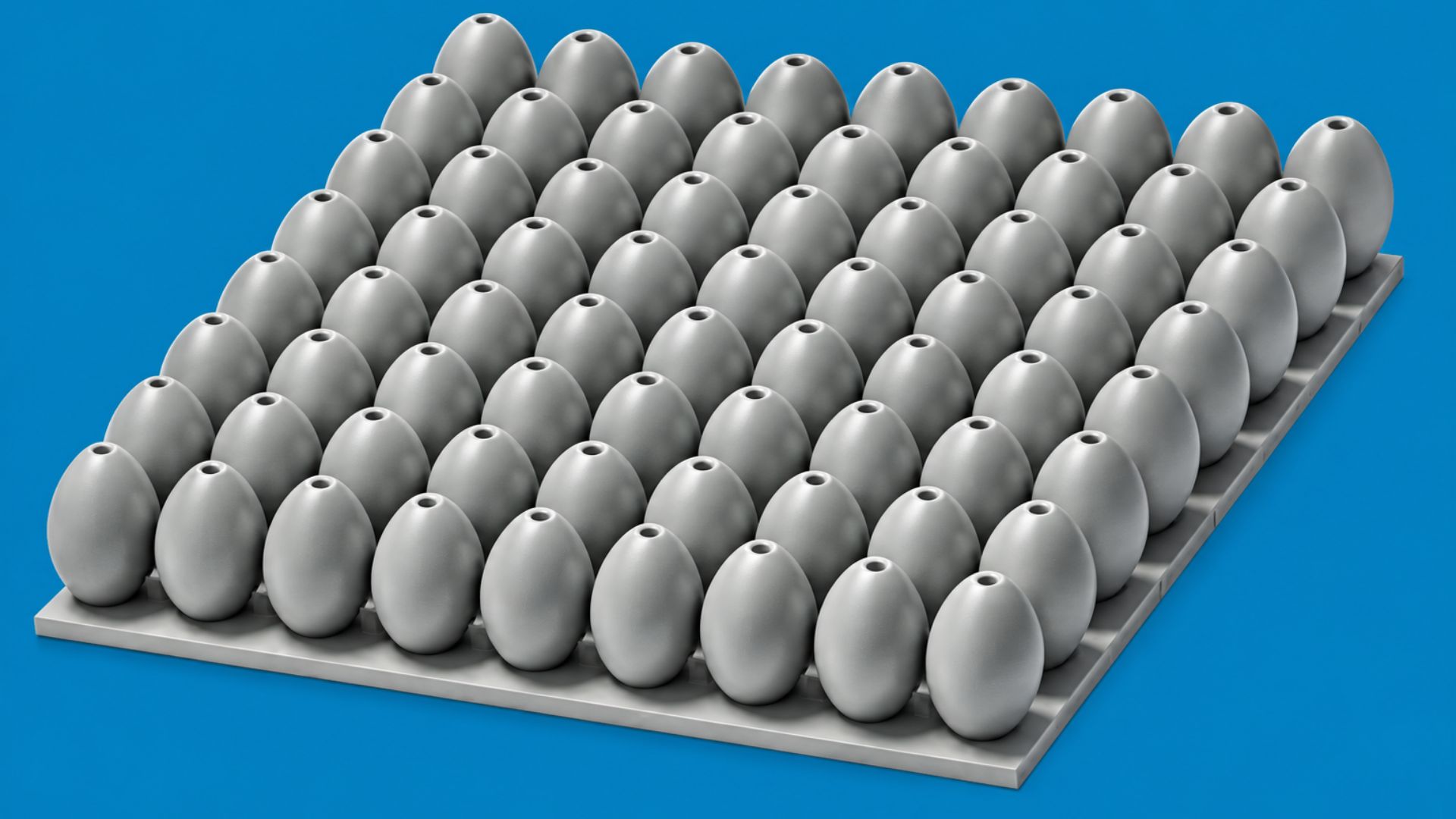
It sounds improbable, but egg-inspired designs could soon protect spacecraft from high-speed orbital collisions. Researchers from Dalian University of Technology have developed a bio-inspired, lightweight metastructure design based on “eggshells” to protect spacecraft from space junk impacts. With the rising number of launches, the orbit is slowly turning into a junkyard. Right now, nearly one million fragments of metal, paint, and shattered rocket parts larger than a single centimeter are tearing through Earth’s orbit at extreme speeds. A tiny fleck of debris traveling at tens of thousands of miles per hour hits with the explosive force of a grenade, threatening to pierce critical satellites, expensive space telescopes, and human-inhabited stations. Engineers have spent decades searching for lighter, tougher armor to withstand these cosmic bullets. The answer could be found in eggshells. The Dalian team in China has proposed a spacecraft protection system modeled after eggshells. The team created a lightweight metastructure by 3D-printing arrays of hollow aluminum eggshells and sandwiching them between two metal impact plates. This design effectively absorbs violent shockwaves that would otherwise shatter conventional armor. “Natural biological structures have evolved to demonstrate excellent energy absorption performance over long-term adaptation,” said author Yuxin Wang. Liquid damping It sounds absurd. Eggs are famous for being fragile, cracking open at the slightest nudge against a countertop. Yet nature engineered the egg to be a geometric masterpiece. Organizing them into an array creates a surprisingly tough structure. The researchers placed water-filled aluminum eggshells blunt side down between two metal plates. This design spreads the impact force across the whole system. As a result, each shell collapses sequentially, gradually absorbing and dissipating the kinetic energy. “A single eggshell breaks easily under local force, but the protection mechanism of the eggshell array is completely different,” Wang said. “The cooperative deformation of these eggshell units transforms the local impact load into distributed energy dissipation across the metastructure, thereby significantly enhancing the anti-impact performance of the target plates.” Adding water inside the aluminum eggs further enhances the armor’s performance. During a high-speed collision, the trapped liquid sloshes around and dampens the resulting shockwaves before they can spread. To evaluate the design, researchers ran 3D-printed tests and simulations comparing solid aluminum plates, water-filled aluminum spheres, and the eggshell metastructure. Impact reduction The water-filled eggshell structure outperformed all other designs, slowing impact projectiles by nearly 65 percent compared to just 51 percent for solid aluminum plates. Positioning the eggs upright with their narrow tips facing the top plate yielded the best results. “This work demonstrates that bionic, lightweight metastructures are a promising route for hypervelocity-impact protection,” Wang said. “We hope this research can attract more attention to bio-inspired protective structures.” The material isn’t quite ready for a launchpad just yet. The team is actively refining the thickness, layout, and aspect ratios of the metallic shells to maximize protection while minimizing weight, a critical factor for rocket payloads. It could prevent Kessler Syndrome, which is a dangerous chain reaction where collisions between space objects create thousands of high-speed fragments. These new pieces strike other satellites and rockets, generating even more debris faster than atmospheric drag can remove it. If this bio-inspired approach is adopted, then this it could become the invisible shield keeping humanity’s grandest cosmic endeavors safe from the deadly trash halo orbiting our planet.The findings were published in the Journal of Applied Physics on September 8. Get the latest in engineering, tech, space & science - delivered daily to your inbox.Mrigakshi is a science journalist who enjoys writing about space exploration, biology, and technological innovations. Her work has been featured in well-known publications including Nature India, Supercluster, The Weather Channel and Astronomy magazine. If you have pitches in mind, please do not hesitate to email her.
Water-filled aluminum eggshell structures offer new shield against space debris
Full Article
Original Source
Read the full article at Interestingengineering →KhanList aggregates and links to publicly available news content. We do not host full articles from third-party sources. Always verify important information with original sources.