
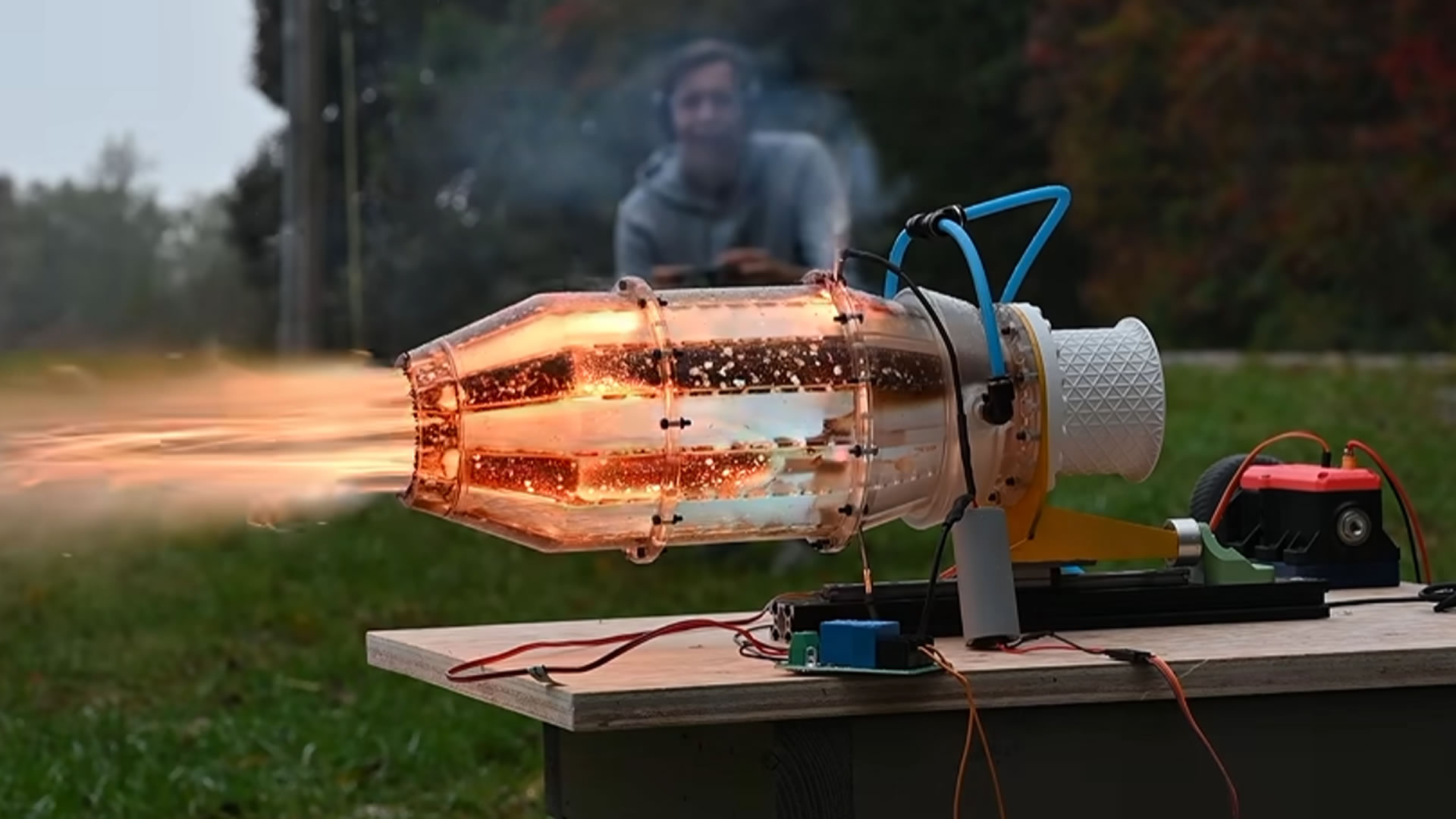
A YouTuber has created a functional homemade afterburner using mostly 3D-printed parts. He essentially took an electrically powered ducted fan (EDF), injected propane into the exhaust, and produced additional thrust. In case you are unaware, an EDF is basically a high-speed electric fan inside a tube. These are commonly used in things like model aircraft to imitate jet engines. Unlike conventional jet engines, EDFs don’t burn fuel. Instead, an electric motor drives the fan, accelerating air backward to produce thrust. Its electric motor drives the fan, which accelerates air backward to produce forward thrust. For his latest project, YouTuber Michael Rechtin decided to add a combustion chamber behind it. The process was fairly straightforward, at least on paper. The fan should accelerate air through the duct as normal. After that, propane can be injected into the moving air downstream of the fan. Some form of ignition source will then ignite the propane. This heats the air dramatically, expanding it and exhausting the hot gas at a much higher velocity than normal. In theory, much like an afterburner, this should increase the thrust produced by the “engine.” The physics is sound, but to make it viable, the “cost” of fuel must produce sufficient additional thrust to make it worthwhile. Jet engines and propulsion are fundamentally about momentum. The faster you throw a given mass of air backward, the more forward thrust you can generate. When the propane burns, it adds thermal energy to the airflow. If the duct and nozzle convert enough of that energy into additional exhaust velocity, thrust increases. But heating air doesn’t automatically mean more thrust. The added combustion chamber can introduce pressure losses, turbulence, and drag that cancel out the benefit. In “real” afterburners, the aircraft’s jet engine or turbojet compresses air substantially before combustion. When it reaches the afterburner, the air still has enough pressure for acceleration. Boosted thrust by 50% An EDF, on the other hand, barely compresses incoming air at all. This creates two issues. The first is combustion stability, whereby air can extinguish the flame, especially if fuel isn’t mixed well. The second is that without enough pressure (and a suitable nozzle), most of the additional heat can just be exhausted without adding thrust. So, just adding a combustion chamber after the fan does not make an afterburner. So, did it work? Well, according to his video, the fan alone produced 2 pounds-force (9 N) of thrust. With the afterburner engaged, this jumped to 3 pounds-force (13.3 N). That’s a 50% increase! Immediately following the test, the 3D sections showed significant charring, but appeared to have survived the temperatures generated by the combustion. Since the assembly is mostly made of plastic, continued use could, in theory, eventually permanently damage it. Especially given that most 3D-printing plastics soften at temperatures far below the combustion point of propane. Rechtin knew this, and his design included clever geometry to at least improve its chances of surviving experiments. That said, because it was 3D-printed, producing replacements is the least of the YouTuber’s worries. So, moving forward, Rechtin plans to make an upgraded version of the design using metal, not 3D-printed plastic.Get the latest in engineering, tech, space & science - delivered daily to your inbox.Christopher graduated from Cardiff University in 2004 with a Masters Degree in Geology. Since then, he has worked exclusively within the Built Environment, Occupational Health and Safety and Environmental Consultancy industries. He is a qualified and accredited Energy Consultant, Green Deal Assessor and Practitioner member of IEMA. Chris’s main interests range from Science and Engineering, Military and Ancient History to Politics and Philosophy.
Watch: YouTuber makes 3D-printed propane afterburner for electric fan, boosts thrust by 50%
Full Article
Original Source
Read the full article at Interestingengineering →KhanList aggregates and links to publicly available news content. We do not host full articles from third-party sources. Always verify important information with original sources.