
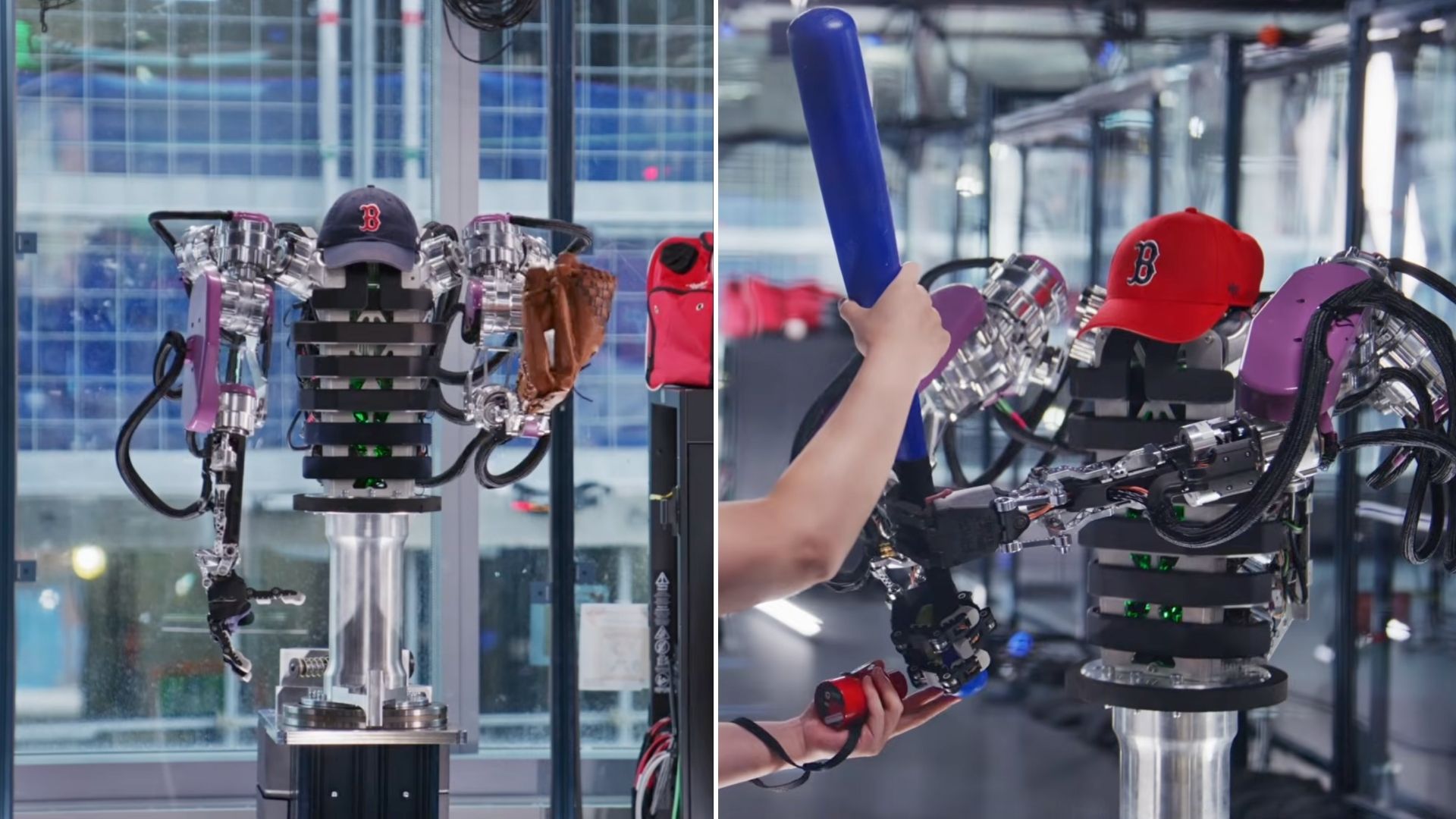
A new two-armed robot developed by the Robotics and AI Institute (RAI) has demonstrated its ability to throw, catch, and hit balls with coordinated, human-like movements, offering a different approach to a longstanding challenge in robotics: interacting with objects dynamically rather than simply moving them from one place to another. Called AthenaZero, the robotic system was designed to replicate some of the mechanical properties that let humans perform rapid, forceful, and delicate movements. In experiments reported in Science Robotics, the robot completed three baseball-inspired tasks involving throwing balls, catching them, and hitting them with a bat. The research was led by roboticists including Andrew S. Morgan, who told TechXplore that the team wanted to investigate how a robot’s mass and force-producing capabilities could be designed to more closely resemble those of a human. Building a robot that can yield to forces AthenaZero consists of a central torso, two robotic arms fitted with hands, and a system of motors and gears. Although the arms’ structural segments are rigid, their joints can yield to external forces, allowing the robot to respond in a controlled manner when interacting with objects or its surroundings. This design reflects a different approach to robotic manipulation. Many conventional industrial robots are built to be stiff and precise, making them effective at repetitive tasks such as lifting heavy objects or positioning components on an assembly line. However, that stiffness can make physical interactions harder to manage, especially when objects move unpredictably or require a softer touch. AthenaZero was designed to operate across a wider range of forces, allowing it to be both delicate and forceful depending on the task. The researchers also focused on reducing the robot’s effective inertia, a property that describes how strongly an object resists changes in its motion. Lower inertia can help a robotic arm accelerate and decelerate more readily, potentially improving its ability to react quickly when handling moving objects. According to Morgan, the system represents the team’s first attempt at this low-inertia design approach. Why test a robot with baseball? Baseball provided the researchers with a practical way to examine several difficult manipulation problems. Throwing requires the robot to coordinate its movements to impart force to an object, while catching demands that it respond to an approaching object and manage the forces generated at contact. Hitting a ball with a bat adds another challenge: coordinating both arms to position and swing an object at the right time. These tasks go beyond the predictable movements typically associated with factory automation. A robot must coordinate its joints while accounting for physical contact, timing, and the movement of objects through space. The researchers reported that AthenaZero successfully completed all three tasks during their initial evaluations. The experiments were intended to demonstrate the potential of its mechanical design, rather than establish that the robot can already perform a broad range of real-world jobs. Toward more capable robotic manipulation Robotic manipulation remains a major challenge as researchers work to develop machines that can interact reliably with objects of different shapes, weights, and textures. AthenaZero is part of a more comprehensive research effort to understand how a robot’s physical construction influences its ability to manipulate objects. Rather than relying solely on better control software, the team is investigating whether designing the robot’s mass, inertia, and force characteristics differently can make complex movements easier to achieve. The researchers plan to continue improving the system and evaluate it on more demanding manipulation tasks. Baseball serves as a test platform for these underlying capabilities, with dexterous manipulation, the ability to handle objects skillfully and reliably, remaining the larger objective. For now, AthenaZero demonstrates a promising direction for robotic design. If its approach can be extended to other tasks, robots could become better equipped to handle dynamic physical interactions that remain difficult for conventional rigid manipulators. Get the latest in engineering, tech, space & science - delivered daily to your inbox.Kaif Shaikh is a journalist and writer passionate about turning complex information into clear, impactful stories. His writing covers technology, sustainability, geopolitics, and occasionally fiction. A graduate in Journalism and Mass Communication, his work has appeared in the Times of India and beyond. After a near-fatal experience, Kaif began seeing both stories and silences differently. Outside work, he juggles far too many projects and passions, but always makes time to read, reflect, and hold onto the thread of wonder.
Watch: Two-armed robot throws, catches, and hits balls like a baseball champ
Full Article
Original Source
Read the full article at Interestingengineering →KhanList aggregates and links to publicly available news content. We do not host full articles from third-party sources. Always verify important information with original sources.