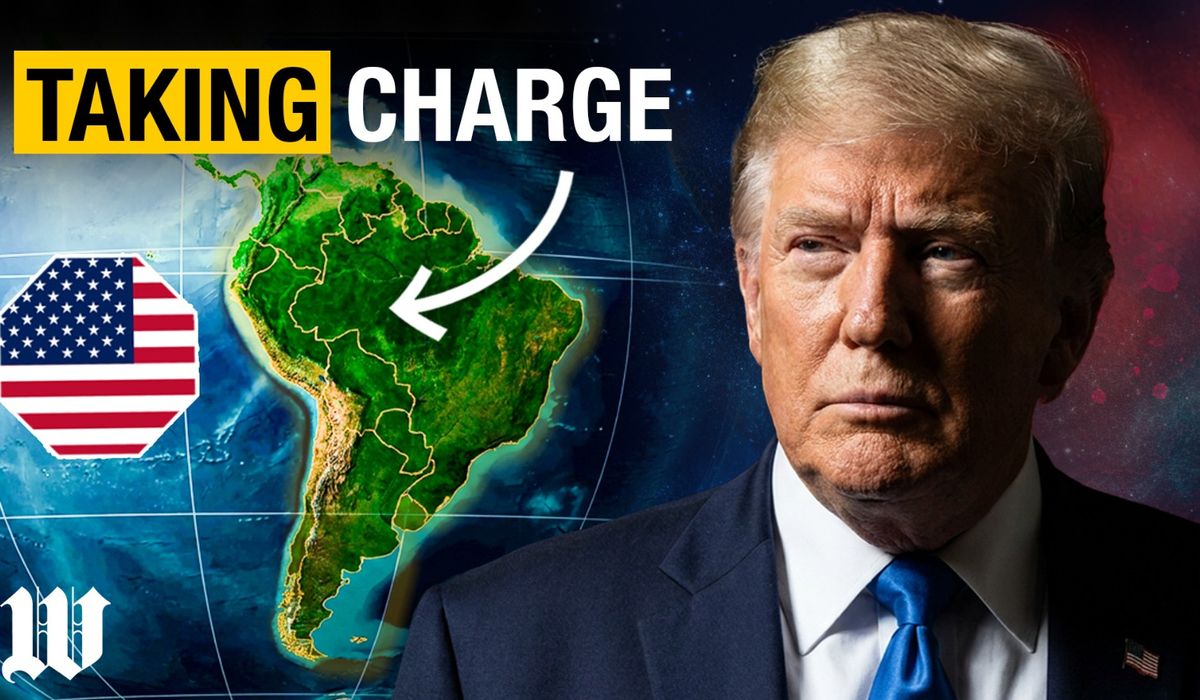
The Trump administration is pursuing a more aggressive U.S. posture across Latin America, a policy some are calling the “Donroe Doctrine” for its echoes of the 19th-century Monroe Doctrine.Washington Times National Security Editor Guy Taylor breaks down what’s driving the push and how far the administration may be willing to go. What is the ’Donroe Doctrine’ and what does it mean for Latin America? The Donroe Doctrine is President Trump’s push to have a much more aggressive U.S. policy towards Latin America as a whole. And it’s a reference to the so-called Monroe Doctrine of the early 1800s, when then-President James Monroe basically sought total U.S. dominance over the entire hemisphere. How closely does it mirror the Monroe Doctrine? The Trump administration’s Donroe Doctrine does compare if you consider that the U.S. used unilateral military force to oust the president of Venezuela in early 2026. What’s probably different is that in the early 1800s, the United States attempted to actually inject heads of state in several Latin American countries. The question now is whether or not the Trump administration actually has the bandwidth to follow through on its promise of trying to do more or less the same thing. Is the Donroe Doctrine more than branding? Some of the administration’s approach is certainly about branding and trying to show the world that the United States is refocused or focused in new ways on deepening relationships between the U.S. and Latin American countries under terms that President Trump wants. But some of it also is very real. Secretary of State Marco Rubio has made repeated trips to the region. The first overseas trip that he made was to Panama, where he publicly talked about countering China’s attempt to control the Panama Canal, an incredibly important trade waterway in Central America. And then you saw the action in Venezuela, which in some ways felt unprecedented. The U.S. media portrayed it as unprecedented. We hadn’t seen anything that aggressive in the region really since the Monroe Doctrine era. Could Venezuela set a precedent for U.S. action elsewhere? I think it sets a precedent that if the U.S. comes up with an aggressive action plan and integrates its military into that plan, that that type of direct action could happen. There are some nuances about the Venezuela case that aren’t exactly replicated in other Latin American countries, and that’s specifically that the U.S. Justice Department had an indictment, a drug cartel-related indictment against Venezuelan President Nicolas Maduro. So there was a legal chain that the Trump administration set in motion to try and carry out this action with some kind of holistic legal backing so you’d have this policy. Just to go in and replicate it in another country would be difficult without such a legal chain. Has U.S. policy changed Venezuela? Maduro is currently facing trial in a U.S. court in New York. And then when we look at the politics inside Venezuela, they’re still very turbulent. And the country has recently faced a massive natural disaster with earthquakes. So it’s hard to measure whether there’s been real progress. There is a feeling that the United States is really focused on attracting private investment into Venezuela’s oil industry. And there are questions about how that will play out going forward and whether or not the Trump administration in its remaining roughly two years left in office will follow through on this policy to ultimately potentially see new democratic elections in Venezuela. Is Latin America shifting right? There’s no question that there are people who identify themselves as conservative, populist politicians who have been winning elections in recent years in several Latin American countries. How could Colombia’s election reshape U.S. relations? Colombia’s president-elect has been very outspoken about his support for President Trump and his alignment with President Trump. One place to watch where the U.S.-Colombia relationship might change is that Colombia’s incoming government so far has said things like it wants a recreation of something called Plan Colombia, which was a centerpiece of the U.S. drug war in the late 1990s and early 2000s, going after drug cartels in Colombia of that era. Another thing that the incoming government of Colombia has said is that it wants to establish some sort of joint counter-narcotics or joint counter-cartel training program actually in the city of Medellin, Colombia. This is very interesting because Plan Colombia was not entirely popular across Latin America when it was implemented a generation ago. And there are questions about whether it could actually be successful if it were recreated. There are also questions about whether or not the Trump administration has the bandwidth to put the muscle behind an initiative like that. So it’s going to be interesting to watch. Which countries could shape the next phase of U.S. policy in Latin America? Definitely Cuba is one of the countries that we should be looking at very closely. And I think it’s dear to the heart of U.S. Secretary of State Marco Rubio. And one of the reasons I think that President Trump picked Marco Rubio as his Secretary of State is because of their alignment on the issue of Cuba and Secretary of State Rubio’s desire or goal of trying to change the Cuba-U.S. relationship and foster a democratic opening of Cuba. Another place I think that is very important to watch is Argentina, a country that has had more than a generation of economic struggles, but has the potential to be an economic and industry powerhouse in the southern cone of South America and currently has a government for the first time in more than a generation, a democratically elected government that has a pro-U.S. posture and a pro-U.S. business posture. For Argentina to be undergoing this political change and potentially aligning with the United States economically is going to be very interesting to watch. How much is U.S. policy in Latin America about countering China? A key kernel within the U.S. renewed interest in deeper engagement in Latin America is definitely a response to China’s growing influence in the region, especially economically. China has been the number one trade partner for almost a generation now of several Latin American countries. China has also made moves in the military-industrial realm in the Western Hemisphere, particularly with regard to establishing space bases in a couple of Latin American countries. There’s a push by the United States to address that and try and say to the government, the Communist Party-ruled government in Beijing, hey, the United States wants to be the leader here in those relationships. And I think that is a driving factor behind the Trump administration’s approach to Latin America. How is the U.S. countering Chinese and Russian influence in the region? It’s hard to measure how the Trump administration is actually countering anti-U.S. disinformation push by China and Russia in the Western Hemisphere because one of the first moves that the administration made was to get rid of something called the Global Engagement Center, the GEC, inside the State Department, that was tasked for years with running counter disinformation operations around the world, particularly in the global war on terror in the post-9/11 era. Without that apparatus there, there are lots of questions about where the muscle is in U.S. efforts to try and counter sophisticated disinformation and anti-U.S. influence operations by China and Russia in Latin America beyond just having a president in the White House who occasionally grabs global headlines by making aggressive statements about the region. What comes next for the Donroe Doctrine? If we’re looking forward, I think the big question to be asking is whether or not this Donroe Doctrine policy towards the Western Hemisphere, towards Latin America, is going to result in a generational kind of pushback against the United States, or is it actually embraced by key political players in several countries around the region? It’s possible that it is embraced and it brings about an era of increased cooperation between the United States and several Latin American countries on things like rule of law, counter cartel and counter organized crime movements and potentially military to military and diplomatic cohesion in the hemisphere like we’ve never seen.
WATCH: Trump's 'Donroe Doctrine' echoes Monroe-era push for hemisphere dominance
Full Article
Original Source
Read the full article at Washingtontimes →KhanList aggregates and links to publicly available news content. We do not host full articles from third-party sources. Always verify important information with original sources.