
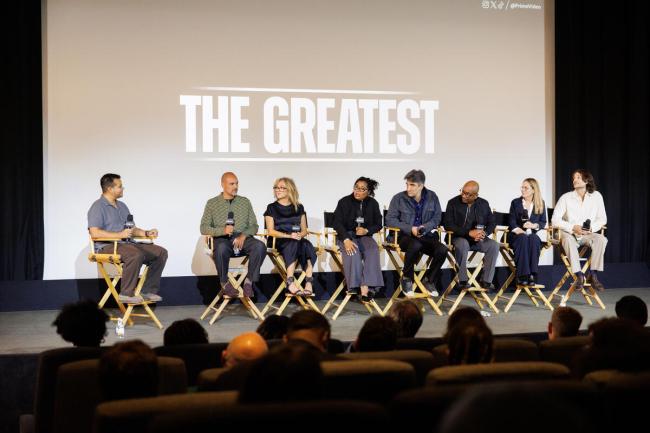
As tall an order as it was to make a series about the greatest boxer of all time, “The Greatest” creator Ben Watkins had faith he assembled the right team for the job and the unique assurance of making it with the blessing of Muhammed Ali’s family. At IndieWire’s recent Consider This event at Pacific Design Center, presented in partnership with Prime Video, he broke down the process that brought the series to life. “One of the things I want to do is humanize Muhammad Ali because everybody sort of pictures him as a fully formed icon and legend. And I want to disconnect people from that and introduce them to a kid who just had a dream. But that means I got to show all of him. I got to show flaws and fears and vulnerabilities and tell the truth like that. And it’s sometimes messy,” Watkins said, recalling his pitch to the boxer’s widow Lonnie Ali . “Her response was, ‘That’s what I want too,’ because that will make him more relatable. And as we introduce him to a younger generation and reintroduce him to the people who already love him, that is what will make this story fresh.” Boxing is an individual sport, but making “The Greatest” was a team effort. Watkins was joined on the panel by many of his crafts team members, including editor Steve Lang, costume designer Marci Rodgers, production designer Elisa Suavé, composer Stanley A. Smith, music editor Jordan Wiggins, and music supervisor Robin Urdang. Stanley A. Smith, Marci Rodgers, Elisa Sauve, Ben Watkins, Robin Urdang, Steven Lang and Jordan Wiggins at the IndieWire x Amazon The Greatest Screening + Q&A held at Pacific Design Center on October 22, 2026 in Los Angeles, California.Rich Polk One of the aspects that made the eight-episode limited series tracking the protagonist’s rise from Olympian gold medalist Cassius Clay to heavyweight champion Muhammad Ali feel fresh was the use of contemporary music, but that also came with its own challenges for the post production team. “Going contemporary in an Olympic boxing match with so many things going on between commentary, the fight itself, the reactions, and then we also have a song playing. I think we went through about 120 songs,” said Lang, telling the story of how they landed on a key piece of music for the series opener. “I usually come on pre-production, [but] I came on during post, and one of the first things was ‘We want an original song here and we need it now,’” Urdang added. “I said, ‘We can’t get it until we create the sound of the show because there’s no sound of the show right now.’” That first music cue became the last song they used for the show, an original track from Grammy winner Wyclef Jean titled “Gladiator.” “There was a poem that [Ali] hears about a gladiator talking about his time in the Colosseum. Ben mentions that to Wyclef, who then takes those lyrics and turns them into the song that you hear during that fight,” said Lang. “It ended up in two spots in episode one, and then it also became the main title [music],” said Wiggins. “It was a lot of cutting that Jordan did for us,” said Urdang. Jaalen Best as Cassius Clay in ‘The Greatest’ on Prime Video.Brooke Palmer/Prime Video The Colosseum also happened to be the setting for one of costume designer Marci Rodgers’ greatest challenges working on “The Greatest.” “I was put on the spot in Rome where I had to do a quick change on camera, which is actually the first scene [as well]” she said. “So we’re in the Colosseum and it’s Marci’s time. And so I reached out to one of my mentors, Paul Tazewell, who walked me through a process in which we see essentially his suit removed as the camera is moving around.” “Those are the things that they said would not be possible. Then the first production meeting I said, ‘Hey, I want to do a shot where he’s in a suit and as we’re circling, it all goes away,’” said Watkins. First it was a challenge to even shoot on location, but “We ended up [as] the first television show to ever shoot in the Colosseum,” he said. Then it was getting confirmation that they could also shoot more around Rome. And finally, it was shooting the aforementioned pivotal scene. “At that point I said, ‘We’ll never get that shot off.’ And then Marci says, ‘No, we’re going to figure out a way to build a suit, to do it in a way to get the shot off.’ And then Elisa and her team figured out a way for us to not just be able to shoot in the Colosseum, but they recreated a 60s-level Italian neighborhood because, ‘Hey, we’re in Rome now, so let’s get the most out of it.’ And they got us all of that, all things they said they couldn’t get.” For her part, Suavé said “When you look at the world in the ’50s and the ’60s, there was no digital anything. Every single sign, every single thing you think was made by our scenic artists by hand, not with projections that they were copying. We did it all by hand. We made all the molds for all the parking meters. We made the molds and we created the gold medals.” She added, “There was not one world that we didn’t touch or create.” Composer Stanley A. Smith also chimed in on how the series kept things analog, saying “We use all live musicians in this score.” “No AI,” added Urdang. “Ben was really great about going to bat for getting the budget to do that. And we used live string players.” said Smith. “Just because of the nature of the tone we wanted, we used predominantly people of color for our strings — not always — but because we wanted that feel. And actually, I’m going to go one step further. It was 60 to 40 percent female.” Ending the panel, Watkins said “That’s the big testament to everybody up here. We took what I would say is a modest television budget and we made a high budget film.” “The Greatest” is now streaming on Prime Video. Watch the complete panel with the showrunner and artisans who worked on the limited series in the video above.
Watch ‘The Greatest’ Team Discuss How They Made the Impossible ‘Possible’ on Muhammad Ali Series
Full Article
Original Source
Read the full article at Indiewire →KhanList aggregates and links to publicly available news content. We do not host full articles from third-party sources. Always verify important information with original sources.