
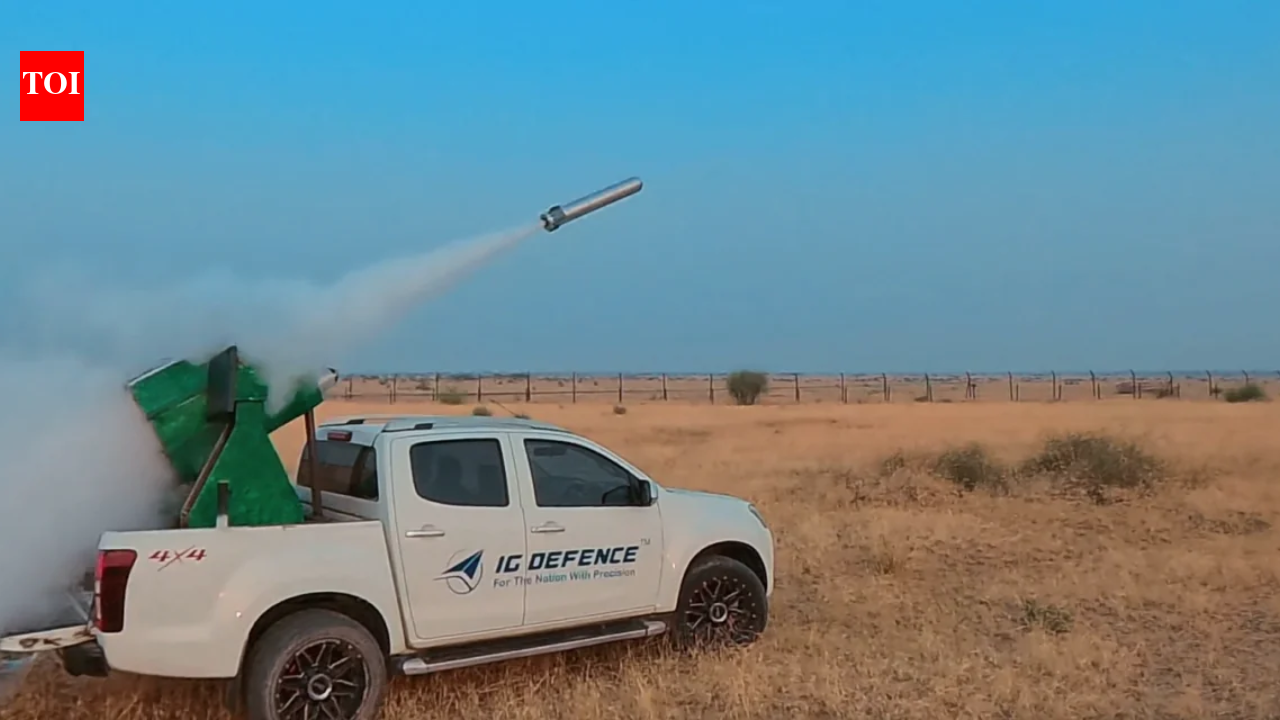
The Jwala missile being fired from a 4X4 vehicle at the Pokhran Field Firing Range. (Image credit: IG Defence)Indian defence company IG Defence has successfully test-fired its JWALA MK-1 autonomous counter-drone micro-missile system at the Pokhran firing range in Rajasthan, demonstrating a new indigenous hard-kill option against small unmanned aerial threats. The company claims the system can engage hostile drones at distances of 2 to 5 km and at altitudes ranging from 50 metres to 5,000 metres.JWALA MK-1 is designed to detect, identify, classify and neutralise hostile unmanned aerial vehicles through an integrated engagement architecture. Its key feature is GRID, an artificial intelligence-based mission autonomy and battle management system developed by the firm. The software integrates inputs from different sensors, identifies and classifies potential targets, supports mission-level decision-making and coordinates the engagement process.According to the company, the missile uses a dual-pulse solid rocket motor and aerodynamic fin controls for propulsion and flight manoeuvrability. It is equipped with a pre-fragmented high-explosive warhead and a proximity fuse, allowing it to detonate near a target rather than depending entirely on a direct impact. The launcher is a truck-mounted, multiple-canister system integrated with 4x4 vehicles, allowing it to be deployed at different locations. Such a capability can also be useful against a drone swarm, as splinters from the pre-fragmented warhead will create a cloud of debris that will hit other drones.The system is being developed against the growing use of inexpensive drones for surveillance, reconnaissance and attacks on military installations and personnel. Conflicts in Ukraine and west Asia have demonstrated how relatively cheap unmanned aircraft can force militaries to expend expensive air defence interceptors. A dedicated micro-missile system could offer a more economical hard-kill alternative, although its actual cost per engagement and operational effectiveness have not been disclosed.Solar Defence and Aerospace and Economic Explosives are developing the Bhargavastra micro-missile system, while the Defence Research and Development Organisation is pursuing directed-energy weapons, including high-energy lasers, alongside electronic and other soft-kill technologies. These systems seek to disrupt or destroy drones through different means. The army has been using air defence guns such as the L-70 and the Zu-23, to take down drones. Air defence guns too offer an effective manner to take down drones.IG Defence is also working on KAL, a long-range one-way attack and loitering munition system, and T-SHOOL, a beam-based electronic countermeasure system. The company plans to integrate these platforms with its GRID architecture and is developing a missile and propulsion manufacturing facility spread across approximately 200 acres in Nellore, Andhra Pradesh.The Pokhran test marks a development milestone for JWALA MK-1, but the company has not disclosed details of the test's engagement conditions, the number of targets intercepted or the system's production and induction timeline. Further trials and independent assessment will be required to establish its operational performance.The army is also holding a competition in Pokhran to test jet-powered kamikaze or suicide drones. This competition is open to domestic firms only. Jet-powered kamikaze drones are extensively being used by Russia against Ukraine. Due to the higher speeds of these drones, Ukraine is finding it difficult to intercept these one-way projectiles.
Watch: India's first autonomous drone-killer micro-missile system tested at Pokhran
Full Article
Original Source
Read the full article at Timesofindia →KhanList aggregates and links to publicly available news content. We do not host full articles from third-party sources. Always verify important information with original sources.