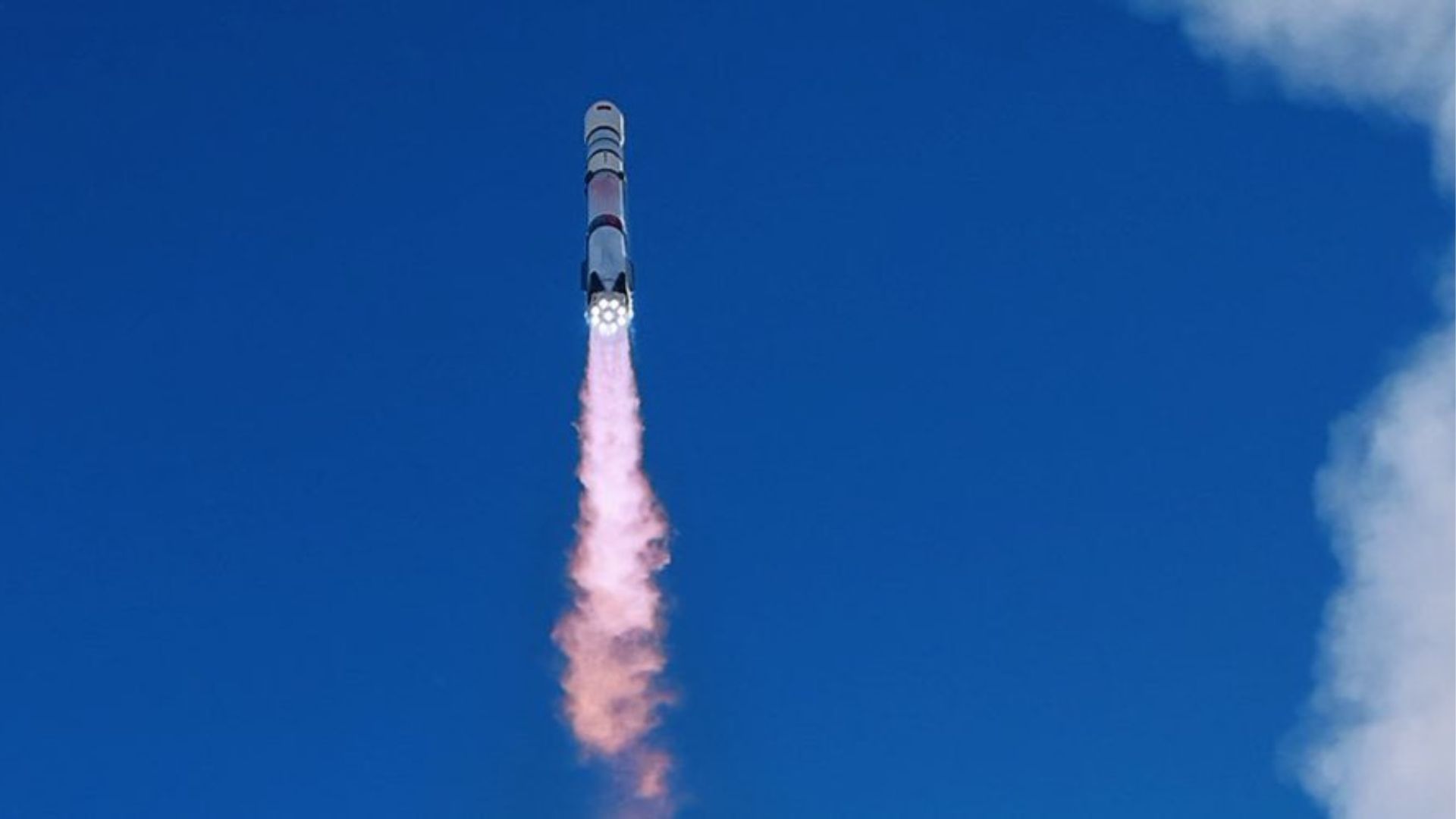
China’s LandSpace successfully launched the 66-meter (217-foot) Zhuque-3 rocket into orbit and vertically recovered its stainless-steel first stage in Gansu province. It quietly stole a victory right out from under Elon Musk’s nose. This marks the world’s first stainless-steel booster recovery following an orbital launch. SpaceX has been racing to land its massive stainless-steel Super Heavy booster, which is awaiting regulatory approval for its own orbital recovery attempt. LandSpace is now the fourth entity globally to recover a launch vehicle. As per the state news agency Xinhua, the launch happened from the Jiuquan Satellite Launch Center in the Gobi Desert at 7.35 am on Wednesday, August 19. After delivering a Honghu-3 internet satellite into orbit, the rocket’s first stage returned to Earth. It made a precise vertical landing in Minqin County, Gansu Province — roughly 390 kilometers (242 miles) southeast of its Gobi Desert launch site. MISSION SUCCESS | ZhuQue-3 Y2 Reusable Launch Vehicle Achieved Full Success in Orbital Insertion and First-Stage RecoveryOn August 19, 2026, at 07:35 (UTC+8), the ZhuQue-3 (ZQ-3) Y2 reusable launch vehicle lifted off from the Dongfeng Commercial Space Innovation Pilot Zone.… pic.twitter.com/fshijOxgtc— LandSpace (@LandSpace_Tech) August 19, 2026 Steel in the sky Just eight months ago, the company’s maiden attempt ended in a fiery explosion three kilometers above the desert floor when a descent engine failed to reignite. Engineers spent the intervening months stripping down flight telemetry, rewiring ignition sequences, and prepping a second hull. This time the company made it. The achievement propels LandSpace into an elite global club of companies that have successfully recovered an orbital launch vehicle. These include only four entities: SpaceX, Blue Origin, China’s state-space agency, and now LandSpace. This milestone gives China a crucial edge in its space race with the US. China is locked in a fast-paced race to build its own global satellite internet networks, dubbed Guowang and Qianfan. Designed to compete directly with Starlink, these megaconstellations require placing tens of thousands of satellites into low Earth orbit. But Beijing has faced a major hurdle: a lack of cheap, reusable launch capacity. While Starlink has used reusable Falcon 9 rockets to launch over 10,000 operational satellites, China’s networks have stalled at roughly 200. Without a reusable workhorse, scaling up is economically impossible. Zhuque-3 could help change that. SpaceX dominates the race Zhuque-3 becomes China’s second orbital rocket to achieve first-stage recovery, following the state-owned Long March-10B’s successful offshore net capture in July. Positioned in the same class as SpaceX’s Falcon 9, both Chinese rockets offer similar heavy-lifting capability into low Earth orbit. Zhuque-3 is capable of hauling 18 tonnes to orbit in reusable mode. The rocket provides the exact lifting power Beijing needs to begin mass-deploying its constellation. LandSpace designed the Zhuque-3 with two key technical upgrades over SpaceX’s Falcon 9: a stainless-steel airframe and a liquid methane-oxygen propulsion system. Replacing aluminum-lithium alloy with stainless steel enhances heat resistance while potentially lowering manufacturing expenses. In addition, powering the rocket with methane and liquid oxygen provides a cleaner burn than the Falcon 9’s kerosene-based propellant mixture, which reduces engine soot and streamlines post-flight refurbishment for quicker reuse. Reportedly, the Zhuque-3 booster has been designed to fly up to 20 times over its operational life. For comparison, SpaceX routinely launches its Falcon 9 around 150 times a year and and frequently reuses individual boosters for dozens of missions. SpaceX proved that reusability lowers the cost of reaching space. China has now proven it can play the exact same game using stainless steel and methane fuel. But Musk’s company already has a vast reach with over 12 million active customers worldwide, making it a dominant player in global satellite communications. Get the latest in engineering, tech, space & science - delivered daily to your inbox.Mrigakshi is a science journalist who enjoys writing about space exploration, biology, and technological innovations. Her work has been featured in well-known publications including Nature India, Supercluster, The Weather Channel and Astronomy magazine. If you have pitches in mind, please do not hesitate to email her.
Watch: China’s LandSpace beats SpaceX with world-first stainless-steel booster recovery
Full Article
Original Source
Read the full article at Interestingengineering →KhanList aggregates and links to publicly available news content. We do not host full articles from third-party sources. Always verify important information with original sources.