
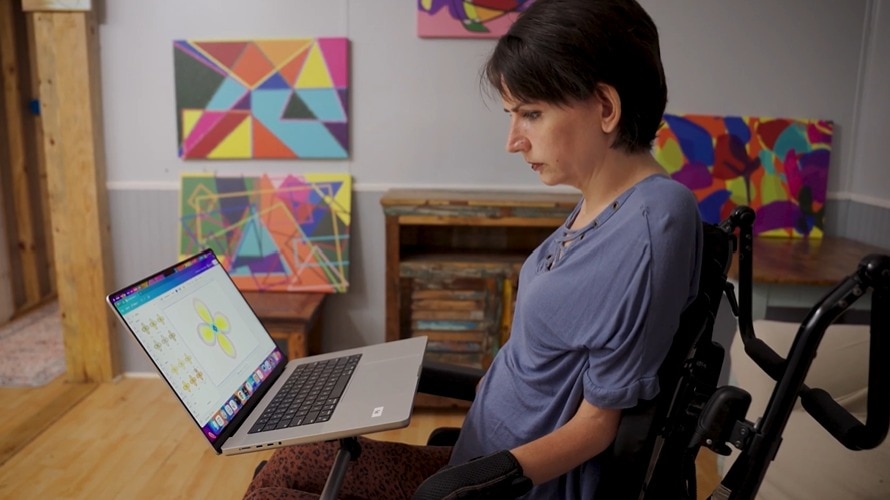
Neuralink is currently testing its brain-computer interface in people with paralysis. In a recent video, the company showed trial participant Audrey Crews using the technology to write and create digital art with her thoughts.Neuralink shared footage of Audrey Crews writing and creating digital art using her thoughts. Photo/ Neuralink Neuralink is currently running clinical trials to test whether its brain-computer interface can help people with paralysis control digital devices using their thoughts. The company has been sharing videos showing how participants are using the technology in their daily lives. In one of its recent videos, Neuralink shared footage of trial participant Audrey Crews using the brain implant to create digital art and write her name on a computer, all without physically moving her hands.Crews, who has been identified as Patient 9 in the trial by the Neuralink team, has been paralysed from the neck down since a 2005 car accident left her with a C4/C5 spinal cord injury. In the new clip shared by Neuralink on X, she is seen using the company's brain-computer interface to control a cursor and make drawings on a screen without moving her hands.Watch the video here: Crews received the implant in 2025 as part of Neuralink's PRIME clinical trial. According to the company, the ongoing study is testing the safety of its N1 implant, R1 surgical robot and related software, while also looking at whether the system can help people with paralysis control external devices using their thoughts. So, how does Neuralink actually work?According to Neuralink, its N1 implant records neural activity from the part of the brain involved in movement intention. The implant uses tiny, flexible threads carrying electrodes that are placed in the brain by the company's R1 surgical robot. The recorded signals are then sent wirelessly to an external device, where software decodes them into digital commands. This allows the recipients to control things such as a computer cursor using their thoughts. Neuralink calls this capability Telepathy. The company's aim is to give people with paralysis a more direct way to interact with computers, phones and other digital devices, bypassing damaged pathways between the brain and muscles.Crews has previously shared some details about her surgery.In an update after the procedure, she revealed that surgeons had drilled a hole in her skull and placed Neuralink’s 128 threads into her motor cortex. She also described the implant as being about the size of a quarter. “They drilled a hole in my skull and placed 128 threads into my motor cortex. The chip is about the size of a quarter,” Crews wrote.Neuralink's own description of the procedure says its R1 surgical robot inserts the implant's ultra-fine threads into the targeted area of the cortex. The implant is then placed under the scalp, where it records brain activity and sends the data wirelessly to the Neuralink application.Do note, however, that Neuralink's work is still at the clinical-trial stage. The company says the N1 implant and other devices being tested as part of the PRIME study are investigational and are not approved for sale. - EndsPublished On: Aug 27, 2026 13:05 IST
Watch: Audrey Crews writes and draws using only her thoughts with Neuralink
Full Article
Original Source
Read the full article at Indiatoday →KhanList aggregates and links to publicly available news content. We do not host full articles from third-party sources. Always verify important information with original sources.